TRANSFORMING COMMUNITIES THROUGH MAIN STREET
Texas Celebrates 35 Years of Main Street Progress in 2016
Annual Letter to Main Street Stakeholders
January 2016
Article written by Debra Drescher, State Coordinator, Texas Main Street Program
In 2015, an economic impact study commissioned by the Texas Historical Commission noted that the “revitalization of Texas Main Streets makes good business sense,” because of the positive impact to the state’s economy. Additionally, the study remarks, “The Texas Main Street Program is more than an economic development program; it is a community philosophy that uses historic preservation as one of its primary tools.” In the
study, that can be found on the THC’s website (http://www.thc.state.tx.us/public/upload/publications/economic-impact-historic-preservation.pdf ), the authors found that historical Main Street reinvestment statistics (adjusted for inflation) show that “Texas Main Street Program activities have yielded an annual average of $310 million in state GDP. This investment has translated into 5,385 average annual jobs created, which produced $240 million in labor income and over $23 million in state and local taxes. Since its inception in 1981, investment in Texas Main Streets has totaled over $5.2 billion.” (The most recent non-inflation adjusted statistics are shared later in this edition.) Two very different programs—Bastrop and Mineola—were also profiled as case studies in this report to exemplify how the Main Street operational model has broad, positive impact.
As the Texas Main Street Program begins its 35th year, this first edition of Main Street Matters for 2016 seemed like a good time to take a look back at our growth and progress while also introducing some exciting developments in the way Main Streets are evolving today and into the future. We feel that sharing these stories in the format of an open letter to our local Main Street programs is a good way to grow pride, celebrate success and share the news pertaining to some important developments in our field. Regardless of whether yours is a newer local program or a longtime one, there are many reasons to continue moving forward with the work of Main Street. Hopefully, this information will be helpful to anyone who may be seeking to learn more about how and why Main Street works.
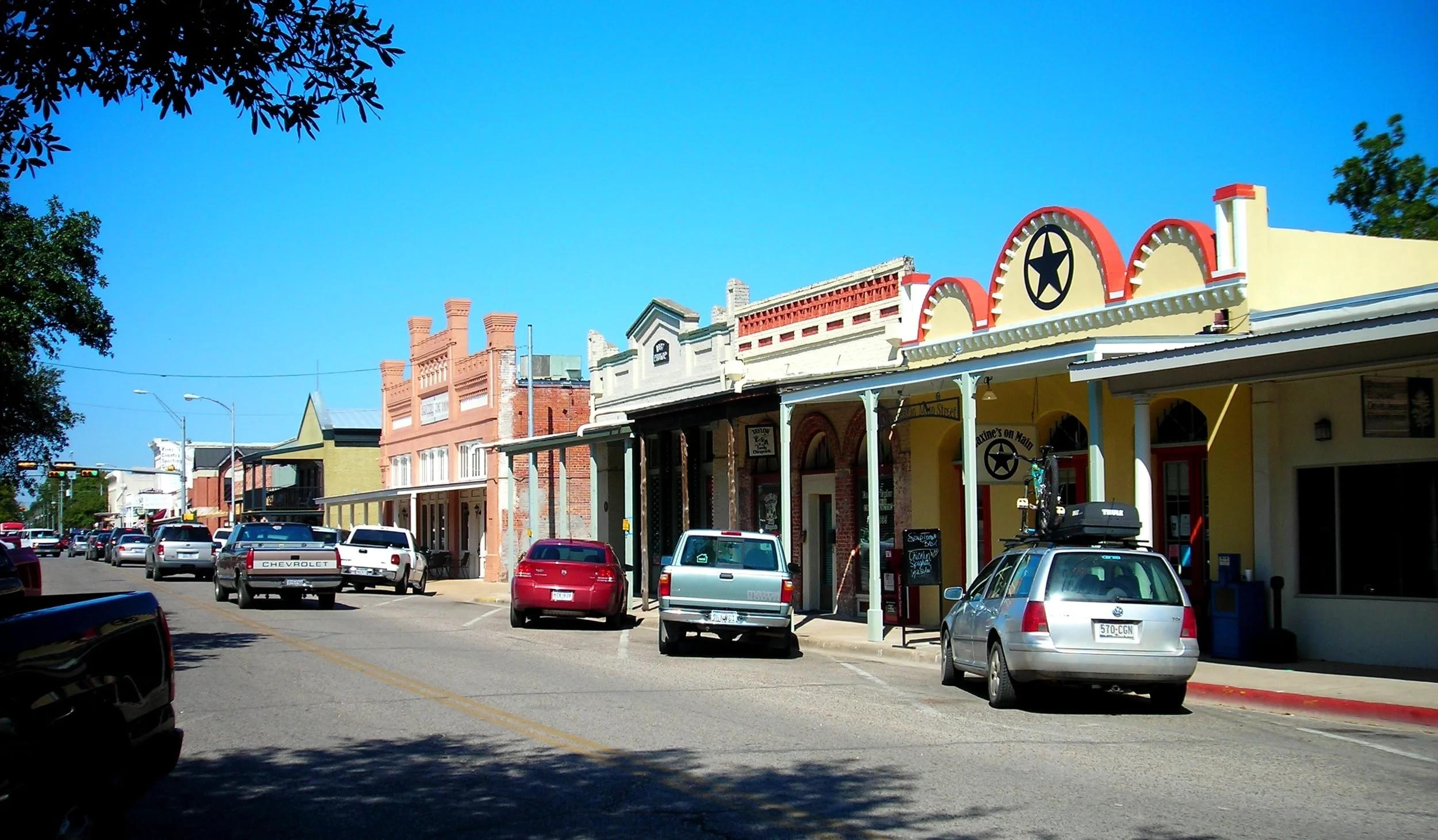
“Within four years of the first project, almost every building in the Bastrop Main Street Program area had been rehabilitated in some way...the interest was already there, but Main Street was able to put a framework around it and make it possible and organized.” – quote from the case study on Bastrop Main Street in the THC’s 2015 economic impact study.
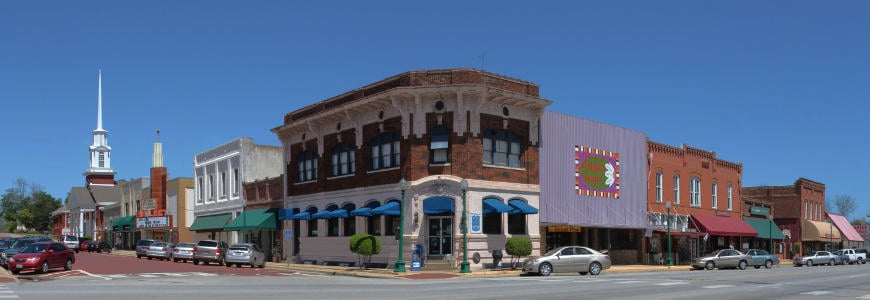
“Over the last 25 years, $27 million has been put into projects in Mineola’s Main Street. For a town of just over 4,000 people, that shows the pride Mineola’s citizens have in their town, and their understanding that historic preservation adds to that pride”. – quote from the case study on Mineola Main Street in the THC’s 2015 economic impact study.
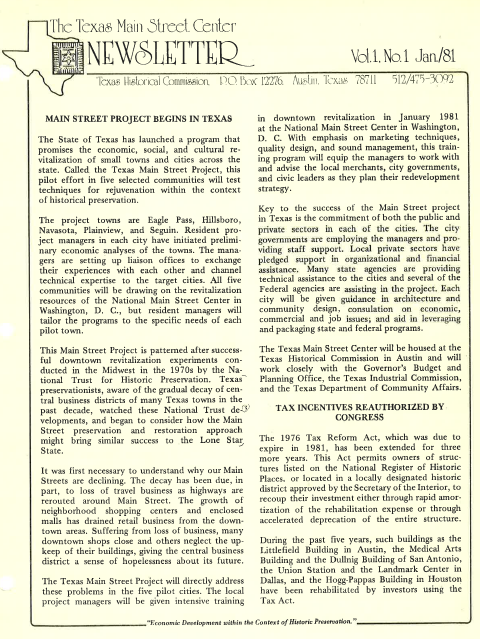
The inauguration of the Texas Main Street Project was announced in this newsletter in January 1981.
Exactly 35 years ago, in January 1981, the launch of the Texas Main Street Project was introduced in the first edition of the inaugural newsletter as a “pilot effort in five selected communities that will test techniques for rejuvenation within the context of historical preservation.” Focusing on the historic commercial district, the effort was to be multifaceted by addressing “economic, social and cultural revitalization” that will positively impact the whole community. Today, we continue to take that holistic approach to our work. We can look back upon that introductory issue to show us how much we’ve changed; how far we’ve come; and how much those early ideals are still sound today.
At first, only “small towns and cities” could be accepted into the Main Street program. Larger communities in Texas did not participate until Longview entered the program in 1988. In 1990 Denton and Tyler became Texas’ next two urban Main Street programs. They have both continuously participated since that time, and between them have had economic impact through the private reinvestment of more than $210 million in their historic downtowns; and the creation of 3,100 jobs and 530 small businesses. In 1999, Denton was named a Great American Main Street Award® winner by the National Main Street Center. This highly competitive award is presented to communities that exemplify the use of the Main Street Four Point Approach™ in revitalizing their historic downtowns.
Today, Texas has 15 urban (over 50,000 in population) programs in all areas of the state, which
includes Corpus Christi and Brownsville that officially entered the program this month. Over those first years of the state program, the philosophy was that programs would have a very strong connection to the state office and its services for at least the first three years. They would then transition to a more
independent status after the initial period so the statewide network could grow by bringing in more local communities, that required intense services from at that time a very small state staff. Technical assistance by the state office ended after the initial three-year period. Growing the Texas program was especially important since the national Main Street Project that had been developed in 1977 under the National Trust for Historic Preservation was also being comprehensively rolled out across the country at the same time. The national Main Street Four Point Approach™ grew out of that 1977 study project by the Trust. The Texas project was one of the first six states to become affiliated with this national effort, and we continue our partnership today under that nationwide brand.
Texas became one of the first six coordinating programs in the country by taking in its first five communities in 1981. Although no communities have remained continuously designated since that first year, four of the first five that were initially accepted remain in the network today: Hillsboro, Eagle Pass, Seguin, and Plainview. Today, almost 60 percent of the Texas network has been continuously involved for 10 years or more. Eleven of those
have been Main Street designated continuously for 25 years or more. This includes places such as Lufkin (1983), Corsicana (1985, profiled
in the May 2015 issue of Main Street Matters), and New Braunfels (1991, celebrating 25 years in 2016). In 2015, Tyler, Denton, and Elgin recognized their 25th anniversaries, while Clifton and Kerrville celebrated their 20th designated years. Congratulations to all for those important milestones!
The way we described what we were doing in those early years is meaningful too. We started by calling it a “project.” Then, as we grew, we were a “program.” Today, Main Street is considered a national “movement.” Collectively, the movement is the leading voice for preservation-based economic development and community revitalization across the country. Made up of small towns, midsized communities, and urban commercial districts, Main Street America™ represents the broad diversity that makes this country so unique,” notes the National Main Street Center on its website.
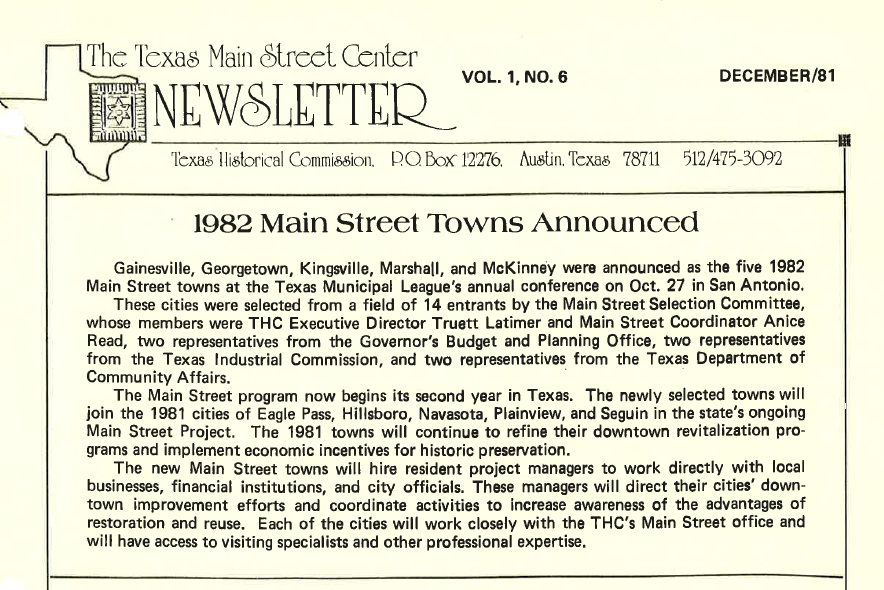
At the end of the state project’s first year, the second set of cities to be inducted were announced. All of them continue to participate today (all recertified): Gainesville, Georgetown, Kingsville, Marshall, McKinney.
Main Street works because of what it tries to do—and what it doesn’t try to do. There is uniformity provided through the framework —the Main Street Four Point Approach™ of Organization, Design, Economic Vitality, and Promotion. It is individualistic—no two communities are exactly alike, so no two will carry out the framework in exactly the same way; nor will two cities define success in exactly the same way–the variances between communities are too great. Some places have more limited resources and finances than others. There are differences in leadership, community vision and priorities. However, everyone works toward goals achieved through a foundation of preservation-based economic development. The key is that each community needs to continuously have focused strategies and activities in each of the four strategy areas. There must be broad-based commitment—many partners need to be involved and supportive. Local government will set the tone and show vision and leadership with their continual support as a key partner, but many volunteers will participate so that Main Street is truly a grassroots, community-led program.
While Main Street is a movement grounded in the past—the legacy of our historic downtowns—it must always be looking toward the future and adapting to trends and needs of current consumers and communities. In the May 2014 edition of Main Street Now, the national center’s digital magazine, Kennedy Smith, a well-known national Main Street consultant, wrote about the Main Street of the future and what is vital to success.
This includes the importance of a “broad mix of uses—and a broad range of capital sources and incentives to make this happen;” organizational flexibility- being nimble; embracing technology; and differentiating your community from another (what makes yours stand out?). In that same issue, Mary Means writes: “As the Main Street program nears its fourth decade, the enduring relevance of its comprehensive and integrated approach has been amply confirmed. The notion that thriving downtowns require deliberate management of many moving parts is now widely understood....” Means was a major part of the creation of the original national effort and was involved in many ways in Texas’ earliest years of Main Street.
As the national movement enters a new era, some changes are being unveiled that will impact the way the work of the Main Street movement across the country will be carried out. This includes a re-branding, and an updated and ‘refreshed’ Four Point Approach™, in which there is “a solid understanding of the market realities of the district, and is informed by broad community engagement;” and creation of Community Transformation
Strategies that “provide a clear sense of priorities and direction for the revitalization efforts.” Implementation all comes together with “an equally
important focus on measuring progress and results.” (http://www.preservationnation.org/main-street). Matt Wagner, Ph.D, Vice President of Revitalization Programs for the National Main Street Center, will be the featured speaker at Texas Main Street Manager Professional Development in February in New Braunfels. Dr. Wagner is leading the launch of the renewed and reimagined Four Point Approach™. Main Street managers and volunteer leadership should all try to attend this important meeting.
FROM THE TEXAS MAIN STREET OFFICE
Return on Reinvestment
Reinvestment figures documenting economic activity in Main Street districts has been collected by the state office continually over the past 35
years. When Main Street was begun, there was little understanding that preservation-based activity had the ability to have significant economic
impact. It was important to show that it could. Otherwise, the sustainability of the effort would be in jeopardy. The Trust’s pilot study showed that there was great potential, but there was not widespread evidence because this kind of focused work had not previously been done.
It started to become clear pretty early on—as the Texas program finished its first three years—that the potential for economic impact was significant. The February 1984 issue of the state newsletter announced that during those first three years there had been reinvestment of more than $43 million in the 14 participating communities.
The Mineola profile in the THC’s economic impact study showed that even a small, rural town can use preservation-based Main Street
activities to create significant economic benefit. At that time the study was written, Mineola Main Street reported $27 million of reinvestment over their 25 years. Since then, that number is more than $31 million. Mineola is a town with a population of about 4,500.
As of the third quarter 2015, Texas’ historical reinvestments for all cities that have ever been designated (but may no longer be involved) show almost $3.2 billion in combined public and private investment during their Main Street participation time. More than 34,000 new jobs have been reported in support of the creation of 8,627 small businesses in the Main Street districts.
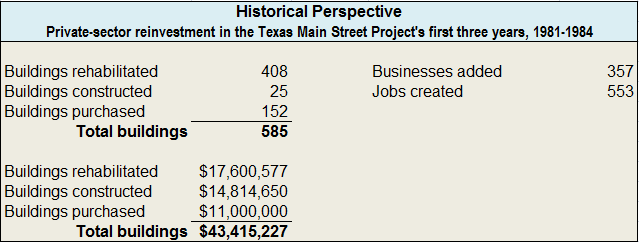
After the Texas Main Street Program completed its first 3 years, figures showed that significant economic impact was being made in Texas communities.
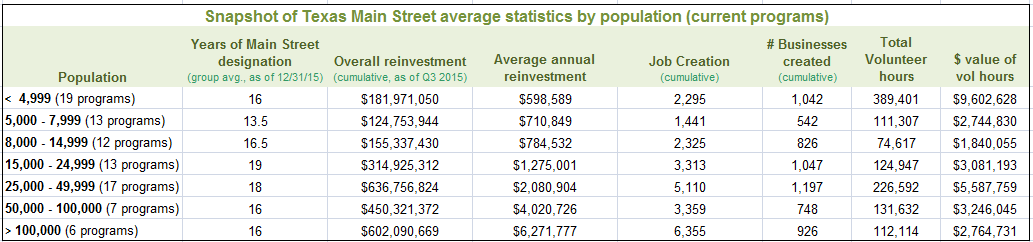
The economic benefit of Main Street.
For currently participating programs, the reinvestment numbers show $2.46 billion in overall reinvestment; the creation of more than 24,000
jobs and 6,300 businesses. Since local governments financially support their local Main Street programs, it is important for the reinvestments
to show evidence that when the public sector invests in downtown through activities like infrastructure improvements, aesthetic enhancements, and incentives, the private sector will respond. The cumulative figure shows that with public investment of about $854 million, more than $1.6 billion has been invested by the private sector. This is a return to the public sector of almost 2 to 1: for every dollar they’ve spent, almost $2 has been returned in private investment.
The highly successful Waxahachie Main Street Program recently looked back over its first 10 years in the program (2002, upon recertification
to 2012) to study the private return on investment that had come in response to local government’s prioritization of downtown. In those first 10 years, more than $100 million had been reinvested downtown. Almost 79 percent of that was public investment, largely due to infrastructure upgrades, construction of county buildings, a public parking garage, and restoration of the publicly owned depot. By 2013, when those publicly
funded projects were completed, the private sector was responding. In that year, public spending was minimal; private investment was more than $1.6 million. “In 2014, public sector reinvestment is dwarfed by the private sector,” says Anita Brown, Waxahachie Main Street director. In that year, there was $3.3 million invested by the private sector in comparison to approximately $100,000 of publicly funded projects. The scenario is similar for 2015. With its leadership and by demonstrating belief in downtown by making its revitalization a policy priority in those early years, local
government improved market capacity and spurred private interest and investment.
Public dollars spent to operate local Main Street programs also show the capacity for a relevant return on investment. According to the 2015 Texas Main Street funding survey (67 programs reporting), about $10 million was spent to administratively support local programs. This figure takes into
account programs in the smallest communities that are housed in city government to urban programs, some of which are non-profits receiving only partial funding from public sources. During that same reporting period, private reinvestment was more than $102 million. In this scenario, the
public contribution in supporting the Main Street programs can be looked upon as helping to encourage a tenfold return.
SERVICES, ACTIVITIES, AND MAIN STREET VOLUNTEERISM
Services and Activities
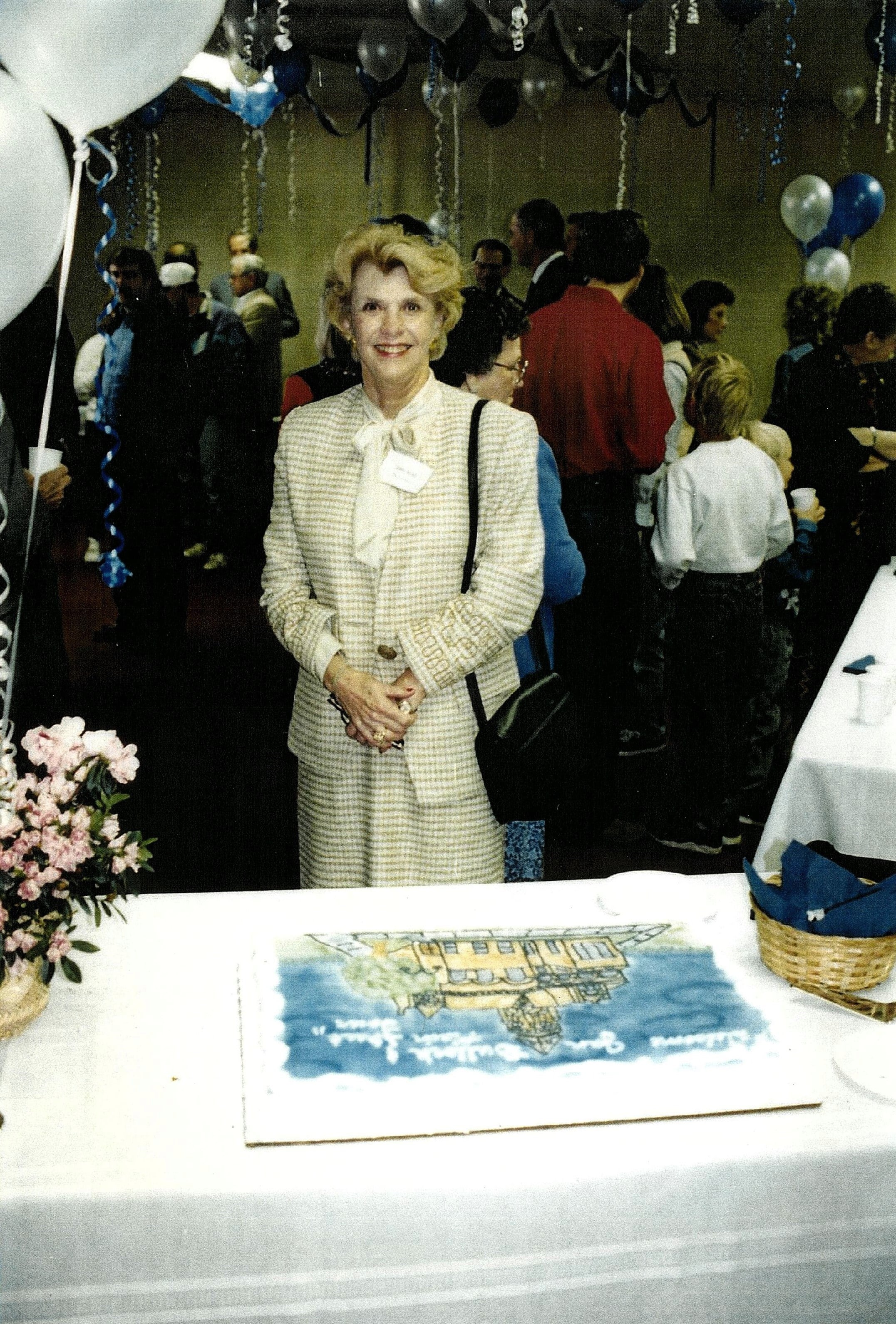
A 35th anniversary issue of Main Street Matters
would not be complete without honoring our
founder the late Anice Read, a visionary who laid
a strong foundation for the Texas Main Street
Program.
The eight-member Texas Main Street Program staff provides continual services to designated Main Street programs in the areas of design/preservation, planning, economic and small business development and organizational management.
During fiscal year 2015 (ended August 31, 2015), the Texas Main Street Program staff conducted 161 site visits and spent almost 6,000 hours on specific projects requested by local Main Street programs. These projects range from design renderings and reports to planning documents for both city planning and organizational management / program development purposes, plus analytical/financing reports. Design staff was directly involved with projects valued at $7,391,187 that were completed during the time period. Over the past five years, design staff has been involved in assisting on property improvements valued at more than $31 million. These projects in local Main Street communities vary widely. They include assistance to property owners on the rehabilitation of historic buildings in the Main Street district; providing technical advice on public projects such as improvements or development of gateways and public spaces; and to businesses in the form of helping to develop better signage or visual appearances (i.e. new canopies or awnings). Design staff worked on 232 requested projects during the year. (A property owner may request a project, but might not actually complete the project in the same year so this number does not necessarily directly correlate to the dollar amount of projects completed by the design staff.)
In May, as part of our recognition of National Preservation Month, we unveiled the TMSP online
resource library. This library currently has approximately 150 documents of specific interest to
Main Street and has been utilized hundreds of times already. We will continue to build this resource over time with articles, technical resources, blogs, and videos/webinars. Another project we’re continuing is the Main Street mentoring program, begun in 2014. The project puts together seasoned Main Street managers with those new to the field. Mentors agree to call and/or have in-person meetings with their mentee on a regular basis for the new manager’s first year.
We also welcomed a new staff member in 2015. Sarah Marshall joined as the TMSP Assistant State Coordinator and Small Business Development Consultant in July. She did a self-introduction in the August issue of Main Street Matters. All issues of the monthly newsletter are archived on the
THC website.
The Main Street listserv continues to be an important facet of our program by allowing local program managers and TMSP staff to regularly converse and share important news, find ideas, and get answers to questions. During 2015, the listserv was utilized 1,056 times.
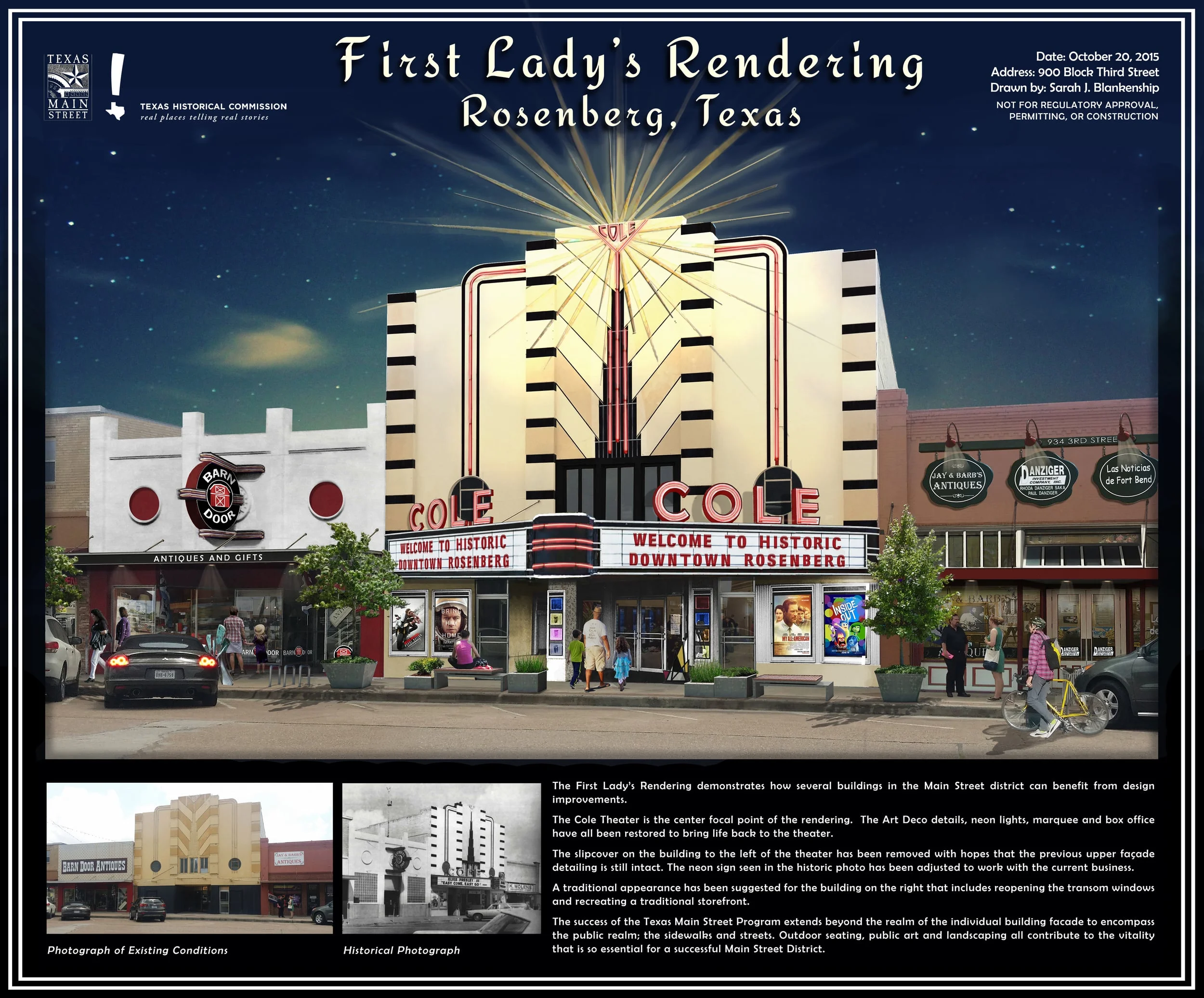
A very exciting part of 2015 was the continuation of a longstanding tradition: the First Lady’s tour of new Main Street cities. Every First Lady since 1981 has participated, and new First Lady Cecilia Abbott graciously honored us by continuing the tradition. Together with THC Commissioners and staff, Mrs. Abbott visited Ennis and Rosenberg on Oct. 20. Images from that visit were posted broadly on social and traditional media and we recapped the visits in the last issue of Main Street Matters. The event also provides the TMSP design staff an opportunity to showcase design possibilities for a particular area of the downtown. Renderings of these selected areas are created and produced by the design staff, and then presented to the community by the First Lady during the visit. In Ennis, the rendering spotlighted several properties and a small park, while in Rosenberg, a historic theater and several adjacent historic properties were showcased.
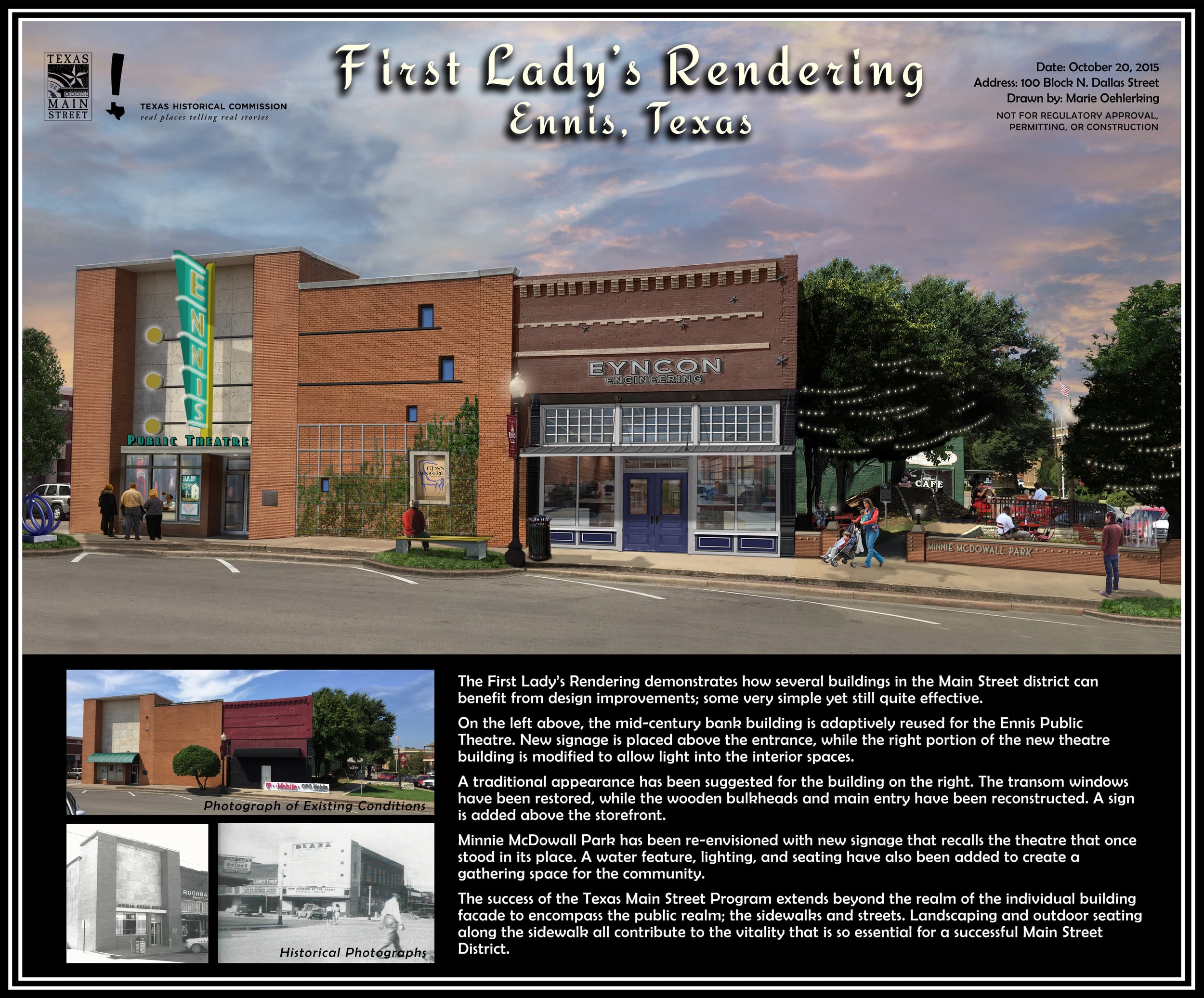
Design renderings created for the 2015 First Lady’s tours to the new Main Street cities of Ennis and Rosenberg.
Main Street Volunteerism
In Fiscal Year 2015, volunteers contributed 149,579 hours, which has a value of $3,688,618, to their local Main Street programs. This is a 23 percent increase over 2014. Over the past 16 years since we’ve been collecting volunteer data, more than 1.7 million hours have been contributed. Using volunteer value calculations through the Independent Sector (https://www.independentsector.org/volunteer_time), Main Street cities have received almost $29 million in financial value from volunteers contributing their time to local programs and supporting the work of staff.
Main Street volunteers are spotlighted in each monthly issue of Main Street Matters. The engagement and leadership of volunteers in Main Street programs are incredibly important to the success of local programs and the spotlights are one small way of saying ‘thank you!’ During 2015, the following volunteers were spotlighted:
- Sharon Brass, Brenham Main Street Program
- Gary Niesner, La Grange Main Street Program
- Karen Cason, Winnsboro Main Street Program
- Sylvia Smith, Waxahachie Main Street Program
- Joanna Runkles, Levelland Main Street Program
- Dr. Curtis Ratliff, Grapevine Main Street Program
- Mary Valva, San Angelo Main Street Program
- Shelly Preston, Childress Main Street Program
- Renee Butler, Rosenberg Main Street Program
- Kyle Tate, Bowie Main Street Program
- Gerry Larabee, Nacogdoches Main Street Program
- Jill Drake, Paris Main Street Program
- Scott Sustek, San Angelo Main Street Program
- Bill DeBrooke, Harlingen Main Street Program
In the February issue, when the Bastrop Main Street Program was spotlighted, Program Director Nancy Wood acknowledged this about
volunteers and their connection to a program’s success: “What I’ve learned over the years is to never underestimate the power of volunteers
in any endeavor; that eventually the right things get done for the right reasons; and that it’s never your idea in the first place when it comes to
things that impact the place where people live… it’s their ideas that make it all happen!”
Any managers who would like to recognize one of their Main Street volunteers in a 2016 issue of Main Street Matters should contact Sarah
Marshall at sarah.marshall@thc.state.tx.us.
Leadership is also very important to the success of local programs, both at the staff and volunteer levels. Leadership development is always
either directly or indirectly a big part of content at all of our Main Street manager trainings each year. In 2016, we will be creating a Leadership
Development Academy for Main Street board chairs. This academy will include a series of webinars and/or conference calls with the chairs
and TMSP staff, designed primarily to connect the volunteer leaders with each other to share common ideas, best practices and such. Along with
this, we’ll be refining the logistics of Main Street 101 trainings. While we’ll still provide training at the local level upon request, we’ll also be setting up a series of regional trainings on specific dates that will hopefully bring together volunteers from multiple Main Street communities. We are continuing to work out the details of both of these new initiatives and more details will be forthcoming.
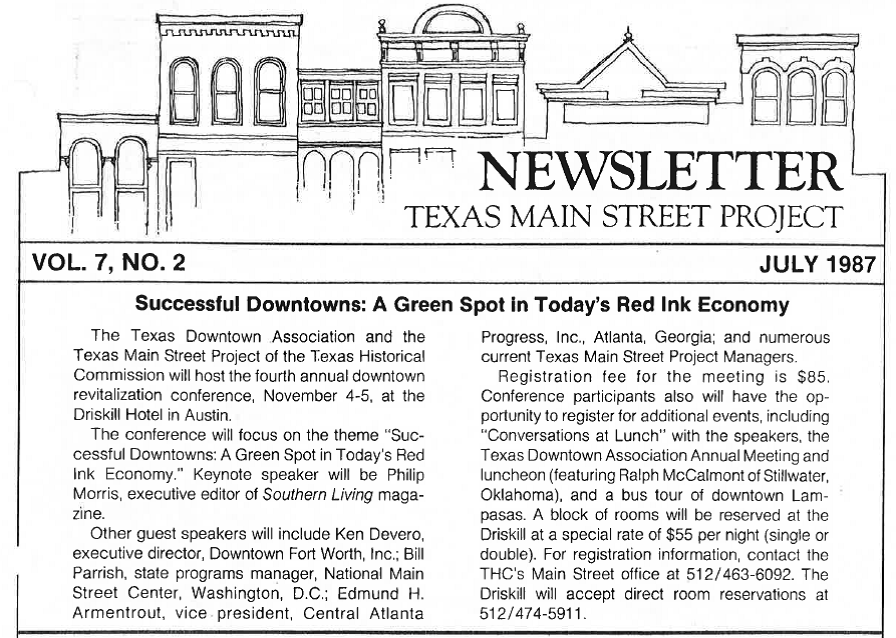
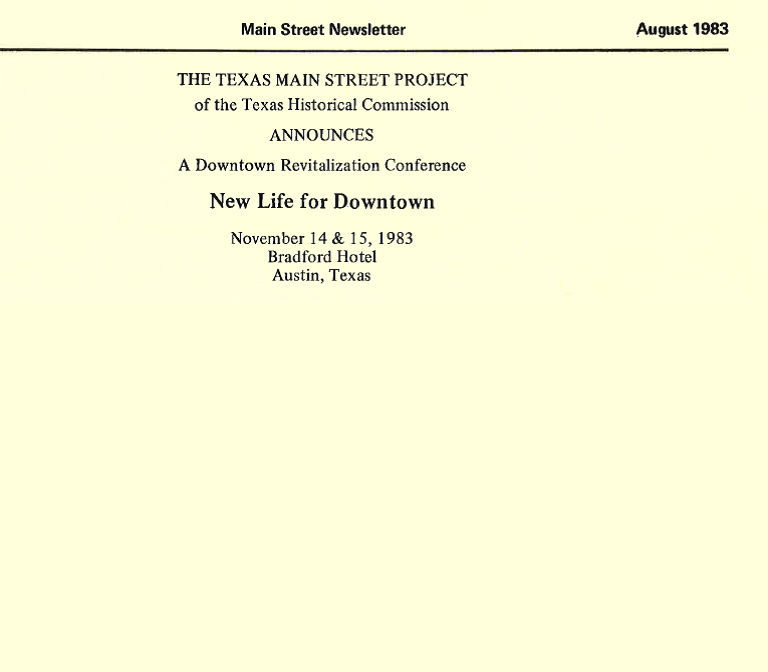
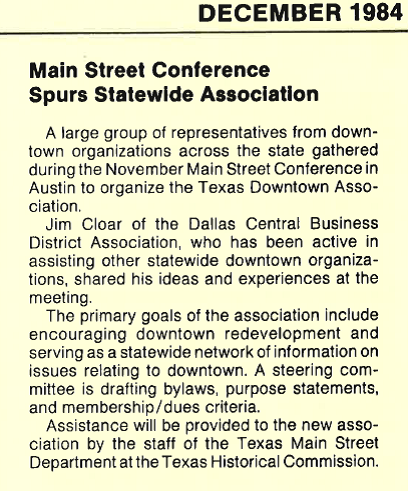
More from the archives: other early issues of the texas main street newsletter inform stakehold-ers of the ἀrst main street conference in 1983; the creation of the texas Downtown association during the conference in 1984 and the beginnings of a joint statewide revitalization conference being hosted by the two organizations together. this relationship continues still continues today.
THE TOWN SQUARE INITIATIVE
Originally introduced in 2014 as the Courthouse Square Initiative, the Town Square Initiative (TSI) is an extension of services provided by the
Texas Main Street Program and offers specialized assistance through the work of an architect, economic developer, and a planner. The initiative utilizes the market-based approach of the Main Street model to work closely, longterm, and at a high level of expertise with a small subset of communities within the THC network who have already demonstrated a substantial commitment to preservation. The objective of TSI is to address the wide-spread challenge of vacant and underutilized historic downtown property by developing market-sensitive building rehabilitation strategies
through a sequenced set of services that includes planning, economic, and architectural analyses.
The TSI team, which includes professionals with expertise in architecture, economic development, and city planning, spent the last year working intensively with several Main Street cities and researching issues related to vacant and underutilized properties. The end result is a new set of services designed for communities where a combination of policy and preservation tools can be leveraged to accomplish local, small-scale, and high quality redevelopment projects. TSI will formally introduce its menu of services through a website launch and presentations at the Main Street
trainings in early 2016.
TSI will also be responsible for creating new tools and resources to assist communities in inventorying historic commercial property and
increasing the market visibility of these assets. TSI generously received grant funds from a private foundation in the fall of 2015 and
redirected Historic Preservation Fund (HPF) monies returned from a CLG grantee to funding the first phase of what has been named the
Downtown Online Inventory. The Downtown Online Inventory (DOI) will be a comprehensive, web-based mapping tool that promotes historic
real estate and business investment opportunities in participating Main Street, Certified Local Government, and other partner communities
by centralizing current, detailed property data along with historic resource survey information and displaying it in an easy-to-use and
broadly accessible online platform. Staff will work with several pilot communities in 2016 to develop Phase I of the software, which
will eventually be made available to all Main Street and CLG communities.
Town Square Initiative Vision
The TSI helps communities reimagine the possibilities for their key historic buildings. The TSI team provides services to spur preservation-based projects so that local, small-scale and high-quality real estate development becomes more achievable in historic Texas downtowns. Through this
approach, development barriers are addressed, a market-driven perspective is prioritized, and vacant and underutilized properties become desirable investment opportunities.
Town Square Initiative Mission
The Initiative addresses barriers to development in historic downtowns that have already demonstrated a substantial commitment to historic
preservation-based revitalization. These objectives are accomplished by providing specialized project assistance for vacant and underutilized properties with a focus on:
- Feasibility studies analyzing redevelopment potential;
- Downtown planning strategies;
- Increasing and influencing the market exposure of available properties
- Providing information, education, and resources on best practices that have a positive impact on local policy and decision-making.
THE TEXAS MAIN STREET PROGRAM CELEBRATES 35 YEARS IN 2016
From five to 90 cities, the Texas Main Street Program has come a long way since 1981. To commemorate this important anniversary, we have some fun items in store for 2016.
- We are also hosting a sweepstakes for a weekend getaway to one of our Main Street communities. Participants must “like” or follow the
THC on a social media network (Facebook, Twitter, or Instagram) or subscribe to the THC e-newsletter or blog, and enter their email address. This contest will increase awareness of Texas Main Streets to the public and celebrate this milestone of the TMSP. - For February training in New Braunfels, we have scheduled Dr. Matt Wagner, the Vice President of Revitalization Programs at the National
Main Street Center, to be our keynote speaker. Matt is in charge of leading the launch of the renewed and reimagined Four Point Approach.
Returning to the Center after having previously worked there in the 1990s, Matt has also been a local downtown director (Racine, Wisconsin)
and the Main Street director in Sheboygan Falls, Wisconsin during which time it became the inaugural Great American Main Street Award winner. He is also a former Small Business Development Center director. - Finally, we also have an article honoring our anniversary in the Medallion, the THC’s quarterly publication with a circulation of 15,000.
Get ready to help celebrate 35 years of downtown revitalization throughout the state! The Texas Main Street Program looks forward to another productive year in 2016 providing services to Texas’ historic downtowns.
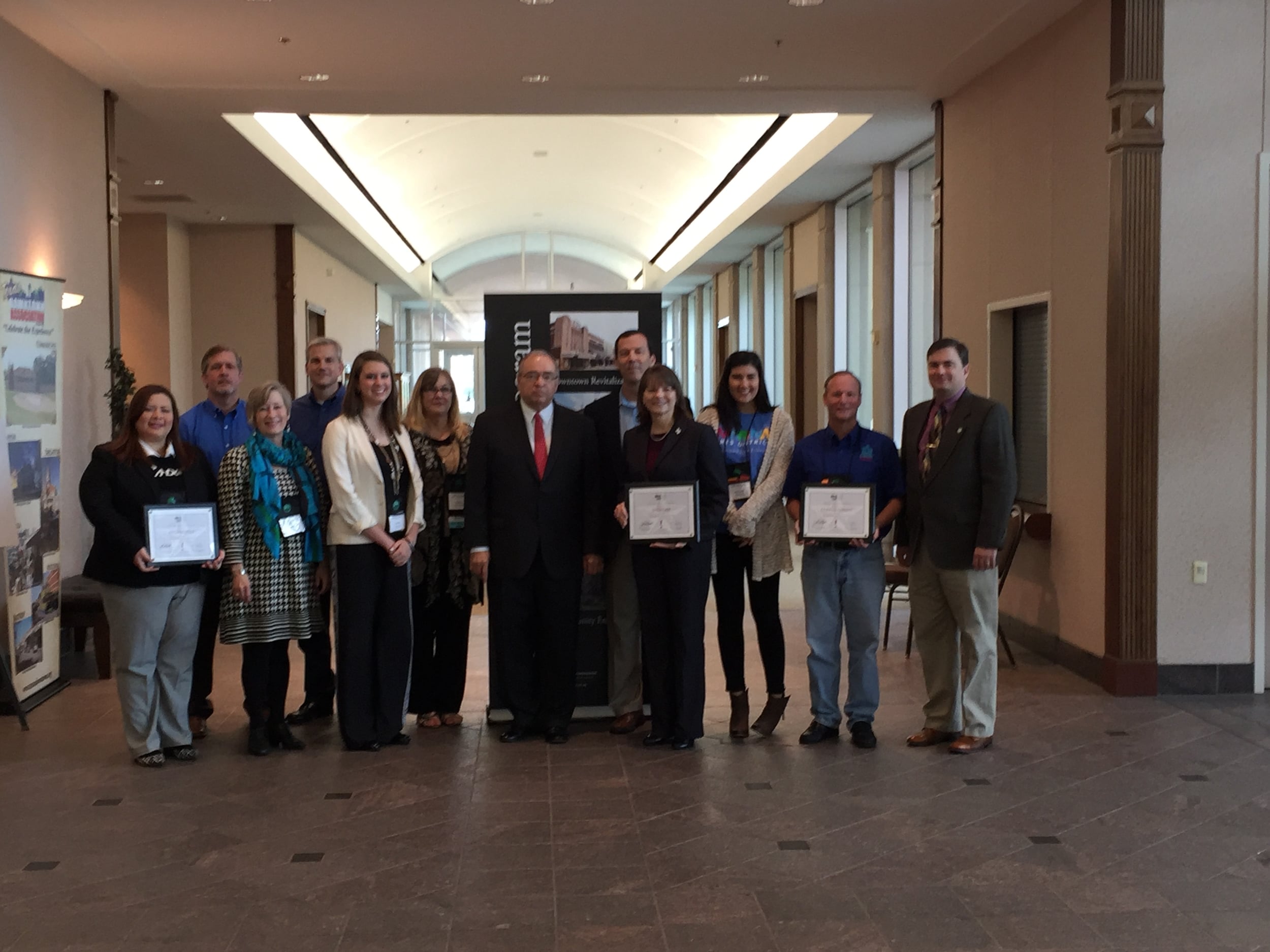
Welcome 2016 Main Street communities! As of January 1, 2016, Brownsville, Corpus Christi, and Sherman entered the Texas Main Street network, bringing the total number of communities served to 90. They were introduced by THC Vice Chairman John Crain during the annual downtown revitalization conference in Waxahachie in November.
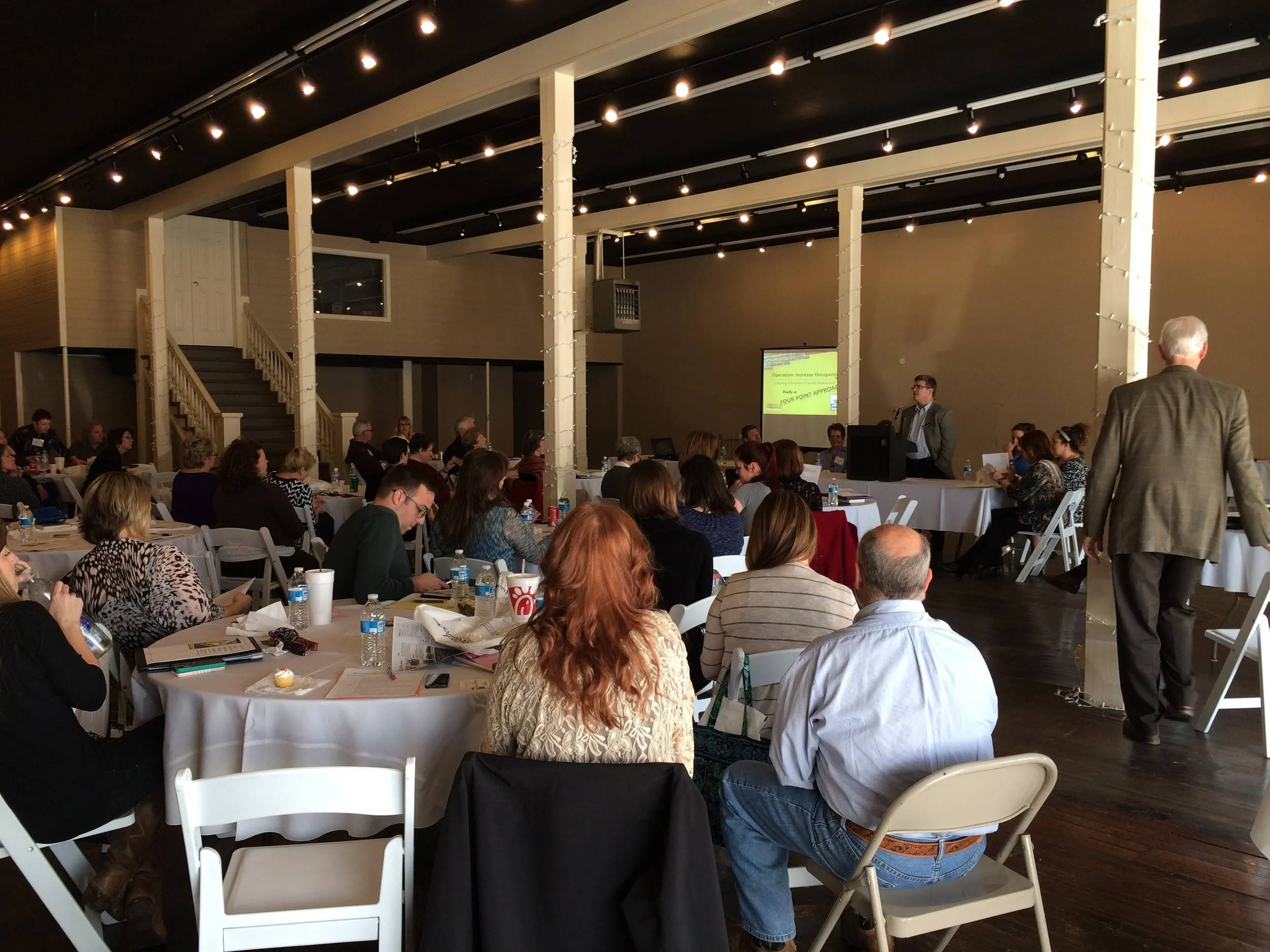
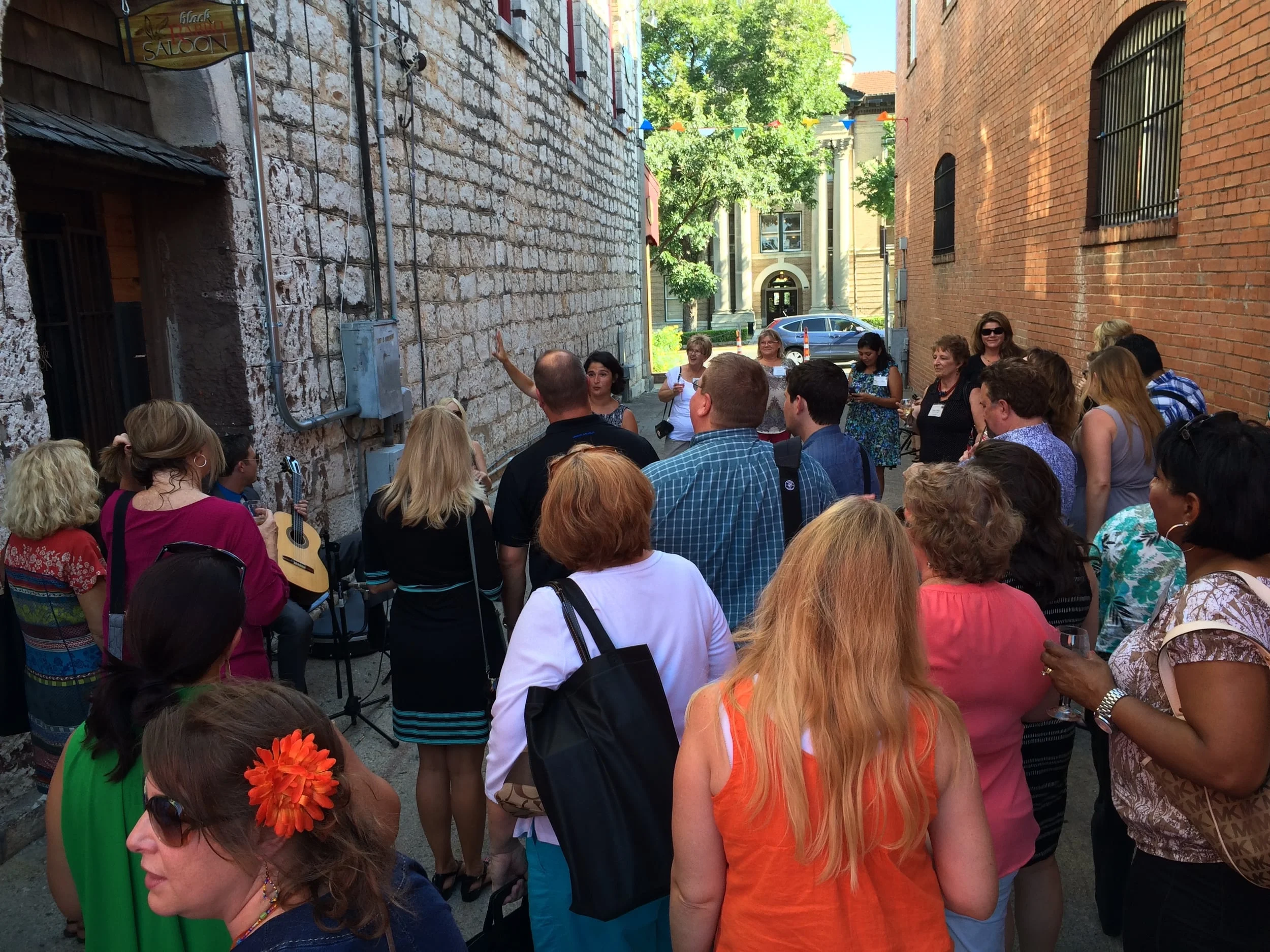
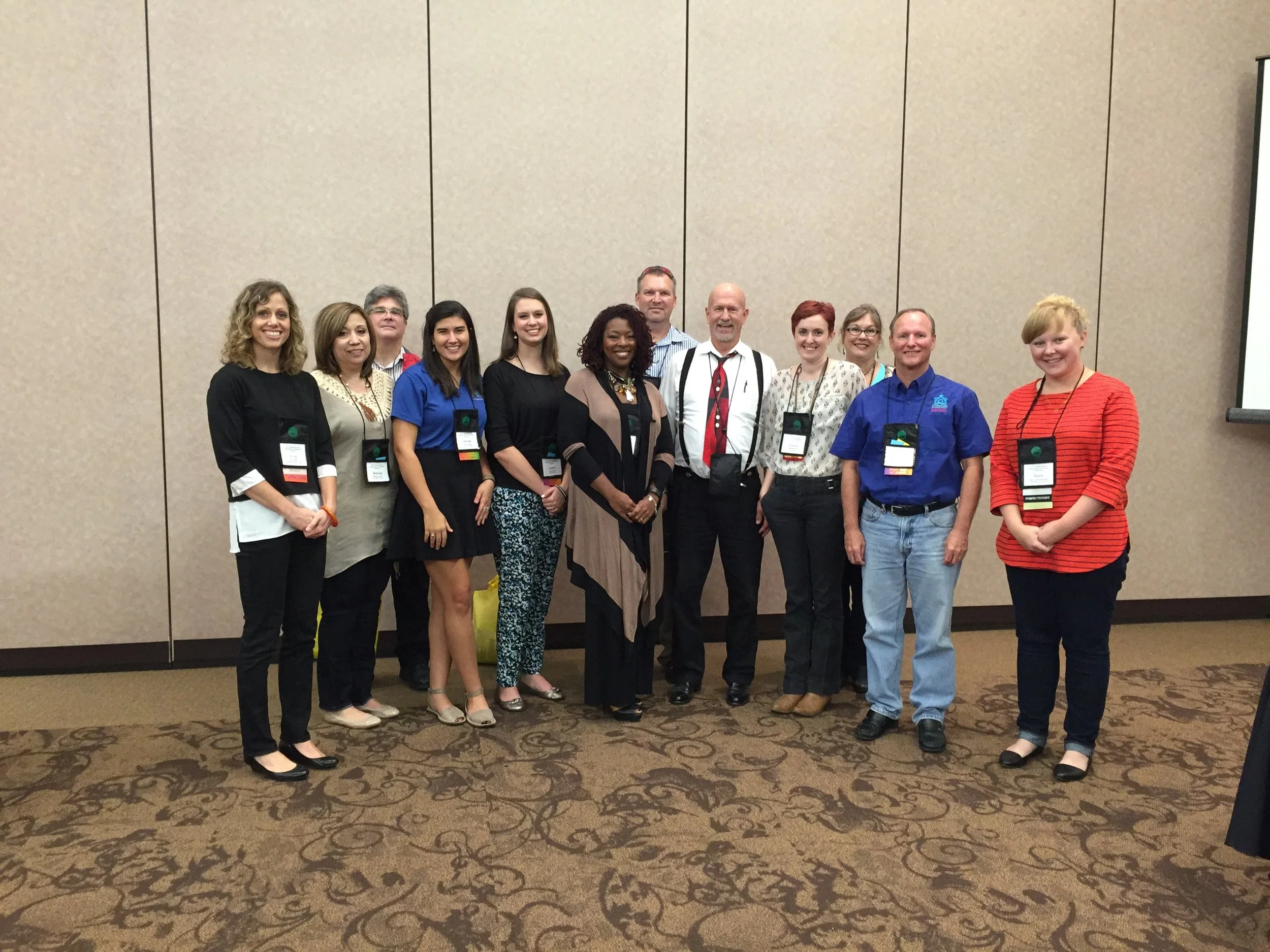
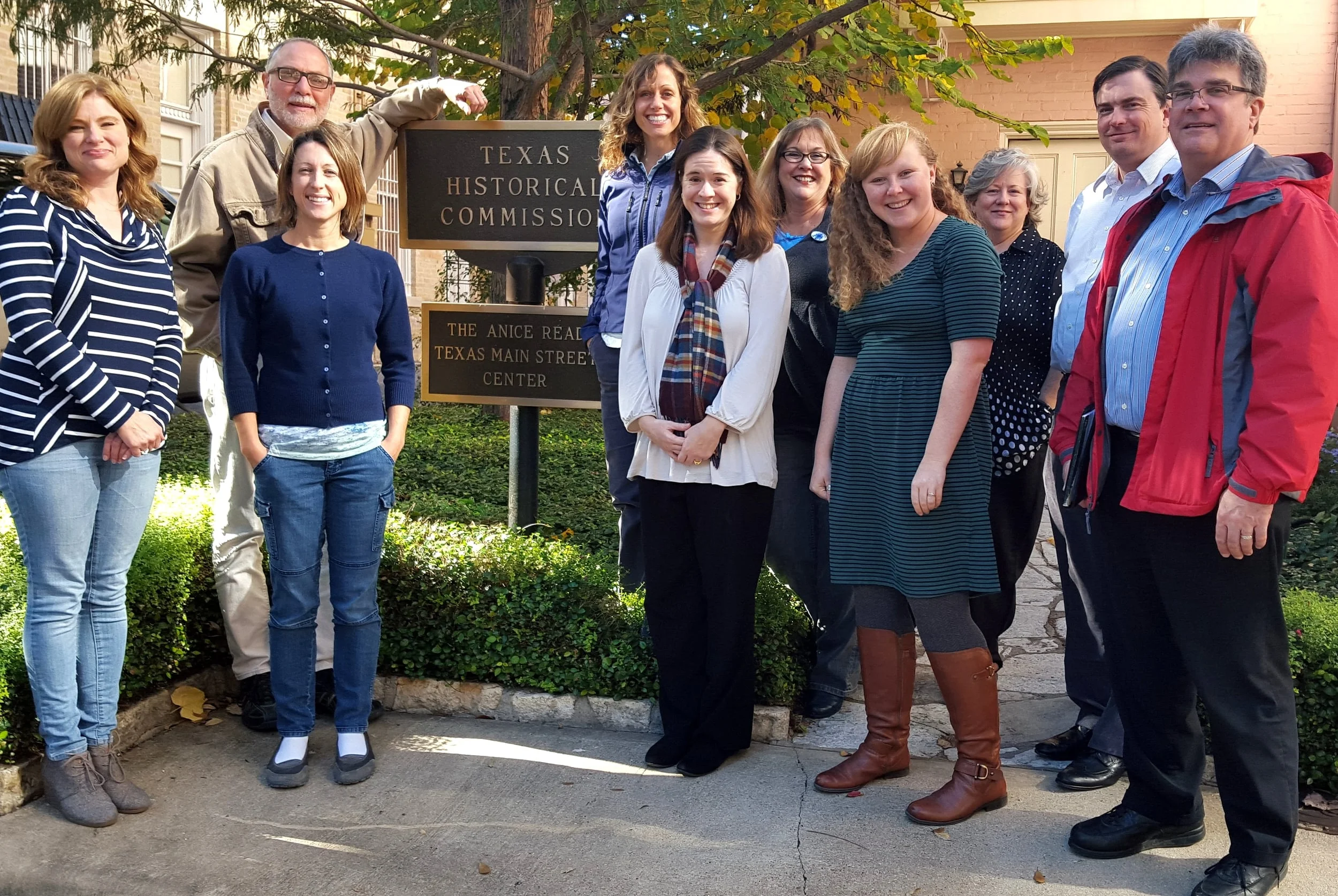
in 2015, managers gathered in Nacogdoches (left) and San Marcos (middle), for main street professional Development. We also gathered for the annual state-wide downtown revitalization conference with the texas Downtown association in Waxahachie (right), also a main street community. Before the start of this conference, tmsp staḀ had the chance to visit with our newest local program managers.