
Written by Audrey Holt, Former Project Design Assistant, Texas Main Street Program
The Secretary of the Interior’s Standards are often mentioned and discussed in Main Street Training and in Texas Main Street Design Reports. This article will outline how the Secretary of the Interior’s Standards came about, why they should be used, and how they can be helpful in your preservation and revitalization work.
The Secretary of the Interior of the United States is responsible for establishing professional standards and providing advice on the preservation and protection of cultural resources. The National Park Service, an agency of the Department of the Interior, has developed guidelines and standards that guide decision-making for these resources at the national, state, and local levels to encourage consistent preservation practices across the country. The Secretary of the Interior’s Standards for the Treatment of Historic Properties are the Secretary’s best advice to everyone on how to protect a wide range of historic properties. Known as ‘the Standards,’ they are neither technical nor prescriptive, but are intended to promote responsible preservation practices that help protect our irreplaceable cultural resources. As noted, while the Standards are designed to be applied to all historic resource types included in the National Register of Historic Places—buildings, sites, structures, districts, and objects— the guidelines apply to specific resource types, in this case, buildings. A full list of the Standards is found at: www.nps.gov/hps/tps/standguide
The Standards are not overly specific, and describe general approaches and decision-making rather than providing a checklist of do’s and don’ts. The Standards are broad partly because no two resources are exactly alike, and each has its own unique features, problems, and issues. They are not meant to give case-specific advice or address exceptions or rare instances. Therefore, it is recommended that the advice of qualified historic preservation professionals be obtained early in the planning stage of the project.
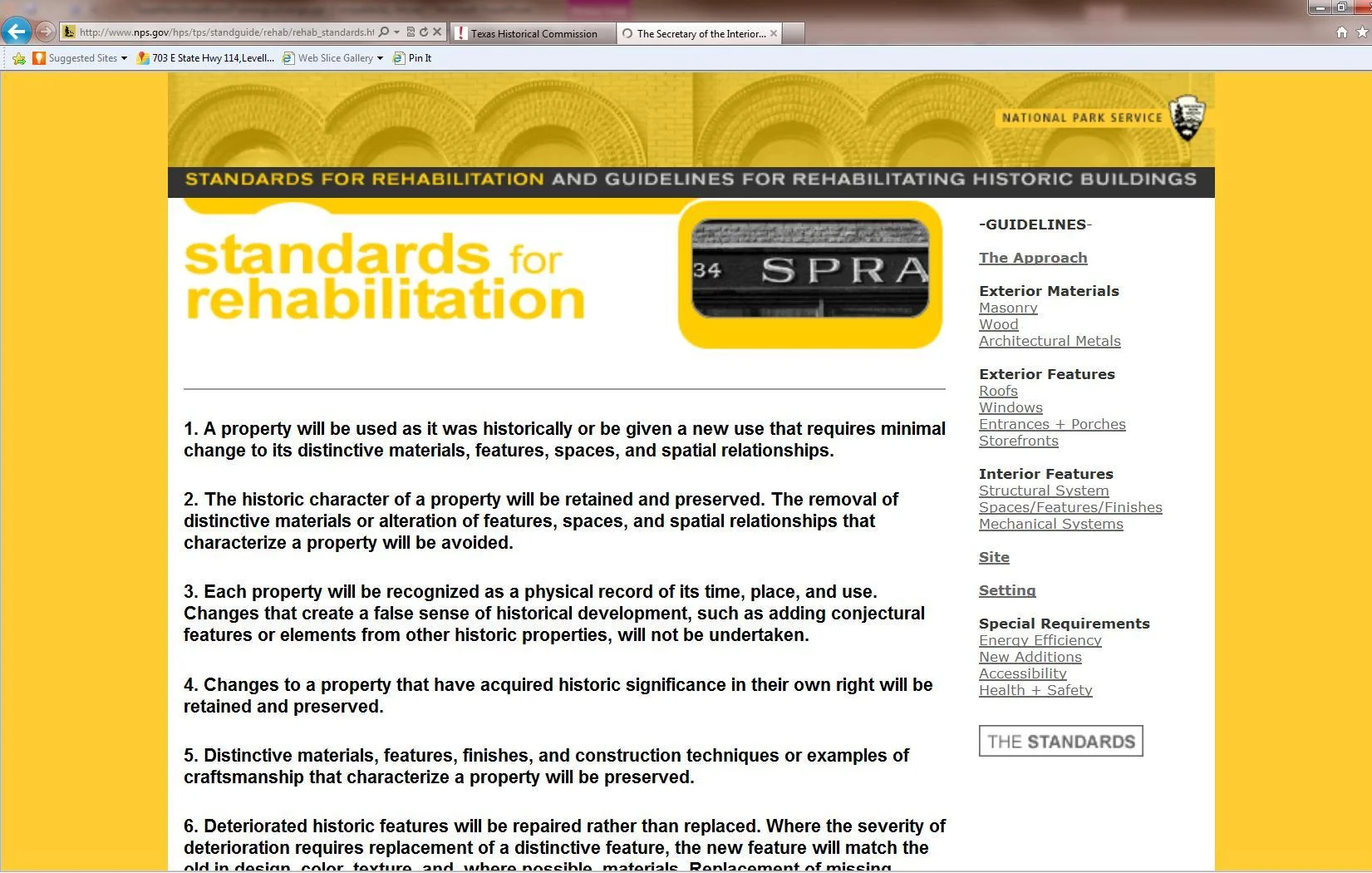
Secretary of the Interior Standards for Rehabilitation webpage www.nps.gov/hps/tps/standguide/rehab/rehab_standards.htm
The Secretary of the Interior has required the application of the Standards in certain programs that the Secretary administers through the National Park Service. They apply to all proposed development grant-in-aid projects assisted through the national Historic Preservation Fund. They are also tied to attaining the Federal Preservation 20 percent tax credit for the rehabilitation of historic, incomeproducing buildings that are listed in or determined eligible for listing in the National Register of Historic Places. Further information about preservation tax incentives can be found at: www.thc.state.tx.us/preserve/proje cts-and-programs/preservation-taxincentives/about-preservation-taxincentives. Some preservation organizations on the local level also link guidelines and grants to the Standards as a way of regulating best practices.
The Standards break down preservation projects into four approaches, with subsequent standards and guidelines for each.
Preservation focuses on the maintenance and repair of existing historic materials and retention of a property’s form as it has evolved over time.
Rehabilitation acknowledges the need to alter or add to a historic property to meet continuing or changing uses while retaining the property’s historic character.
Restoration depicts a property at a particular period of time in its history, while removing evidence of other periods.
Reconstruction re-creates vanished or non-surviving portions of a property for interpretive purposes.
When choosing an approach, a variety of factors should be considered, including the property’s historical significance, physical condition, proposed use, intended interpretation, and mandated code requirements. The Standards are not intended to be used to make essential decisions about what features of the historic building should be saved and what can be changed. However, once a treatment is selected, the Standards provide a general philosophy and approach that must be uniquely applied in each situation based on the desired outcomes and existing conditions. Choosing an appropriate treatment for a historic building or landscape is critical.
The Standards for Rehabilitation are used most often when analyzing and making recommendations for buildings in Main Street communities. Rehabilitation is defined as “the process of returning a property to a state of utility, through repair or alteration, which makes possible an efficient contemporary use while preserving those portions and features of the property which are significant to its historic, architectural, and cultural values.” Of the four treatments, only rehabilitation includes an opportunity to make possible an efficient contemporary use through alterations and additions. The Standards for Rehabilitation and Guidelines for Rehabilitating Historic Buildings are found at: www.nps.gov/hps/tps/standguide /rehab/rehab_index.htm
Sources:
This article relies heavily upon the National Park Service’s website regarding the Secretary of the Interior’s Standards: www.nps.gov/hps/tps/standguide