"Open Mic"
Sarah Marshall, Former Assistant State Coordinator
At February training in New Braunfels, I headed up the Open Mic roundtable. The purpose of this forum was to be able to ask a question on any topic that needed an answer, and our subject matter was quite diverse. The people who joined the table not only got some answers from me, but all of the other managers at the table were extremely helpful as well.
The first question was about economic development groups, and how they finance parts of Main Street. The manager’s city has a Type A, but feels that if they switched to a Type B, there would be more money available for Main Street projects. Although I did not have the answer on hand, I easily followed up when I got back to the office. The survey information that managers fill out with the 10 Criteria reports is amassed into one spreadsheet, and this past year, it included the amount of money Type As and Bs contributed to the Main Street divided between operations and special projects. Then, we remove the city’s name associated with the information for confidentiality purposes and make this report available to the public. I sent the manager the report the following week, and she had all the information she needed. If you ever need this type of data, please ask us!
The second topic of discussion was one that all Main Street managers have struggled with at one time: how do you get property owners to fix their buildings? While everyone wishes there was one antidote that fixes this situation in every community with every deteriorating property, it is unfortunately not an easy problem to solve. We talked about the possibility of initiating a vacancy ordinance in this particular city, and I directed the manager to the Resource Library. The TMSP’s Community & Economic Development Specialist, Brian O’Connor, wrote an in-depth article (link to this: http://www.txms-resourcelibrary.org/vacant-properties) about options to approach the owners of vacant properties. From vacant property registration ordinances to land banks, Brian covers the basics to tackle this issue, and if you did not get enough information from the article or would like to discuss your particular issues, Brian is just a phone call or email away.
The final subject we conversed about is how to make a case for getting support staff in the Main Street office. While many of the Main Street managers give the illusion that they can do it all, in actuality, it is a tough mission to wear dozens of different hats and complete tasks with expertise and efficiency. One suggestion was to work with local universities or colleges to get interns. Not only can you get projects done with little to no cost, you actually enrich a student’s learning by giving them real-world experience. Tasks can range too depending on what plans you have on your plate, and they can include social media, marketing, and downtown inventory to name a few. If you can lay out a clear process, you can utilize an intern.
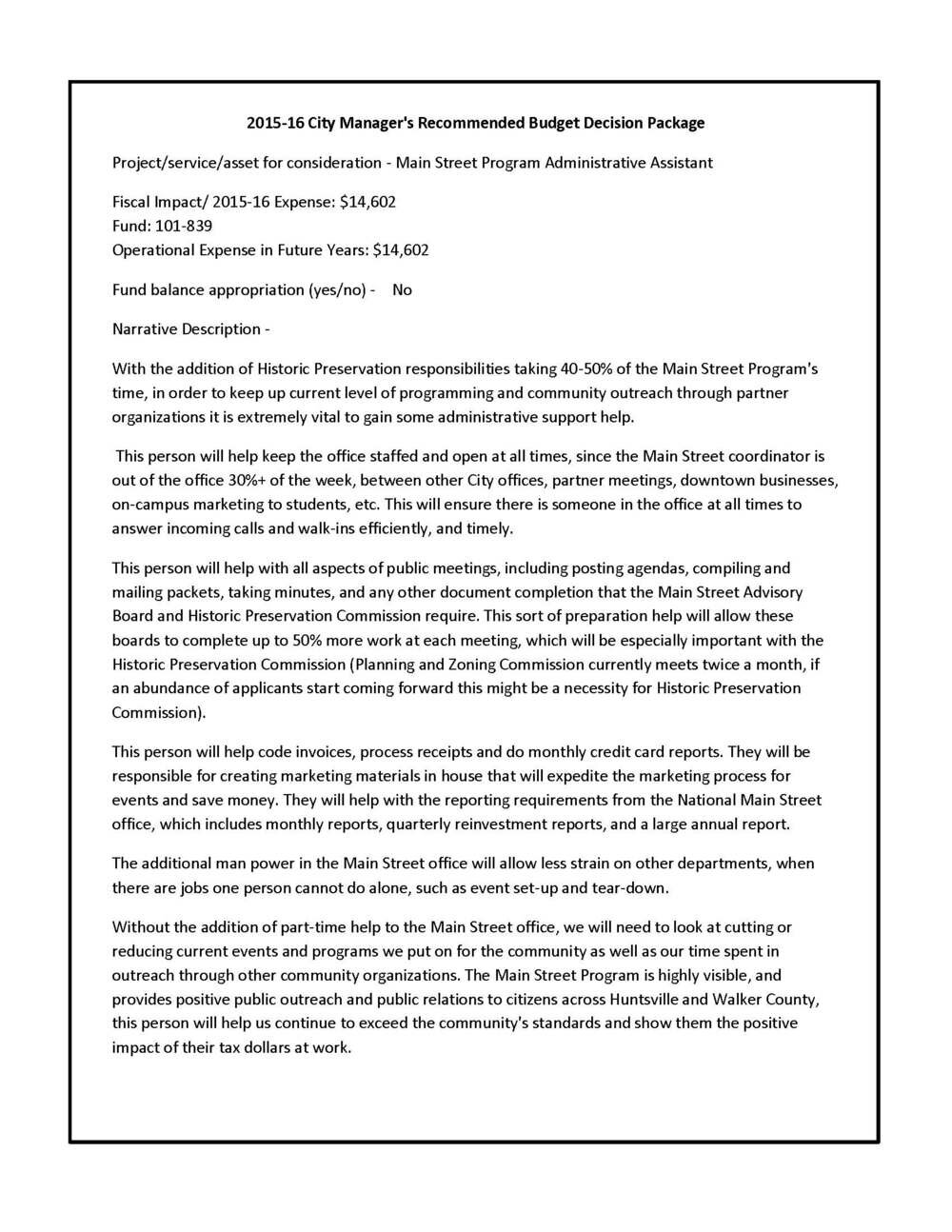
Interns are not always the key to getting the long-term assistance managers need in the office. Lindsay Lauher in Huntsville recommended making a financial case for paid assistance. By demonstrating the necessity and showing how it makes sense economically, the circumstance seems more feasible in eyes of the “powers that be.” Below, you will see the document Lindsay put together to make the argument for an administrative assistant. Although she did not gain an assistant out of this, she is on the right track to demonstrate the help she needs to be successful.