
LEGACY OF ANICE READ:
Memories and Stories from Main Street Managers, Texas Historical Commission Staff, Family, and Friends
October 2016 Main Street Matters
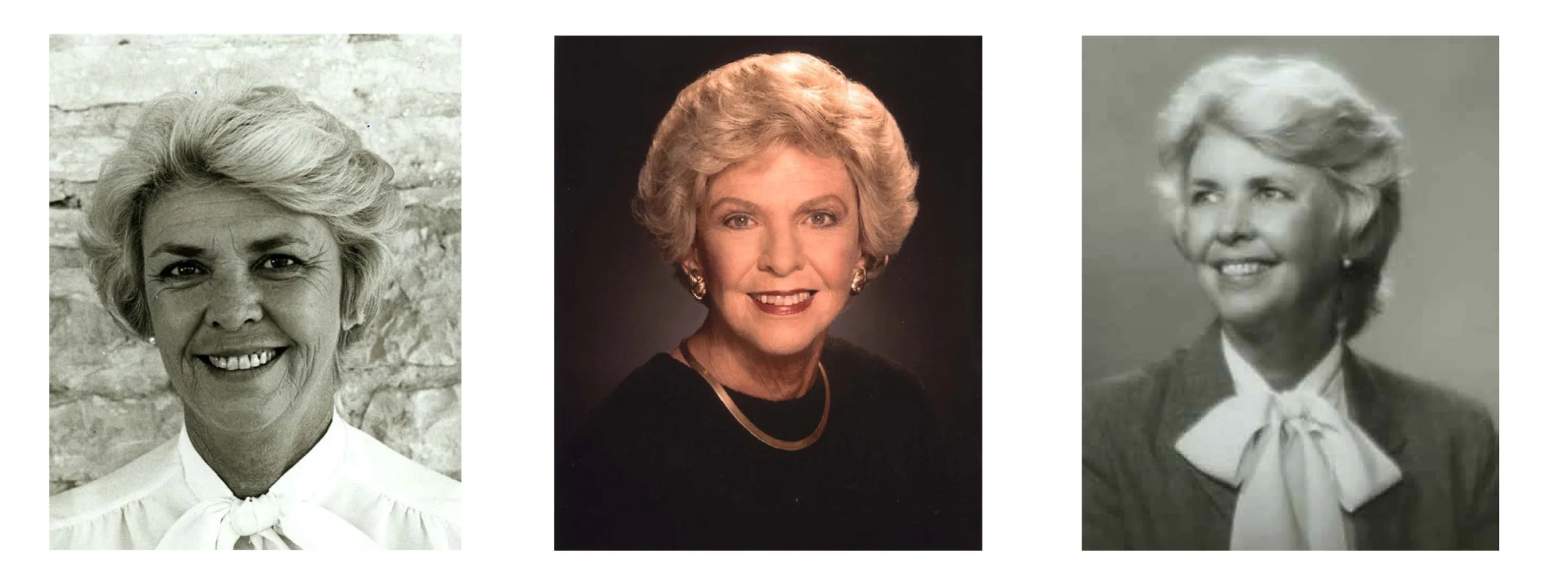
Editor’s note from Debra Drescher, State Coordinator, Texas Main Street Program
This is one of the longest issues of Main Street Matters we’ve ever produced, but it is well worth it. We are excited to dedicate this entire issue to the legacy of the late Anice Read, who brought so much to the world of historic preservation and downtown revitalization not only in Texas, but to the whole country. You’ll notice that there’s a theme of words to describe Anice and her impact: Texas treasure; wise; tough but kind; a master; leader; inspirational; motivational.
This year marks the 35th anniversary of the Texas Main Street Program. It’s easy to trace the roots of our success back to Anice Read, whose
efforts resulted in Texas being one of the first states in the country to introduce the then-new Main Street model to local communities hoping to create economic impact by focusing on the revitalization of their historic downtowns. Anice laid a solid foundation for us in 1981, but her legacy didn’t just extend to Texas Main Street. In 1985, she also created the non-profit Texas Downtown Association so everyone with an interest in their local downtowns could have a partner for their work. Anice was appointed to the Texas Historical Commission (THC) in 1969, and served until
1976. The next year, she became an employee of the agency as Director of Programs. When she brought the Texas Main Street Program to Texas
and became its director in 1981, she also put into motion many activities that continue today. This includes comprehensive trainings and professional development for managers and volunteers; Main Street resource teams to get newly designated programs off the ground; and the annual visit of the First Lady of Texas to new Main Street communities. In 1994, Anice also brought on the Independent Bankers Association of Texas (IBAT)as a partner to this event; this relationship between Main Street and IBAT continues today. Anice retired from the THC in 1996, and was honored with a ceremony in the Texas Senate chamber hosted by then – First Lady Laura Bush, former First Lady Nellie Connally, and Jan Bullock, former THC Commissioner and wife of Lt. Gov. Bob Bullock, for whom the state history museum in Austin is named. At that time, the offices of the THC’s Community Heritage Development Division were renamed the Anice Read Main Street Center in her honor.
Over the years, Main Street has become a powerful national brand and movement. It represents the great things that can happen when people
band together and work toward a common goal, and communities are better for it. Anice was on the ground floor of making all of it come about. Over time, almost 180 Texas communities had been designated Main Street programs, with 87 currently participating. As a result of their efforts, the state’s economy has improved through more than $3.3 billion of investment into designated Main Street districts. More than 35,000 jobs have been created, along with nearly 9,000 small businesses.
Main Street’s brand recognition can be felt through our 35th anniversary Celebrate Main Street sweepstakes that offered terrific weekend packages in designated Main Street communities. For the first three packages–to Marshall, Denton, and Seguin–there were more than 4,000 entries! The last contest of the year is to Denison, a 27-year Main Street community. The Denison sweepstakes runs the month of October. To enter, sign up until midnight October 31 on the THC website: http://www.thc.texas.gov/main-street-sweepstakes.
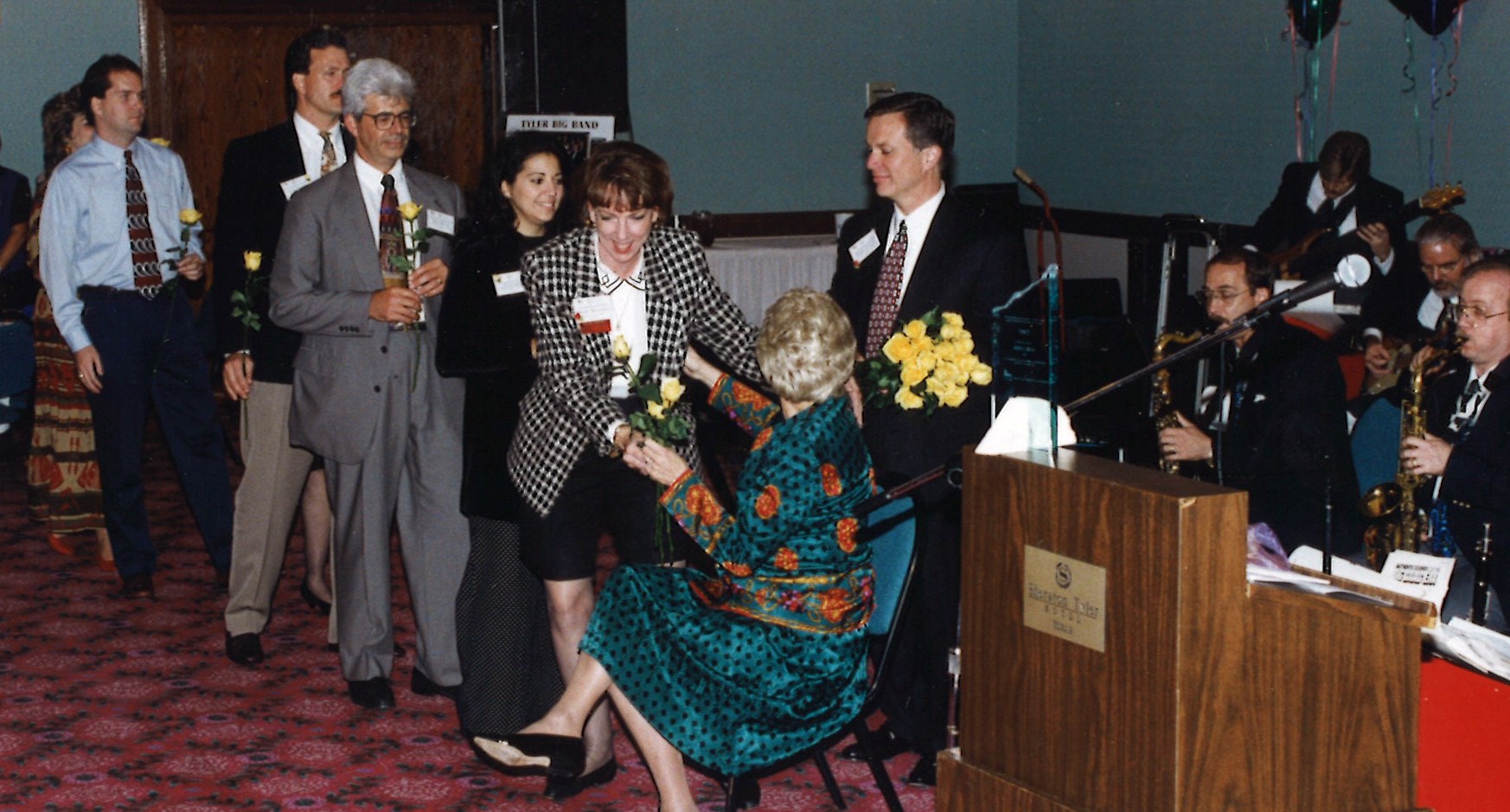
Anice was honored with yellow roses and serenaded during a 1996 meeting in Tyler by state staff and
local Main Street managers.
Even though I only met Anice twice, briefly, the impact she had on my life has been evident for almost 20 years. In 1998, I answered a tiny ‘Help Wanted’ ad in the Austin American Statesman to contract with a small nonprofit called the Texas Downtown Association. My interview was held in a small historic house across from the State Capitol that served as offices for the Texas Historical Commission. I didn’t really think at the time that it would turn into a long-term stint, but I ended up staying with TDA for seven years, even though I wasn’t housed in the place in which I interviewed. Then, I moved on to Anice’s Texas Main Street Program, where I’ve been for 11 years–and I’m now housed in the same office where I had that unrelated interview all those years ago!
Even though I didn’t know Anice personally, I think a lot about my responsibility to honor her legacy, and I try to do so every day. That means working daily to keep our Texas network strong, and sometimes it just means baking the “world-renowned” Texas Main Street cake that was Anice’s symbol for “how to get your way.” For me, a good day is when I can leave work and think ‘I would have made Anice proud today!” A notso-good day is one where I think ‘Anice probably wouldn’t have liked that so much.”
Anice passed away in 1999, and is buried in the Texas State Cemetery, reserved for “legendary Texans,” according to the cemetery’s website. We hope you enjoy this tribute to Anice. We received many responses from all across the country, and are so glad to share them with you, in their words. We had to edit some for space, so we apologize in advance that we couldn’t share everyone’s thoughts in their entirety.
‘Mr. Anice Read’
Memories from Julian Read, Anice’s husband. Julian Read has had an impressive career spanning more than six decades, but in Main Street circles, he was best known as “Mr. Anice Read.” Julian is a nationally known communications and public affairs professional, and his work in Texas and across the country has included the founding of several notable firms with clients such as Southwest Airlines, Ringling Brothers, Barnum & Bailey Circus, and Siegfried & Roy. Julian was chief of staff to Governor John B. Connally, who was in the motorcade with President John F. Kennedy in Dallas on November 22, 1963. Julian authored “JFK’s Final Hours in Texas: An Eyewitness Remembers the Tragedy and Its Aftermath” for the 50th anniversary of that tragic event.
The Texas Main Street Program was a labor of love for Anice Barber Read from the days back in 1980, when she wrote the original application for the Texas Historical Commission to be one of the first to launch this new community revitalization initiative of the National Trust for Historic
Preservation. She earlier had been appointed as a member of the Commission, by Texas Governor John Connally in 1967. During her tenure, she was persuaded by its executive director, Truett Latimer, to accept a professional position with the agency that led to her becoming the Mother of Main Street. It is gratifying—but not surprising, to hear from former managers how she impacted their lives and the communities they served. As “Mr. Anice Read,” I continue to hear similar testimony as I travel across the state.
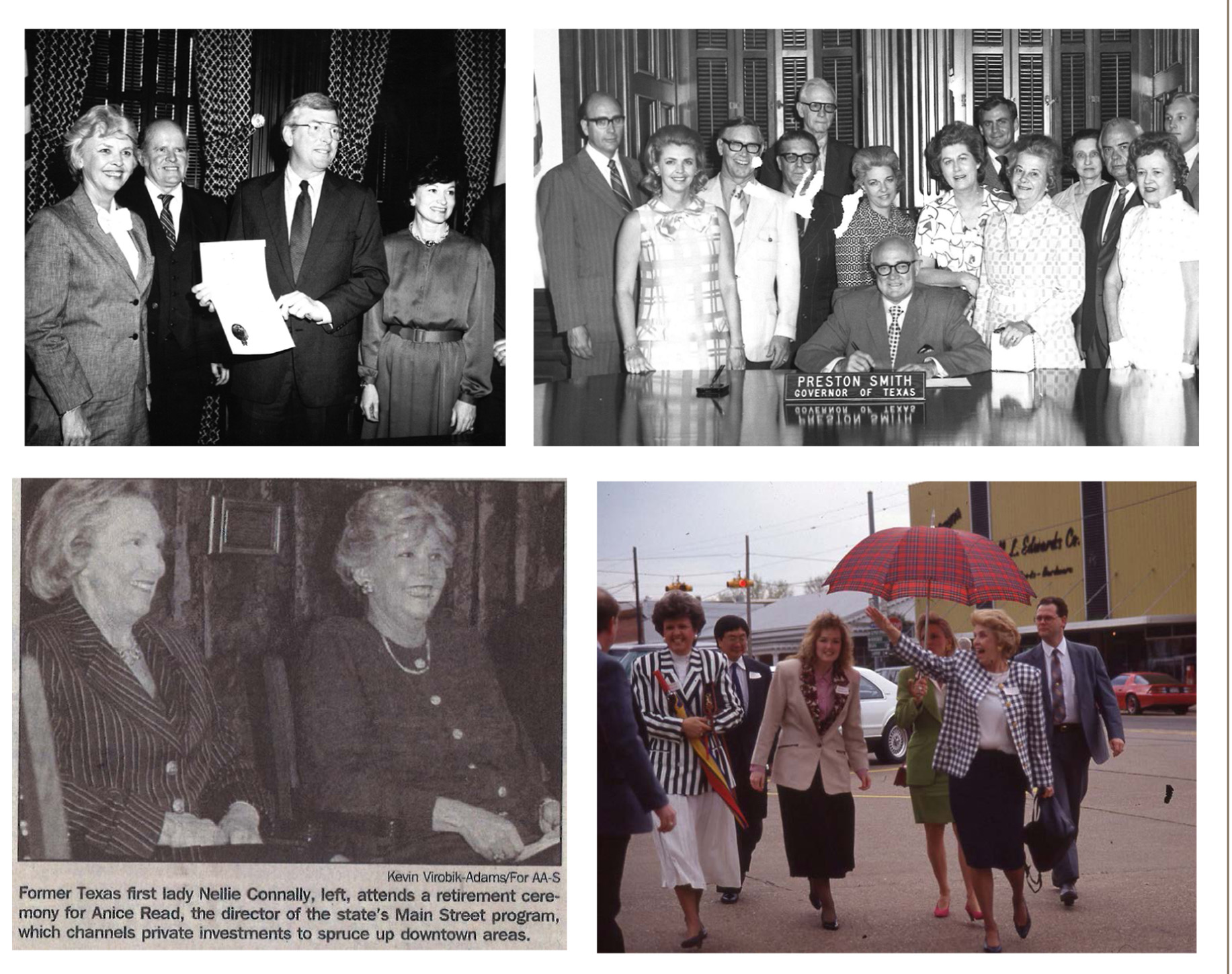
Anice Read took the Main Street message far and wide, from the governor’s office and the state Capitol to the heart of Texas communities. With Gov.and Mrs. Mark White (top left); Gov. Preston Smith (top right); First Lady Nellie Connally (bottom left); and with Jan Bullock (behind Anice), wife of Lt. Gov. Bob Bullock (bottom right), at the 1992 First Lady’s tour to Mount Vernon during the period when Ann Richards was governor of Texas.
Her success combined vision, industry, and an indomitable will. She had a way of firmly motivating while retaining grace. It was hard to tell her “no.” I still have a cartoon that she posted on our kitchen bulletin board of a small fish caught between the jaws of a large crane. The caption reads “Never, never give up.”
Anice’s stewardship of Main Street was a 24/7 mission. Her managers became a second family. I remember well those late night phone calls at home from members of her flock. They might include a young man who was discouraged after a setback from his city hall, or a young woman who was distressed about her personal life. She welcomed them all with calm, insightful advice, and sometimes a dose of tough love.
She took great pride in hearing from her alumni who had gone on to advancing opportunities, and were grateful for the life lessons they had learned.
Two recognitions were especially gratifying for her. The National Trust for Historic Preservation bestowed on her its most prestigious national honor, the Louise duPont Crowninshield Award, for her lifetime achievements in preservation. And when health problems sapped her boundless energy and forced her retirement, she was honored by a legion of Main Street managers, prominent state officials, and longtime friends at a special salute in the Senate chamber of the State Capitol in Austin. The program featured praise from Texas First Lady Laura Bush, former first Lady Nellie Connally, and Jan Bullock, wife of Lt. Governor Bob Bullock. That occasion culminated with the unveiling of a sign christening the Main Street headquarters west of the Capitol as the Anice Read Texas Main Street Center.
* Editor’s note: The Trust honored Anice with the Crowninshield award in 1998. The awards program began in 1960 when it honored the Mount Vernon Ladies Association for their efforts to restore George Washington’s estate. Anice was honored “for pioneering work in the development of the Texas Main Street Program that has contributed significantly to the advancement of the grassroots preservation movement in cities and towns across the state.”
Thoughts from a daughter’s perspective
Memories from Courtney Read Hoffman, Anice’s daughter. Courtney has had a wide-ranging career in public relations and Texas politics. Over the years, she has represented a variety of industries from insurance to medical transportation to IT procurement, and has walked the halls of the state Capitol on behalf of youth, education, the elderly, and rural Texas.
Mom was an early riser. Many a morning she was up and baking Main Street cakes at 4 a.m. to be on the road by 6 a.m. to whatever small town was awaiting her resource team for that day. She drove to every corner of the state, putting the pedal to the metal, and using her CB radio to talk to
truckers along the way who looked out for the Smokies ahead. While in those towns she patronized “her merchants,” and those purchases often showed up under the tree on Christmas morning. The question was not what is the gift, or who is it for, but which Main Street merchant benefitted from her visit?
She was an amazing “multi-tasker” even before the term was coined. Her bottom file drawer in her office at the beautiful Gethsemane Lutheran Church was filled, not with file folders, but a blanket and pillow. Grandchild #3 often took his afternoon nap on the altar of that church while she fielded calls from around the state or the Capitol building. She loved being a grandmother and always made time for her ‘grands.’
She was a leader, serving as elder and deacon at University Christian Church. But all at church knew when the Dallas Cowboys had a Sunday noon kickoff, she would be out of that pew, and headed for home as soon as the sermon concluded, to cheer on her boys in silver and blue. She loved the Dallas Cowboys, and as a devoted fan, had season tickets for home games. Juggling her Sunday Dallas games and Monday morning work was no big deal to Anice. She and Julian flew on Southwest Airlines to Love Field where there was no need to rent a car to get to the stadium. Our family never sold cars; they were scattered around the state at various airports. Anice always found a way to attend the game, and return to Austin before work the next morning. High energy kept her on the move at all times, and barriers were seen as opportunities for creativity.
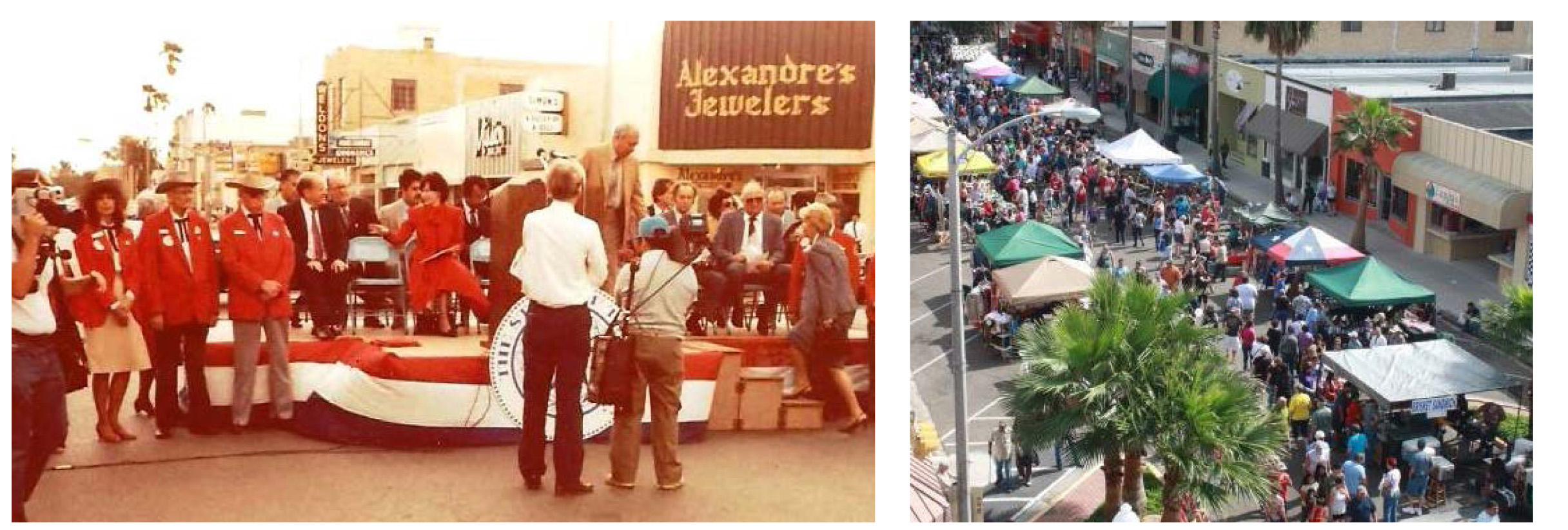
(Left) Anice comes onto the stage on Jackson Street to join then-First Lady Linda Gale White in Harlingen for the 1983 First Lady’s tour. (Right) A similar view of an active Jackson Street in Harlingen today, showing evidence of the strength of the Main Street effort that Anice initiated in Texas.
Always keen to the latest technology, she carried one of the first cell phones, about the size of a man’s shoe. And although computers were new to her generation, she embraced the software that allowed her to work electronically, while most others were still using paper and pen.
Most of all, she genuinely loved preservation, and the people she met while on the preservation journey. People fueled her, and she fueled people. It was a magical marriage at a critical time for Texas. What a legacy she left in the Texas Main Street Program. She is smiling as you celebrate 35 years!
Anice as Career Counselor
Memories from Terry Colley. Terry retired as Deputy Executive Director of the Texas Historical Commission in 2014.
For many of us, Anice was our first interview after graduating from college. Her office in December of 1983 was on the second floor of the Carrington Covert House, the main office of the Texas Historical Commission (THC). When my interview was over she said I could have a second interview in either San Marcos or Athens, and I chose San Marcos. I got the job there the following month and I’m sure her recommendation of me to the city manager carried the day.
I interviewed with her again in January of 1991, when I joined the staff of the Texas Main Street Program. Her office was then in the Gethsemane Lutheran Church, now the THC library. She knew I had been called to the ministry, and that I wanted to pursue that call at some point. Her advice, and I remember this like it was yesterday, was to “work at the THC for 20 years, complete your graduate work along the way, and then retire to
pursue fulltime ministry.” As it turns out she only missed it by about 3 years. I worked for the THC for 23 years, finished my masters and doctorate, retired, and am now in fulltime ministry.
When her health would no longer let her continue to serve as the Deputy Executive Director of the THC, she called me on the phone in my office one day. She didn’t say, “You might want to consider applying for my position.” No, she simply said “I’m recommending you for this job. You can do it.” I can honestly say that there were times when her confidence in me was the only thing that kept me going in that new position. She was a master at reading people, and she wasn’t afraid to pull them up the career ladder.
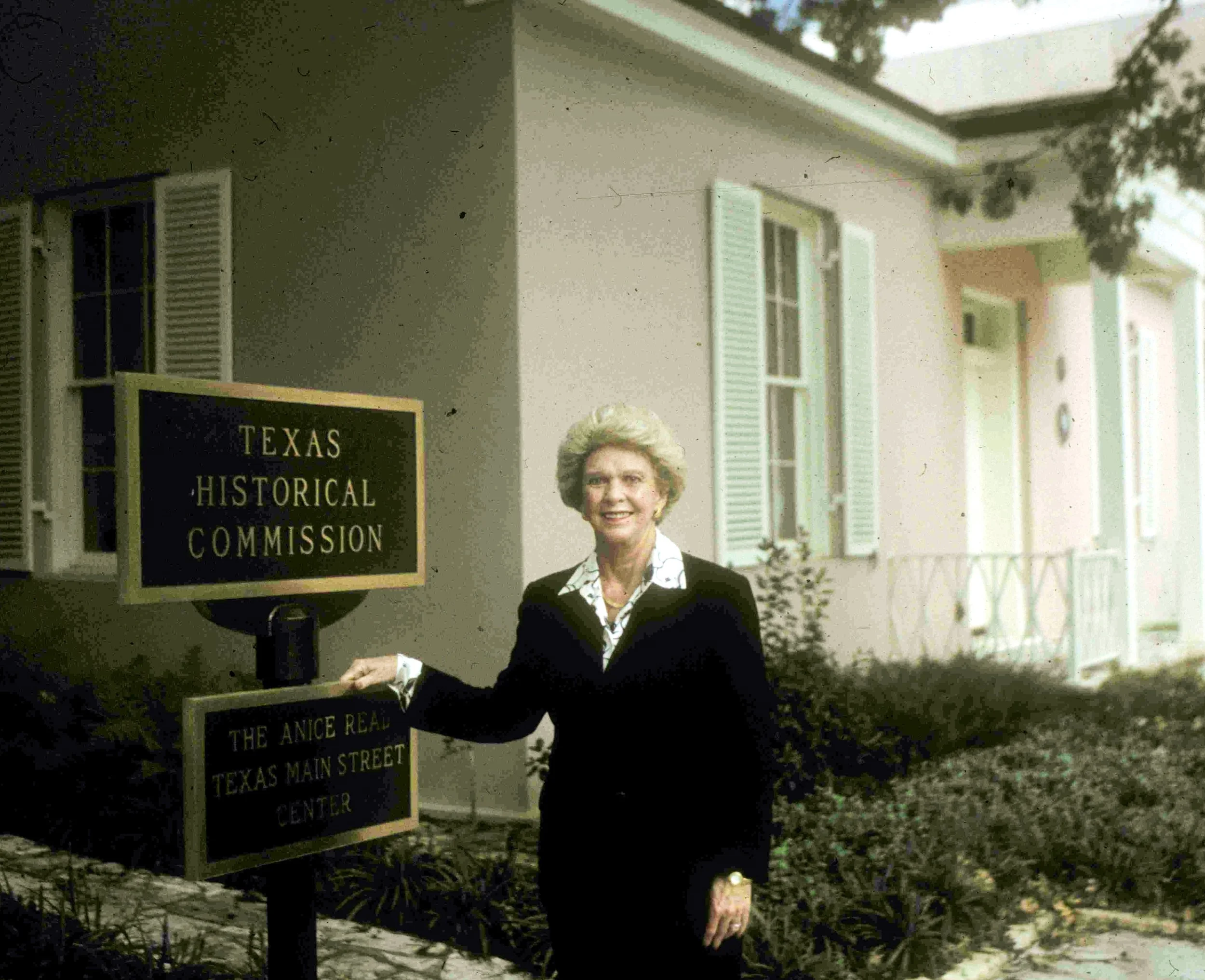
Texas Main Street is a part of the THC’s Community
Heritage Development Division. CHD’s offices,
which are at the edge of the state Capitol grounds
in downtown Austin, were named after Mrs. Read
in honor of her efforts.
Anice did that same thing for countless Texas Main Street Managers. She set us on a career trajectory that continues today, and will continue for many years. And although she is no longer with us, her wise advice and counsel still rings in our ears. Not because it was part of her job description, but because she cared about each of us as individuals, and wanted us to get off to a good start. All I can say is, “Thank you Anice.”
Kennedy Smith
Kennedy co-founded the CLUE Group (Community Land Use + Economics) in 2004. Before launching the CLUE Group, she served on the staff of the National Trust for Historic Preservation’s National Main Street Center for 19 years, the last 14 of them as the director of the national Main Street program. Kennedy will be the closing keynote speaker Nov. 10, 2016 at the Texas Downtown Association/Texas Main Street Conference in Killeen, Nov. 8-11, 2016.
I have LOTS of stories about Anice. But here’s one about her biggest influence on me:
I joined the staff of the National Main Street Center in 1985, after two years as the manager of a downtown revitalization program in Virginia. That fall, the center launched Main Street News, its longrunning national newsletter, and the center’s editor asked me to write an article about low-interest loan pools. She suggested that I call Anice, and interview her for the article, since some of the communities participating in the Texas Main Street Program had had good experiences with them. I had not yet met Anice. I called her and told her I’d been asked to write an article about low-interest loan pools, but that I didn’t know much about them. Her advice? “Well, just make it up, girl!” She didn’t mean that I should pretend to know about something I didn’t know about, she meant that I should create a body of knowledge about it, and that I should be bold and decisive about it. I suddenly realized how new the profession of downtown revitalization was, and how much there was to explore and to create.
Tony Rutigliano
Tony is the President and Chief Executive Officer of the Downtown Arlington Management Corporation. He is the 2016 President of the Texas Downtown Association which was created by Anice in 1985. Main Street and TDA have co-sponsored the annual statewide downtown revitalization conference for 30 years. More information on this year’s conference can be found at http://www.texasdowntown.org/revitalizationconference.html.
Anice was a tireless champion of everything that makes our Texas cities so great; history, culture, pride, and people! Without her passion and perseverance, our downtowns and Main Streets would not be where they are today.
Janie Headrick
Janie started at the THC in December 1985 as an administrative assistant, became a training specialist, and then program specialist with the Texas Main Street Program. In April 2000, she became the state coordinator for the Texas Heritage Trails Program, another program of the THC. Before retiring in 2009, Janie also served as special projects coordinator for THC’s Administration Division.
Anice was one of the most determined women I had ever met. Her life-long love of Texas and historic preservation served her well. After successfully receiving the National Trust for Historic Preservation’s designation to be part of the charter downtown revitalization program, she set about developing one of the most successful programs in the United States.
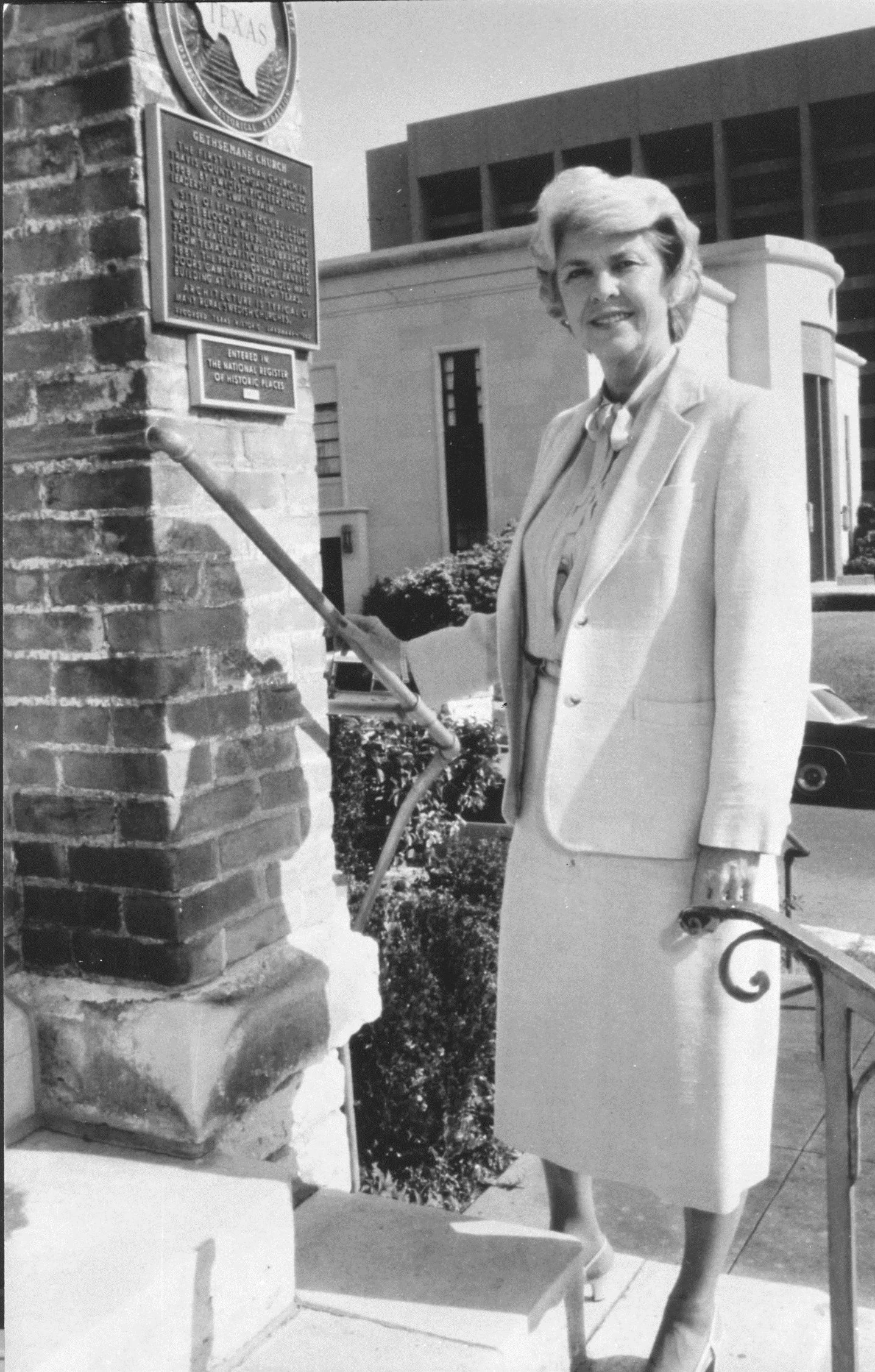
One of the early offices of the Texas Main Street Program was in the 1882 Gethsemane Lutheran Church, which is now home to the Friends of the
Texas Historical Commission and the THC library.
Her leadership skills led to the successful development of partnerships in the private sector, non-profit arena, and in government. She developed relationships with mall management companies, real estate development companies, architectural and landscape firms, as well as consultants from various service industries to aid in the professional development of the Main Street managers. These folks also served as members of the resource teams that evaluated the Main Street cities. One of the things that Anice was most proud of was the professional development of hundreds of women and men who served—and some still serve—as Main Street managers. Anice provided Texas communities, large and small, new hope that their cities could create a “can do” self-help program that would economically revitalize their cities and create long-lasting community pride.
Her legacy lives on in communities across the state. I live in one of the many successful cities—Georgetown. Many times when I’m downtown in the evening, during the week or on weekends, and there’s no place to park, and people are everywhere, I think about how proud Anice would
be of our community, and the people here who have and continue to work so hard for historic preservation and economic vitality.
Scott Byler
Scott was the original Main Street manager in La Grange when the community entered the program in 1996. Today, he is La Grange’s economic development director. This year is La Grange Main Street’s 20th anniversary.
My memories of Anice Read have been of vision, leadership, commitment, challenges, joy, inspiration, achievement, optimism, respect, creativity, and a positive cando attitude with failure never being an option to name a few. There are not enough complimentary adjectives that I can use to describe this fine lady for what she meant to me personally, to the Texas Main Street Program, and the influential legacy she left behind through the state of Texas in contributing to downtown historic preservation, architecture, and the vibrant business climate in our Texas towns. The Texas Main
Street Program was in her heart and her soul. Anice never knew a stranger. She had a gift for making you feel comfortable around her as though
you had known her your entire life. She was the type of person that if she were in a room full of strangers at a meeting, chances were excellent that
by the end of that meeting, she would know them all, and know something about each and every one of them. She was a cherished Texas Treasure, and truly one of a kind.
I had the pleasure of meeting Anice Read for the first time in 1996, when the city of La Grange was selected as a newly designated Texas Main
Street city into the Texas Main Street Program, and I became the Manager for the La Grange Main Street Program. Little did I know at that time
what was in store for me, and the life lessons that I would learn from Anice as an individual, and a professional that still serve me well to this day. She was always energizing at the Texas Main Street Manager trainings, and you always came away with a sense of renewed spirit and motivation.
I recall in memory from one of the trainings that she said to me, “To be an effective Main Street manager, always work to be a positive influence
whenever and wherever you can, and concentrate only on the things that are within your control as a manager to the best of your abilities. If can do this consistently you will find, as a manager, that everything else associated with your duties will fall into place, and whatever issues you are having to deal with tend to in time take of themselves with an improved outcome.” I took this to heart and have never forgotten this message. I still to this day try and use this message in everything that I strive to do professionally in my career and life in general.
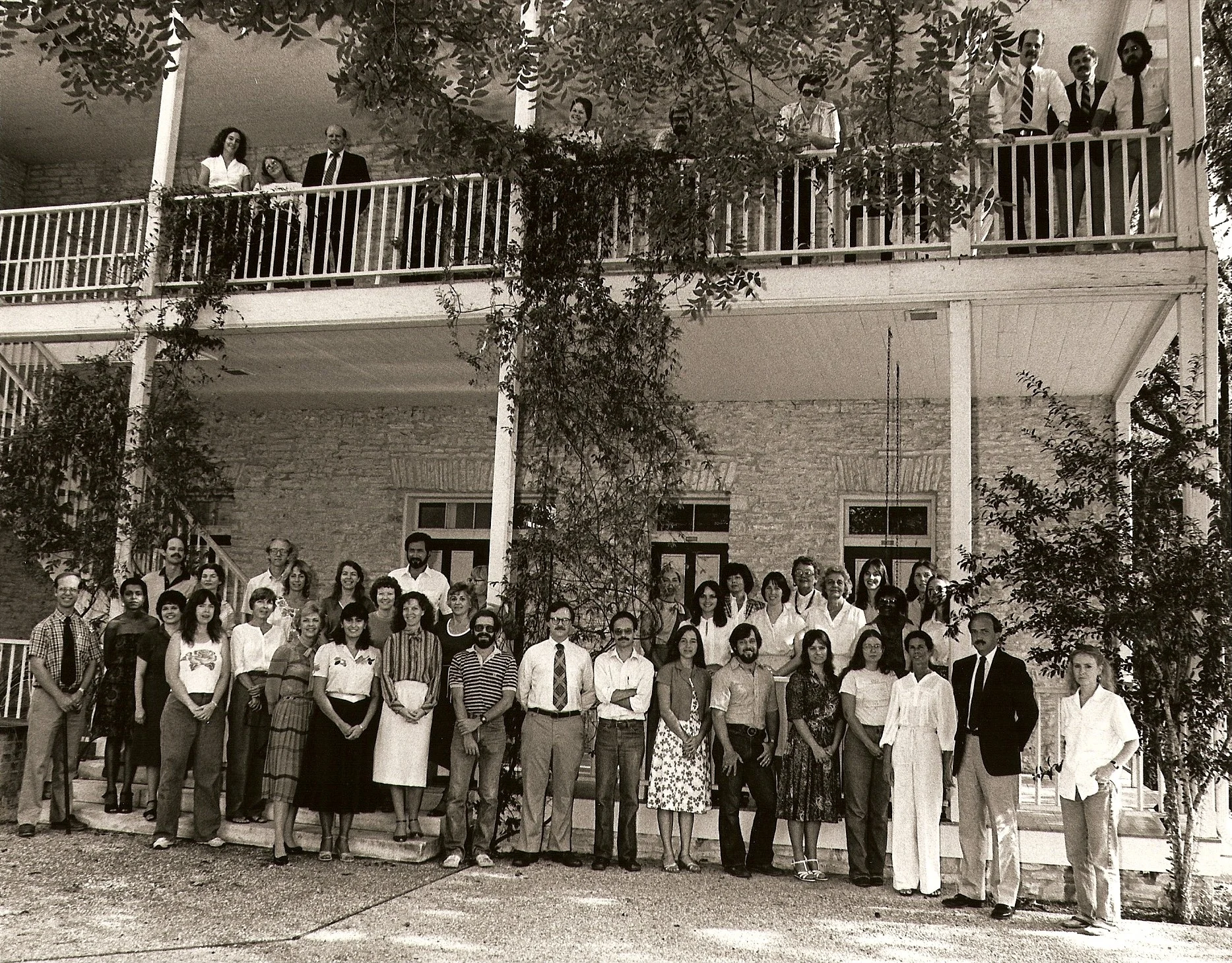
Staff members of the THC pose on the building’s back porch. Anice is sixth from the left, front row.
I would like to sincerely say that when I first met Anice Read, I was at a crossroads, and in need of positive reinforcement not only in my career,
but also with my life in general. Her inspiration filled that void for me, and her positive influence played a huge part in assisting me with redefining my career and certain aspects of my life during this timeperiod. For this, I will always be extremely grateful. We all have known or will know certain people that come through our lives and truly make an impact or difference. Anice Read was one of those people for me, and as I am sure for countless others who had the pleasure of meeting her. Whether it was by my good fortune or my destiny to cross paths with Anice Read I am not sure. But one thing I am absolutely sure of is this: I was lucky enough to have known her.
Kay Harvey Mosley
Kay was employed at the Texas Historical Commission for many years in a variety of capacities—both on the Texas Main Street staff as interior design specialist and as state coordinator. She was also the division director for the THC’s Community Heritage Development Division.
Anice brought people together to collaborate on how to turn dying downtowns around. She was enthusiastic about her mission and inspired folks around her, including mayors, bankers, merchants, Main Street managers, and staff.
Mary Alice Torres-MacDonald
Mary Alice was on the Texas Main Street design staff, and also served as state coordinator. Additionally, she was the division director for
the THC’s Community Heritage Development Division. Currently, she is an associate professor in Texas Tech’s College of Architecture.
It’s hard to put into words what an impression Anice made on my early career. To walk in fresh from undergraduate school, and have her give me her complete confidence was at the very least, inspirational and motivational to a young professional right out of architecture school. She was
my first example of the power of a woman in the workplace, and while we may not have seen eye-to-eye on how this was approached, she inspired me to be stronger in my work and to learn to blend in with a professional world predominantly led by men.
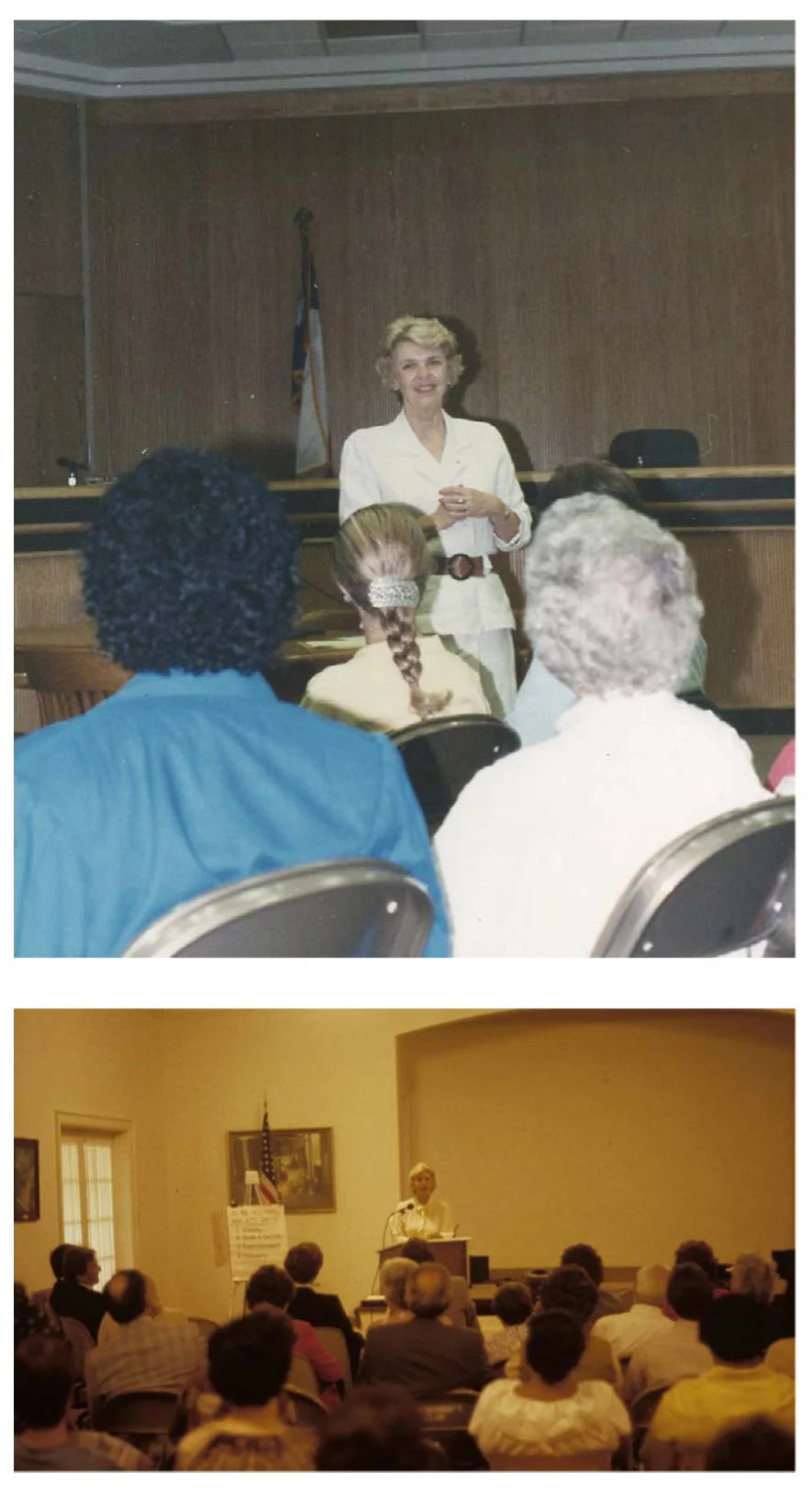
(Top) One of Anice’s greatest joys was talking to people about Main Street, whether that was through training managers or speaking at public meetings, like this one (bottom) in 1982 at the Marshall Main Street resource team site visit.
There were three work/life skills Anice taught me as a young professional that have been invaluable to me in my life as a community designer, leader, volunteer, mother, and teacher:
- Know what you know and know what you don’t know (i.e. never pretend you know something you don’t.) But just as important—know who to go to to learn what you don’t know—so you can deliver on the message, “I don’t have an answer for you, but I will find out and get back to you right away”...and then deliver on that!
- Network, network, network! Knowing people who can help you solve problems will give back to you over a lifetime. So far, it has held true. As a young professional woman, she painted a picture of what the workforce was like at that time for a woman, and how much harder I would have to work to prove I knew what I was doing, and could do it well. None of it would be possible without a network of great people that have helped guide me, open doors for me, and allow me to do so in return.
- Communication. Be clear about your message. Work to be understood. And, be open to accepting that the bigger picture cannot always been seen from every viewpoint. Helping the team reach its goals means you need to get along and go along. You may not always agree, but don’t kill progress because it isn’t being done your way. The bigger picture can be reached in many different ways.
I was fortunate enough to be young and new to the field when I began working for Anice. I was blown away by the force of her presence. She demanded respect, but she also allowed me to call her on the things when I didn’t agree with her (even if I didn’t always convince her!). Thank you, Anice, for being my boss at “just the right time.”
Kent Collins
Kent was the Hillsboro Main Street Manager from 1982-84; and the Dallas City Center Urban Main Street Manager from 1993-95. Today, he is principal of Austin based Centro Development LLC.
I first met Anice Read in 1974, when I was going out with her younger daughter Ellen, so I knew her personally before I knew her professionally. She was fun, and dinner table conversation at the Read home was lively. I think I first knew that Anice was an independent thinker because sometimes she left the dishes to be dealt with the next morning.
Fast forward to early 1982. I had graduated with a bachelor’s degree in architecture from UT –Austin in December 1981, and had gone to Boston to seek a position in architecture. There was a pretty severe recession at that time nationally, and I didn’t get a job in Boston. When I returned home I learned about the Texas Main Street Program, and that Anice was the executive director. I had grown up with parents who were both from small
Central Texas communities, one of which had ceased to exist by 1981; after reading about the goals and objectives of Main Street, I knew it was a program that had great possibilities for Texas’ small towns. Anice told me that by early 1982, there were only two towns that needed managers: Seguin and Hillsboro. Both had been 1981 Texas Main Street towns, the first year the program began in Texas. Both had directors who were
leaving. Anice said that I should go interview in each town. I first went to Seguin, but the folks there made the decision to hire someone who
lived in the community. Next I went to Hillsboro, where the Main Street manager, Paula Peters, was leaving to go to work in Austin for the THC.
Paula was a Main Street star and one of Anice’s favorite protégés. I could tell that it would be a hard job to follow in Paula’s footsteps. I think
the folks in Hillsboro grudgingly hired me, so I set out to continue what Paula had started there.
Anice became a valued mentor; there were few weeks when I didn’t call for advice or strategy from her. Weekly updates (faxed because this
was pre-email) to all the managers kept us on our toes, congratulating our peer managers, and keeping up a healthy competition between us, while
filtering ideas and concepts about downtown revitalization from many sources. Anice had realized early in the program that Texas was different from some of the other states, and that its program had to work differently. As an example, the National Main Street Center had come out strongly against Wal-Marts in small towns. Anice was pragmatic enough to realize that Texas towns would have to learn to live with Wal-Mart, and focus downtowns on a different kind of retail, and other service and employment in Texas downtowns. I think that is one reason that Texas’ Main Street has been so successful.
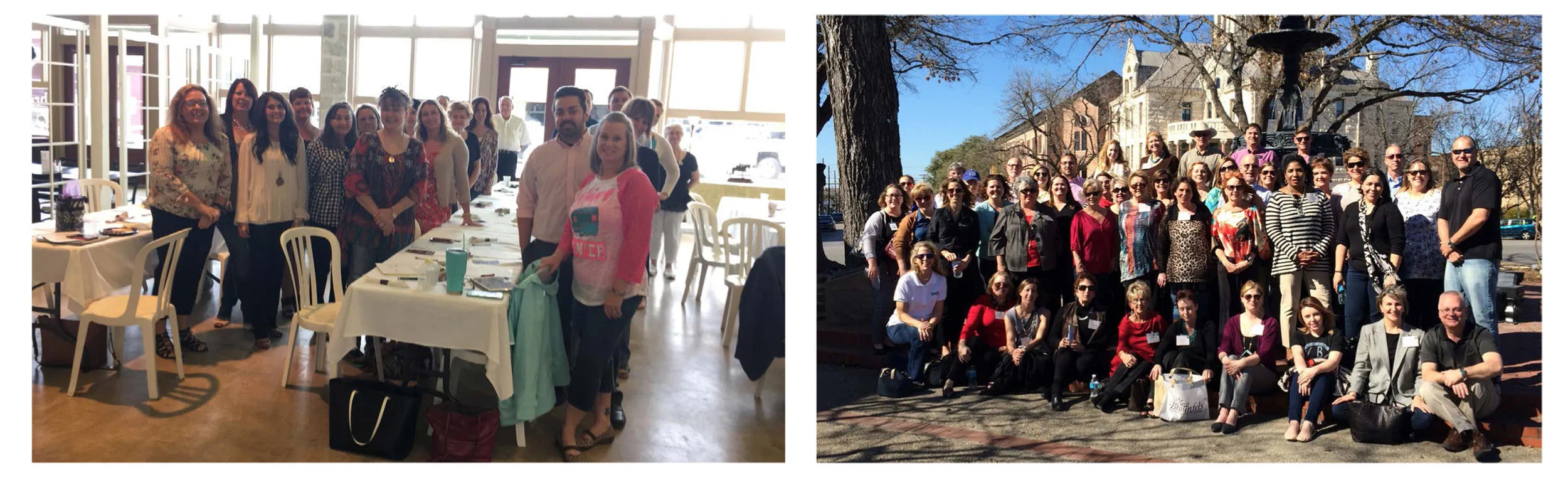
Anice’s legacy lives on today through the many people who are active in their Main Street programs all across Texas. Last month, the Bridgeport, Decatur, and Bowie Main Street programs came together for a regional workshop (left), and Main Street managers and volunteers still come together several times each year to share and collaborate, as they did in February in New Braunfels (right), a 25-year Main Street community.
The training sessions for managers took place in Austin, and Anice brought in existing and former managers to help train new ones. She held quarterly Main Street retreats in other Main Street towns all over the state, which we all eagerly looked forward to attending. Anice taught us how to count our votes at council meetings and to “sell ice to eskimos.” At the National Main Street conferences, the Texas folks seemed to us, to be
better, faster, taller, and could also tell taller tales, all due to Anice’s leadership and moxie. She was also legendary for her Main Street
chocolate sheet cake. I was always amazed at how a cake my mom had made all my life had been elevated to mythic status as Anice Read’s
Main Street cake!
Anice Read taught me that the most noble goal in life was to care about something bigger than ourselves. Money and power were not any more important than saving our small town downtowns that were the places our parents, grandparents, and families had come from. They deserved to thrive and continue. Sometime after I left Main Street, (I was even a second-time Main Street manager in downtown Dallas after receiving my MBA and working for Disney), I would have doubts and think how I would have laid a better foundation in business if I had stayed in larger cities working
for larger companies. Then I would realize that the things Anice Read, Main Street, and my parents taught me is that some things are worth
fighting for sometimes the passion that comes from having a position of leadership in a small town early in one’s career, and realizing that
people are depending on me to make change was vastly more important in my career and life. I still miss calling Anice up and asking her opinion on a problem or approach.
Mary Helen (Alexander) Barrick
Mary Helen first met Anice when she interviewed for the Main Street position in Cuero, which came into the program in 1985. Twenty years
later, in late 2014, Mary Helen reentered the Main Street network as director of the Victoria Main Street Program.
The Texas Main Street Program was fairly new. I remember that when I applied for the job, I was asked to meet with Anice prior to my interview with the City of Cuero. I was more nervous about meeting her than I was about the possible interview with the city. I guess you could say that it was an unofficial interview. I ended up meeting at her house while she was working in her yard. She told me at that time that this was her therapy, working in the yard. Very informal, but very informative. Her passion was evident. To this day, every time I am gardening or working outside, I still think of Anice. When I had the opportunity to come back into the Texas Main Street Program my thoughts went to Anice. Two things she would say that have stayed with me, not just in my job with the Main Street Program, but in life. The difficult we do right away, the impossible takes a little longer. She would have loved social media due to the fact that “if you don’t have a picture it didn’t happen.” Anice, it is definitely happening!
Sallie Andrews
Since 1991, Sallie has worked in a variety of preservation and tourismrelated positions in Grapevine, which has participated in Main Street since 1984.
I met Anice Read in 1997 when I went to Austin for my Main Street training. She and Terry Colley taught our class, and I remember her telling us that we needed to always look professional – even in our off hours. She said if you run to the grocery store looking badly, you will run into some of your constituents and you will be sorry! In class she and Terry were very strict - and I thought to myself - do they think we are kids? Ha ha—we were! And the things they taught us have stuck with me ever since. It is a good thing to be a professional person in all areas of your life! When you are a public servant, there are no real “off hours.”
She told us about her Main Street cake, how it sweetened the deal and saved the day—and now, in Decatur where I live, I am known as “the cupcake lady” to my county commissioner. I don’t use Anice’s recipe, but I do use her idea about thanking and encouraging people with something sweet and delicious. Anice Read was a true Texas treasure, and the impact she made on cities AND lives is immeasurable! I am grateful she was a part of mine!
Betty Voights
Betty is currently executive director of the Capitol Area Council of Governments that serves 10 counties in Central Texas. She was involved in hiring the manager in Harlingen when that city first came into the Texas Main Street network in 1983.
I interacted with Anice circa 1983-85. One memory stands out because I was surprised at the time—after Harlingen was selected as a Texas Main Street community, I was very busy trying to write a job description with no idea what it needed to say, so I called her. Well, no need to worry about that because she had a pool of candidates ready to go and would send me information on a couple she thought would fit what we needed. We hired one of them and never since has it been so easy to find someone for a position! My enthusiasm for downtown and Main Street came from my relationship with Anice. Though I was not the Main Street manager, I went on to develop a small business loan program for downtown, and spent a lot of time coaching would-be Main Street merchants; so much that Anice asked me to teach a session at one of our workshops for the managers on small business financing.
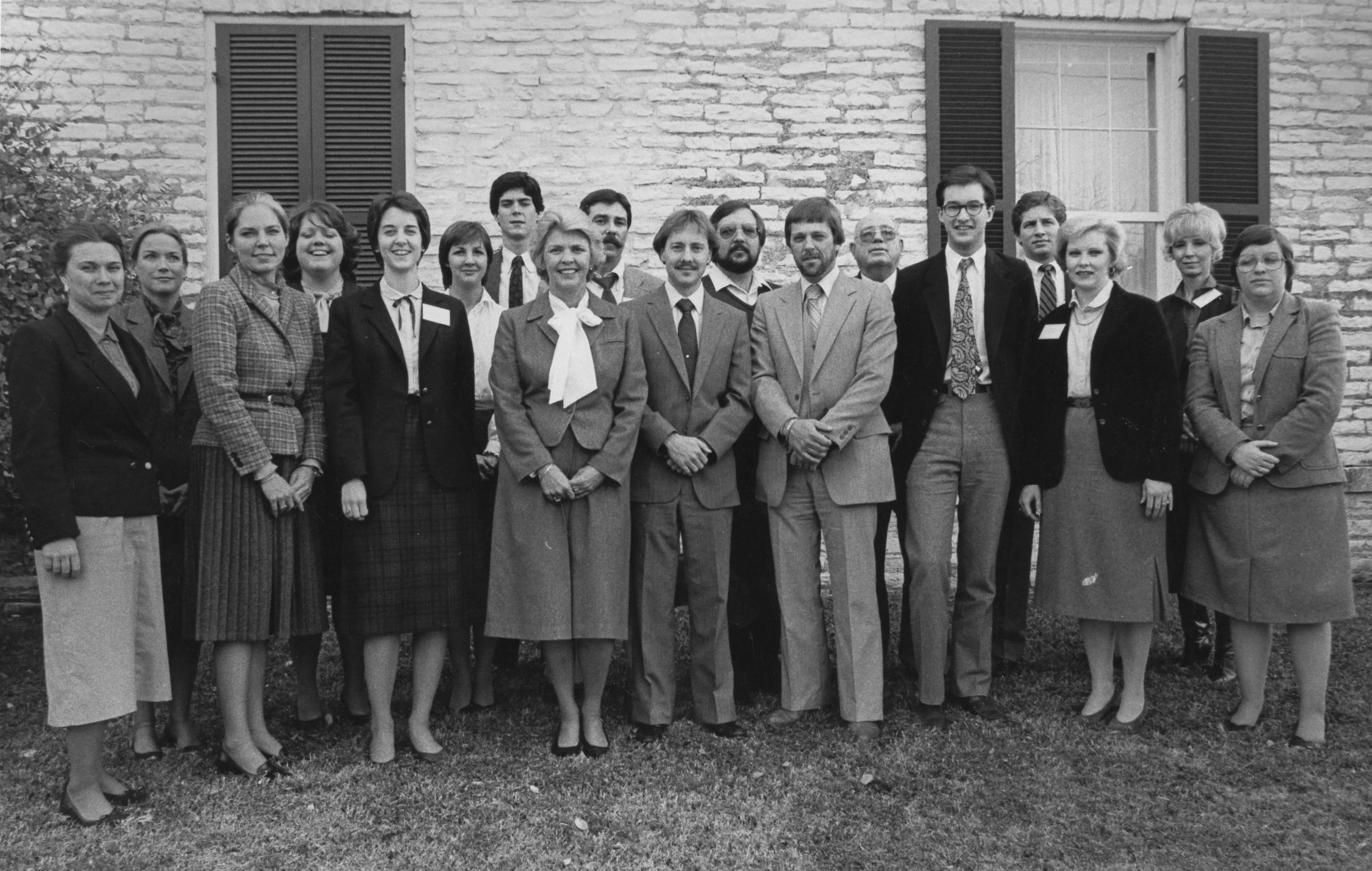
Some of the first Main Street managers in Texas pose at the THC’s executive offices which are housed in the historic Carrington-Covert House near the state Capitol. Anice is at center.
Susie Clinard
Susie was recruited by Anice in 1983 for the Georgetown Main Street position. Later, she went on to start the Oklahoma Main Street Program. After 10 years, Susie moved to Savannah, GA to work at the Savannah College of Art and Design (SCAD) as Dean of Special Programs and then as vice president of Human Resources. Retiring at 60, she spent the past decade continuing to volunteer is positions such as president of Historic Savannah Foundation while in Savannah, and now secretary of the Historic Shawnee Alliance.
In a crowd of 2,000 attendees at the National Trust Conference opening night reception in San Antonio in 1983, I had my first encounter with Anice Read. Bill Murtaugh, keeper of the National Register, was asking me what I planned to do now that I had my historic preservation degree from SCAD. As we were talking, he spotted Anice and introduced us. After a moment she tells me, “Be at the Menger Hotel tomorrow at 2 p.m. for an interview.” That interview was followed by a return trip to Texas the following month for Main Street interviews in McKinney, Paris, and Georgetown. By the end of December, I had moved to Georgetown, and my education in Main Street began.
Anice had high expectations. New manager training, quarterly trainings, telephone calls, and visits by Anice to Georgetown, were better than
any master’s program. She was a mentor to all of us. We learned how to work with politicians both locally and in the legislature. There’s the famous chocolate cake of course. I adopted her First Lady Tour once I moved to Oklahoma to start the Oklahoma Main Street Program (OMSP). The Oklahoma annual awards banquet was another way to keep the legislators involved. It informed about the towns, and continues today. I’ll never forget noticing that Anice kept thank you notes in her purse. As soon as she had met with someone, she was writing a personal note to that person. I guess the big lesson there was: engage, keep them informed, and don’t forget to thank them. It is good advice in any personal or professional experience. Anice’s quarterly trainings were legendary – packed full of helpful information presented by some of the best in the state of Texas.
Marketing stands out as a major theme throughout the trainings. We all learned how to tell our story not only to the legislators and city council, but to the media as well.
The Oklahoma Main Street Program was modeled after the Texas Main Street Program. Without Anice’s training and mentoring, I don’t think the
OMSP would have been as successful as it is today. In those early years, I was always remembering how Anice did it, or “what would Anice do,” which helped me lay the groundwork for a program that just celebrated its 30th anniversary. No doubt many others can trace their success to
lessons learned from Anice.
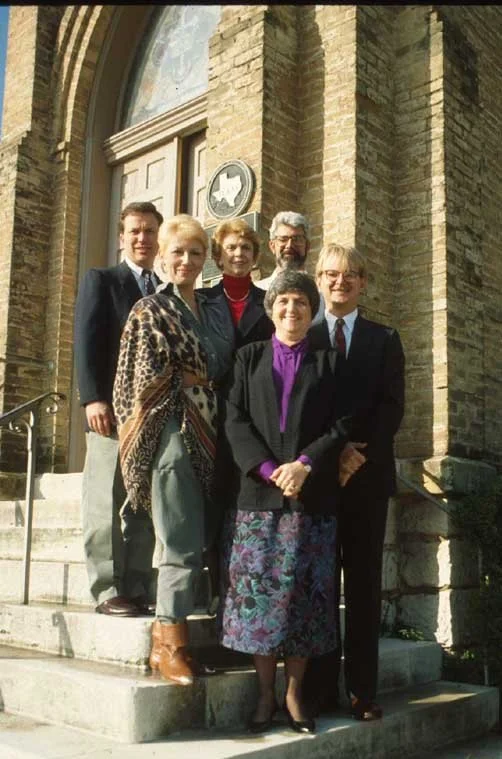
TMSP staff members from the early 1990s, including (from top) Terry Colley, Kay Howard, Anice Read, Dick Ryan, Vince Hauser, and Janie Headrick.
Adah Leah Wolf
Main Street Manager, Farmersville
Anice Read had a significant impact on my life—she is clearly why I have been a Main Street manager for the last 13 years! When I first moved to Texas in the mid 1980s, I was working at the Sam Rayburn House Museum in Bonham, which was a THC – operated facility. I was lucky enough to join a team of THC staff as we traveled throughout the state giving preservation workshops. My portion of the program was about museums. As
we did these workshops, I heard her presentation about Main Street many times! It was always fun and inspiring to hear, and I never tired of it. The best piece of advice I received was “the meeting’s not over until it’s over,” emphasizing how important it is to stay to the end of the gathering, as that’s often when important comments (and maybe decisions) are made.
Amy Miller
Amy became the Elgin Main Street manager in 1996. She continues in that position today, along with serving as the city’s Community Development Director.
I interviewed with Anice on a Saturday for the Main Street manager position in Elgin. She impressed me greatly with her dedication and drive related to this thing called Main Street and what a difference it could make in a community. I took to heart many “Anicisms,” including to keep a jacket and a spare pair of pantyhose in your office; that photos speak more than words in some cases; and that it’s important to get out of town periodically. She worked so hard; it seemed automatic to work hard here in our little town. Her persistence and pragmatism were
contagious. I guess since she never gave up on this amazing cause, I didn’t want to ever give up either. Anice was someone who inspired you to try – try and make a difference, and see who would try to make a difference with you. She and Main Street are truly grass roots. I love working for the
community through Main Street and I know that thanks to Anice, I found the best work and the best place that I could be.
Thom Guzman
Iowa Downtown Resource Center, retired.
I had the pleasure of meeting Anice very early in my Main Street Career. In 1985, I was a brand new Main Street program manager in Grass Valley, CA, when I attended my very first National Main Street Center sponsored conference on the Main Street Four Point Approach. One of the
training faculty was this smart and out spoken Texan by the name of Anice Read. Anice taught me the skill of managing up and the magic of making connections, two very important skills that I used extensively during my 30 plus years in Main Street, both at the local and state level. Thanks to the
inspiration from people like Anice, I found a life long home in Main Street. I am forever grateful to her for willingness to share some of her secrets of success with me as I was entering Main Street.