
ONCE UPON A TIME BEFORE THERE WERE CARS:
A Guide to Walking Tours
April 2014 Main Street Matters
Article written by Howard Langner, Architect
The best way to get people to experience the historic architecture in your Main Street city is to get them out of their automobiles and onto the sidewalks. You can accomplish this by providing a great walking tour.
What constitutes a great Main Street walking tour? In a word: planning. Every great walking tour starts with a map. Locate every historic building, business, public artwork, and residence in the Main Street District on your map and you’re off to a terrific start.
After all of the sites have been located and inventoried, the tour must develop around a theme. Some ideas for themes include architectural styles, building maintenance, narrative history (who, what, when, and where) associated with the buildings, or the urban growth pattern of the city as it developed around a courthouse, railroad, or highway and how these growth patterns shaped the physical form of the city. Whatever the theme, it must be of interest to your visitors. You must ask yourself if the people on the tour want to learn the information you have to offer and, furthermore, if you can successfully market the tour.
When the theme has jelled, it’s time to cull out the specific stops on the tour. Time limits are one factor in deciding what is addressed on the tour and how long to spend at a particular location. A rule of thumb for walking tours especially in hot/cold/rarely in-between Texas is one hour; longer than that and you are going to end up with worn out and cranky people. The other thing to be aware of is the number of stops you take. Ten stops in the hour is probably the limit; more than that and you are overwhelming the visitor with information.
Once you have narrowed down your destinations, you need to figure out the best way to get from one place to the next. Consider where the tour should logically start and end. Investigate any potential safety issues along the proposed route such as wide street crossings or areas deplete of safe sidewalks. When people are at a stop on the tour are they able to sit or stand in shade on a hot day? Are there potential problems with property owners at the stops? Does traffic noise prohibit your tour members from hearing the guide speak?
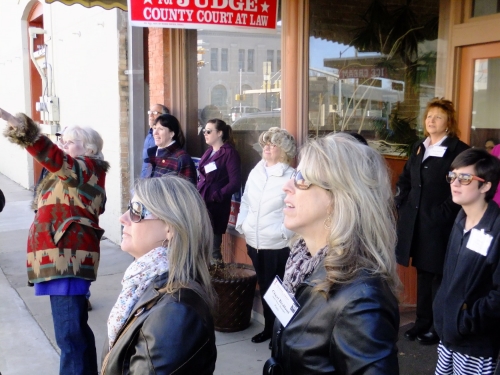
Just to recap for a moment; you have a theme, you have stops, and you have a path. What else do you need to make your Main Street walking tour a success? You need to define exactly what you want your participants to learn as a result of taking the tour. You need to define the tour’s objectives. Certainly, upon completion of a Main Street walking tour you will want participants to be able to describe some of the more important architectural styles in the downtown. You will want people to have some understanding of how the town developed over time and who was responsible for its development. You will want to convey the history of commerce in your town and how it affected the current appearance of the town. Finally, you might even want to point out things in town that have had a negative effect on the town and allow participants to consider or discuss possible ways to correct those issues.
One way to keep a sense of flow and cohesion with your tour is to think of it as a form of storytelling. A good story has a distinct beginning, middle, and end. A good story also has interesting characters and action. So too does a good walking tour and just as every good story is geared towards a specific audience, the Main Street walking tour should be carefully crafted with a specific audience in mind. Renowned heritage interpretation authority John A. Veverka has determined that a walking tour audience will fall into one of the following categories:
- Local residents who have lived in the community a long time (and who may have history to share in the form of memories or artifacts/photographs)
- Local residents who are new to the community but are anxious to immerse themselves in the history of their new home
- Local school groups who may be required to take the tour as part of their studies (this can be a particularly difficult tour if themes and objectives haven’t been very carefully outlined)
- Tourists from Texas who have a general knowledge of their State’s history but are interested in focusing in on the particular’s your city has to offer
- Tourists from outside of Texas who are seeking a broader knowledge with the occasional foray into the details a particular place offers
- Families comprised of all age groups that likely require differing themes and objectives all within the same tour (this has to be the most difficult tour to provide)
- Architects/historians/preservationists who will require very specific themes and objectives clearly defined well in advance of the tour.
The last point to cover in our discussion of walking tours is the form that the walking tour will take. While this article was put together with a real-person tour guide in mind, the information similarly applies to self guided walking tours as well. Some further thoughts from John A. Veverka:
-The self-guided tour booklet can be an effective tool. It can be obtained at a variety of suitable locations such as convention and visitors bureaus, chambers of commerce, local museums, shops, and government buildings. It can be made to be graphically appealing with maps, photographs and brief written narratives about important sites, and it can be kept as a memento to be revisited by the participant at a later date.
- The interpretive panel/wayfinding type walking tour requires more financial investment (the cost of the signs and likely some amount of site development at each sign location) but under the right circumstances, this approach can result in a highly effective walking tour. One example that comes to mind would be a former industrial site that has been transformed into an open air museum; different steps in a manufacturing process might be highlighted with photographs, diagrams, and narrative in a well crafted and visually appealing interpretive panel. Veverka points out that a self guiding booklet or at the very least a map is still usually required for this approach.
- The last type of tour we’ll discuss is the electronics-based tour. Not too long ago, this meant tape recorders (Walkmans), followed by compact discs (CD’s), finally leading up to today’s cell phone and QR code technology. It is safe to say that this approach, if done well can be quite expensive but the results can easily be worth the investment.
Clearly, we have only scratched the surface in this discussion of walking tours. There are so many other considerations such as establishing and providing a budget, determining if tour items are offered for sale and if so how the accounting would be handled, how many visitors are honestly projected to partake of the tours, how the tours will be marketed and promoted, who is the point of contact for tour information and scheduling, and finally, what is the expected rate of return on the tour investment? Is the tour going to have a noticeable impact upon the local businesses particularly the cafes, bakeries, markets, and restaurants?
Finally, realize that walking does more than expose people to the unique architecture and history of your Main Street city; it consumes calories, builds appetites, and gives residents and visitors a reason to linger. Lingering, of course, is what Main Street is all about.
Bibliography/references:
The work of John A. Veverka, Interpretive Planner
Portland Walking Tours, David Schargel Blog
The Cupcake Tour of New York