
When cleaning brick it is important to use the gentlest means possible. Plain water with a soft bristle brush is a first step. If that is not sufficient then power washing with a mild detergent or chemical cleaning can be considered. Power washing should not exceed 300 PSI (pounds per square inch) because higher pressure could damage the hard exterior of the brick. If the hard exterior surface is damaged, the softer interior of the brick is left exposed and vulnerable to deterioration. The following resources provide guidance and techniques on brick maintenance.
National Park Service
- Preservation Brief #1 - Assessing, Cleaning, and Water Repellent Treatments for Historic Masonry Buildings - http://www.nps.gov/tps/how-to-preserve/briefs/1-cleaning-water-repellent.htm
U.S. General Services Administration
General Cleaning of Exterior Brick Masonry - http://www.gsa.gov/portal/content/112842
Removing Biological Growth from Exterior Masonry and Stucco - http://www.gsa.gov/portal/content/111774
Other Resources - http://www.gsa.gov/portal/hp/hpc/category/100371/hostUri/portal#Masonry
Uh-Oh, Cracks in the Wall!
August 2013 Main Street Matters
Article written by Howard Langner, Main Street Architect
While this Main Street Matters design article will make you aware of some basic issues related to masonry cracking, it is not intended to make you an expert in analyzing and prescribing structural design solutions. The Texas Main Street design staff, even with years of experience in dealing with masonry problems in Main Street buildings, will almost always recommend the services of a licensed structural engineer when a masonry cracking issue is encountered.
Simply stated, cracks in a masonry wall indicate movement. This movement may be “skin deep” meaning it is not caused by significant structural problems, or it may be quite serious, indicating a severe structural failure is imminent. Let’s have a look at three common Main Street crack types and their likely causes:
1. Stepped Cracking above Upper Floor Windows
Stepped pattern cracking rising from upper corners of window opening
This is probably the most frequently encountered type of cracking on a Main Street site visit. This situation usually indicates a structural weakness occurring in the span at the top of the window opening. As the weight of the masonry above the opening bears down vertically (as a result of gravity) the window opening must be designed to support the masonry and resist downward bowing or collapse.
Weight of wall above window opening is being “pulled” by gravity.
If the Structural element spanning the opening is faulty or inadequate, the masonry above the opening will begin the process of downward movement by cracking at the mortar joints.
Possible Resolution: A structural engineer should be contacted. It may be that the movement is no longer active and the cracking has therefore become benign, but it is much more likely that the cracking is just the first step in a process that will lead to partial wall collapse. It may also be that the horizontal structural element above the window opening, known as the lintel, may need to be replaced and all of the masonry in the affected area will need to be rebuilt.
2. Vertical Cracking on the Side Wall near the Front Facade
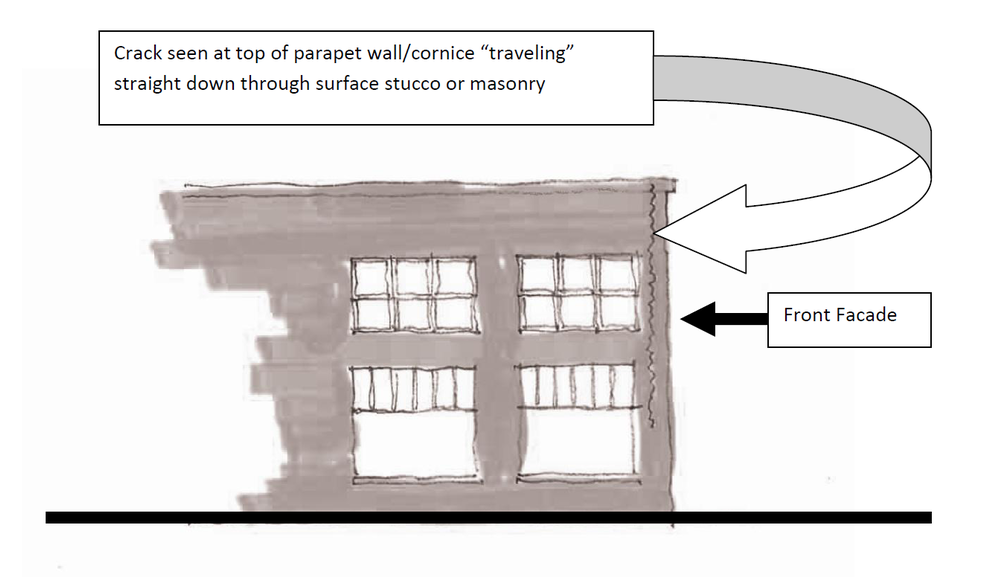
This type of cracking is often seen during Main Street site visits. What’s happening here is that the front façade of the building is either “pulling” away from the rest of the building or it is rising and falling in a straight vertical line independently of the remainder of the building. This situation occurs because the front (and rear) facades are built somewhat independently of the side walls (party walls or firewalls) and roof structure. This independence results in a state where the front and back walls have a tendency to move differently than the side walls.
This type of cracking probably indicates a vertical movement known as shear. Shear can best be described as the opposing vertical forces (up and down) that eventually result in a tear or crack along the line of stress. This shearing is illustrated by the two opposing black arrows in this diagram.
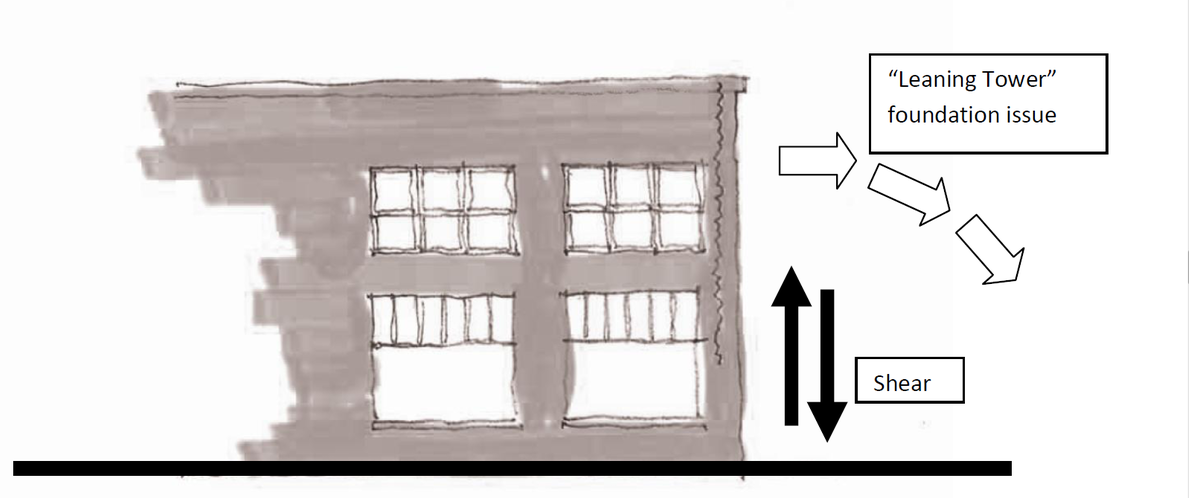
The other explanation for such a crack is that the front façade is literally falling away from the rest of the building. This might be the case when an old building has had a new façade affixed to the front of the old façade without properly connecting the two. It might also be caused by an inadequate foundation (subsurface wall support) that leads to the “Leaning Tower of Pisa” effect. This is illustrated by the series of three arching arrows shown above.
Possible resolution: Shear or tilt may be the result of a very serious subsurface condition. A structural engineer should be contacted. The solution may involve the design and construction of a new foundation wall. This might involve a complex procedure known as under-pinning which requires the temporary support of the compromised wall while the old foundation is removed in preparation for the new foundation wall. It is also possible that the engineer will decide that new foundation work is unnecessary. It may just be that structural connections are required at certain vertical intervals that prevent the front wall from shearing or tilting.
3. Diagonal cracking on the Lower Side Wall at the Front or Rear Façade
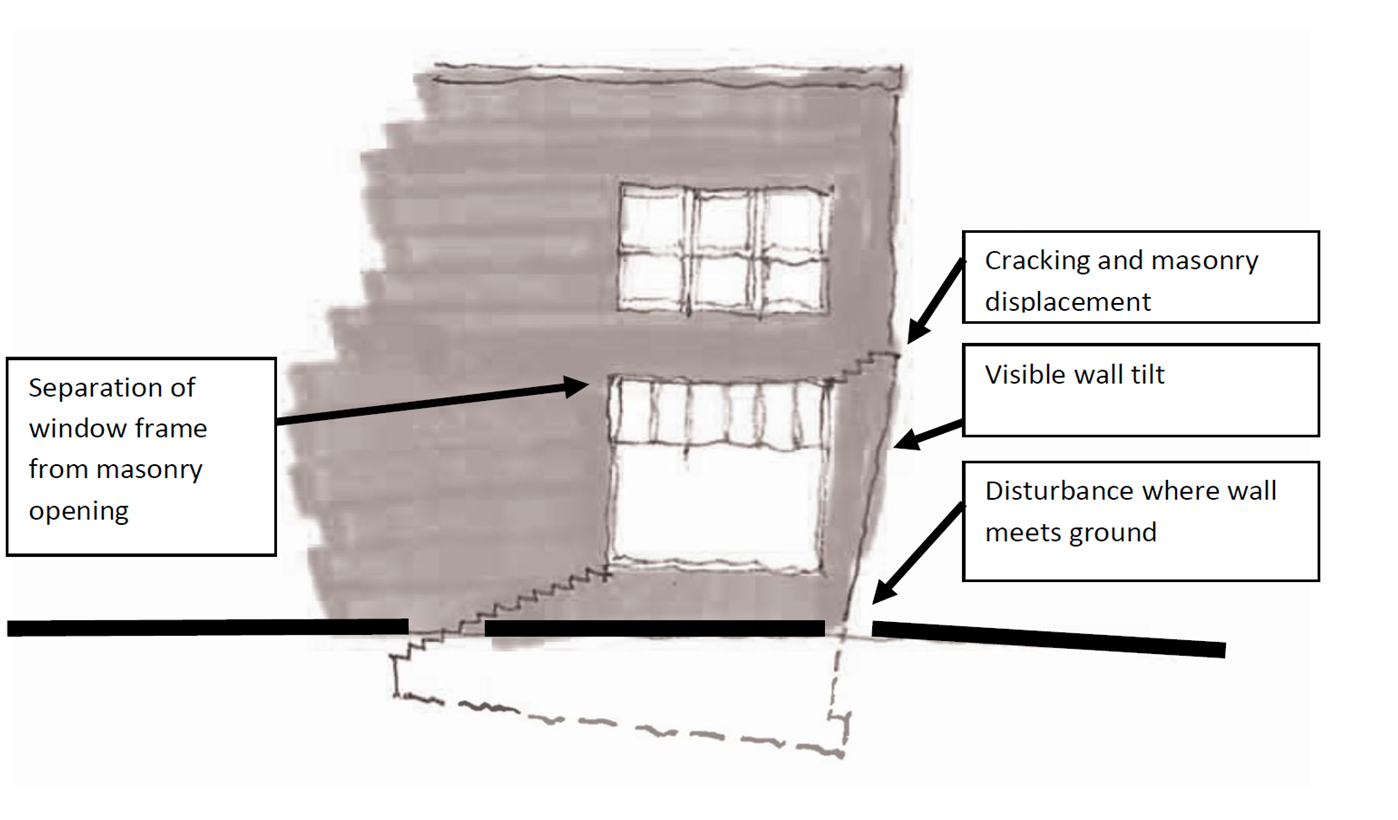
The foundation wall under the corner has settled differently than the rest of the building. Factors that cause this condition include different soil conditions, removal of ground water, or the presence of tree roots that have undermined the foundation.
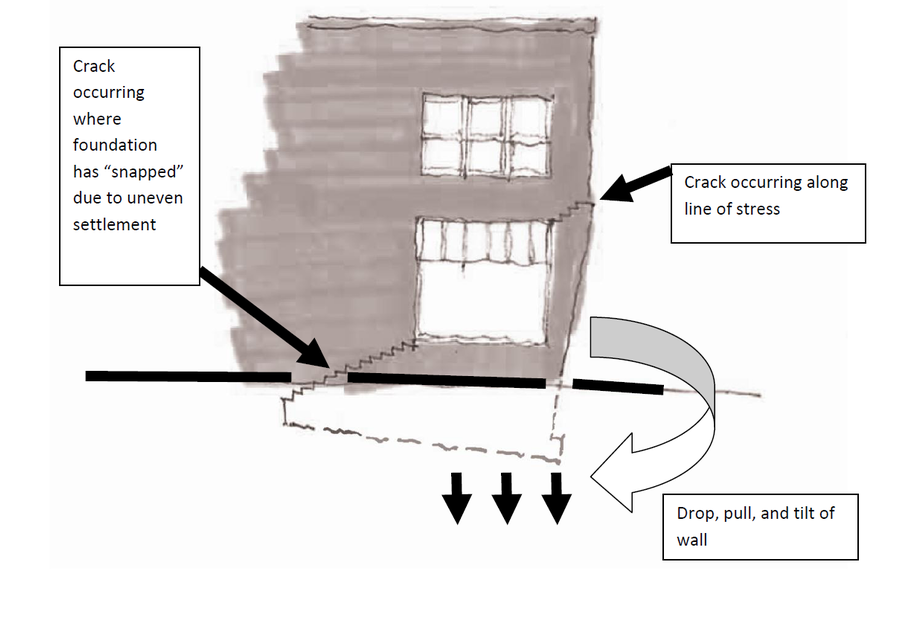
Possible resolution: This is a very serious type of cracking because two contiguous structural walls are being compromised. A structural failure in this location would certainly result in a significant collapse of building material. When such a condition is observed, a structural engineer should be contacted without delay.
Conclusion: These are just three of a huge list of issues having to do with masonry cracks and deterioration. In future Main Street Matters articles we will discuss a few of the more common masonry issues including manufacturing defects, installation defects, the effects of climate, the effect of airborne pollutants, the effects of airborne abrasives such as dirt and sand, the effect of impact (usually from the impact of attached elements), and the effects of fire. We will also have a closer look at specific types of masonry deterioration including rising damp, moisture penetration, spalling, crazing, mortar and adhesive deterioration, and buckling. Stay tuned!