
Parking Lots: Can they be Pretty?
November 2017 Main Street Matters
Written by Marie Oehlerking-Read, Project Design Assistant, Texas Main Street Program
Parking is a downtown necessity. Most people come to your downtown in a car, but little thought is often given to how parking lots look or how they compliment the buildings around them. Some towns are lucky enough to have elaborate garages that can be camouflaged and designed to blend in with the surrounding building stock. However, most Texas Main Street cities only have surface lots, consisting of asphalt and a few painted lines. What if parking could be both functional and pretty? Better yet, what if it was environmentally friendly? Below are a few examples from around Texas and beyond to show you how parking can be all of those things.
Buda Mill and Grain, Buda
Design: CTA Group
Engineer: Hollingsworth Pack
The Buda Mill and Grain development anchors the south end of the recently established Main Street district. The complex is a mixture of both historic buildings and new construction that tie into the site’s industrial and agricultural history. There are approximately 27,000 square feet of retail, restaurant, and office space on the site. Current tenants include a bakery, salon, yoga studio, consignment boutique, coffee and cocktail
restaurant, bike shop, and art gallery.
The site is slightly disconnected from downtown and far from the public lots provided by the city. Street parking could not be incorporated because of site constraints, so parking a lot was a necessary part of the design. The main lot was placed at the center of the site with buildings wrapping three sides of it. From the street, the lot is screened from view with landscaping and trees. Wide sidewalks were also added along the perimeter to tie into the downtown district. The central parking lot has about 32 spots, while the south parking lot can serve over 50 cars.
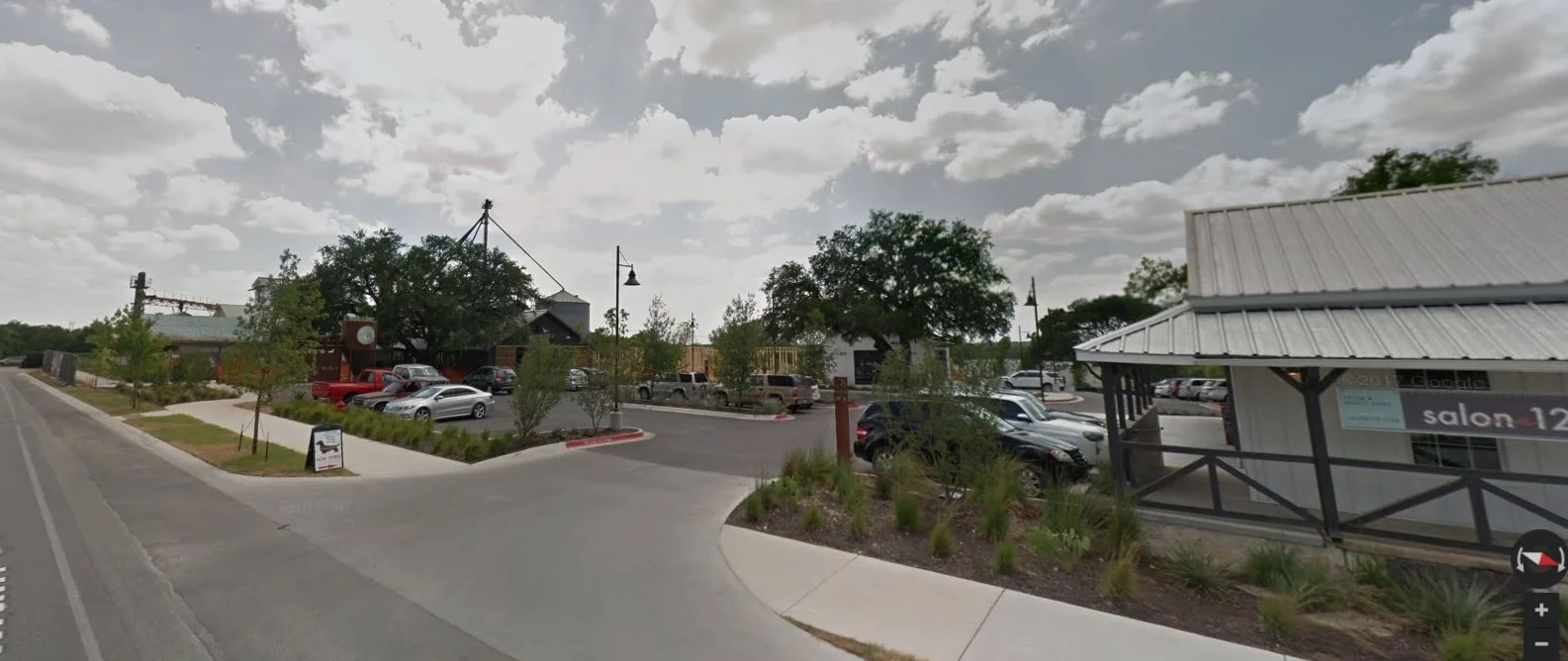
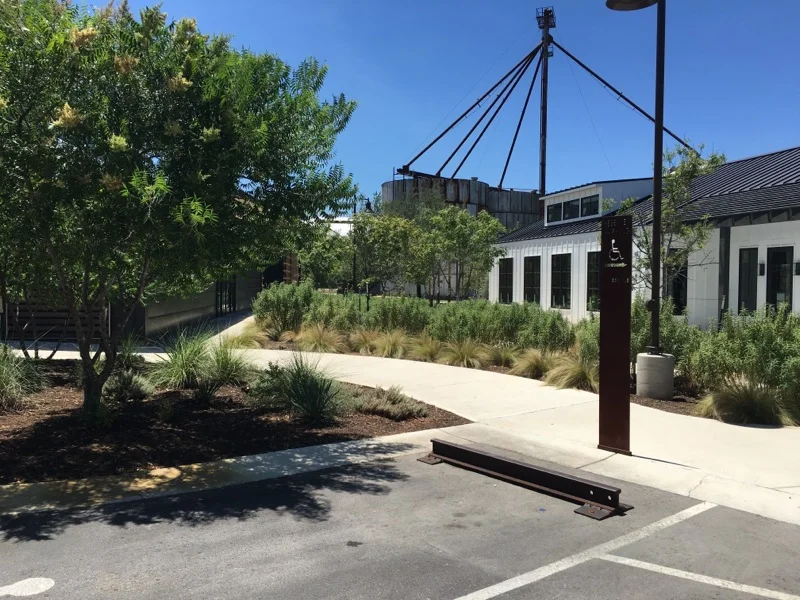
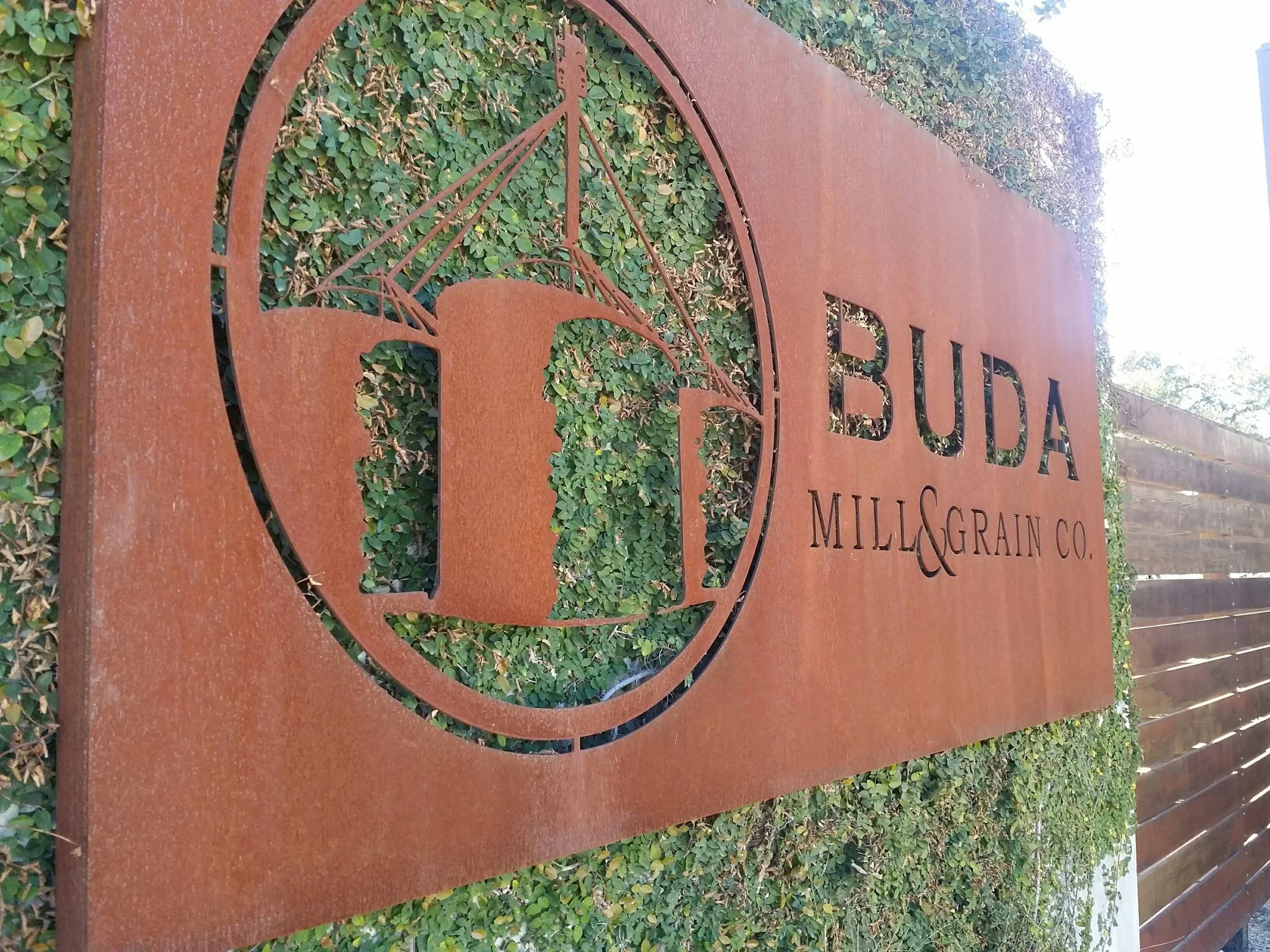
(Top) Buda’s central parking lot is screened from the street with landscaping. Wide sidewalks are also incorporated into the perimeter. Source: Google Streetview. (Bottom left) The design of the signage and curb stops in the Buda Mill and Grain parking lot tie into the industrial history of the site. (Bottom right) Unique signage at Buda Mill and Grain links to the industrial history of the site.
The attractiveness of the unique Mill and Grain site is immediately experienced as you get out of your car. Instead of using standard handicap and
parking restriction signage, the designers extended the industrial aesthetic into the lot by incorporating metal panel signs with a rust patina. The lettering and symbols are cut out of the sign instead of printed, which creates a sophisticated appearance. Old Union Pacific rails found on site serve as wheel stops in each parking spot. Landscaping is also a large component, making this lot more inviting and comfortable to pedestrians when compared to other surface lots. The designers retained existing shade trees and added other native plants along each row of parking. These
elements extend the identity and the brand beyond the Mill and Grain buildings into the parking lot, which makes the entire site feel like a unique
experience instead of just another strip center.
El Monumento, Georgetown
Design: Overland Partners
Engineer: Mark Word Design
El Monumento is more than just a nice place to have dinner in downtown Georgetown. It is a one-of-a-kind building that was designed with
the goal of creating an, “oasis in the middle of the city,” according to co-owner Clark Lyda. The building is situated on the fringe of the
downtown district, next to the San Gabriel River. The primary lot can fit about 50 cars with an additional 30 spaces on the side streets.
The “oasis” feeling starts at the parking lot. The medians and perimeter around the lot are filled with plants native to rural South Texas
and Mexico, which tie in to the restaurant’s aesthetic. From the main thoroughfare, Austin Avenue, the parking lot is barely visible because
of the landscaping screen. The parking lot goes beyond the look of an outdoor refuge, and it starts to function as one by considering how
the lot affects the surrounding environment. The parking lot is made of decomposed granite, which helps reduce storm water runoff created
by traditional paving materials. It also aids in lessening the “heat island” effect that too much pavement can cause, which keeps temperatures
cooler in the area.
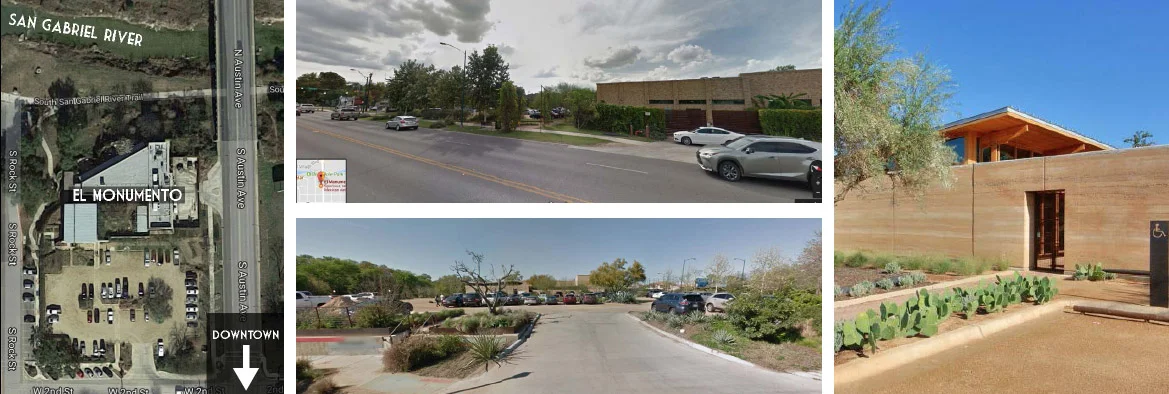
(Left) Aerial view of El Monumento in Georgetown. (Middle top) El Monumento from Austin Avenue. Source: Google Streetview. (Middle bottom) El Monumento
entrance from West 2nd Street. Source: Google Streetview. (Right) Overland Partners utilized decomposed granite instead of traditional parking lot paving and
unique signage to tie the look of the design together. Source: http://bartlettcocke.com/project/el-monumento-restaurant/
The required signage ties into the overall aesthetic of the restaurant by utilizing metal panels that compliment metal elements seen on the building.
Parking spaces are marked by rustic pipe curb stops instead of painted striping. Through the parking lot design, customers are transitioned from the hustle and bustle of downtown on the outside, to the relaxing oasis-like restaurant on the river.
Central Market, Windsor Square Neighborhood, Phoenix, AZ
Design: Venue Projects
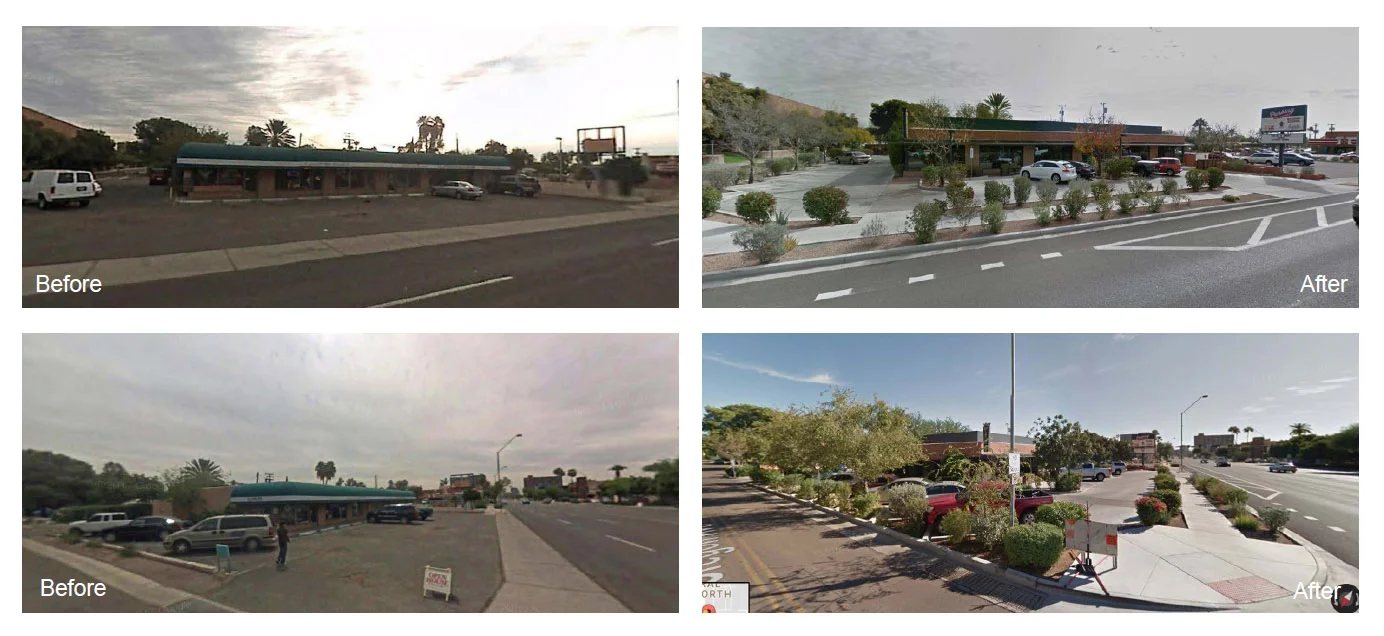
Before and after the photos of the Central Market Strip Center Conversion in Phoenix, AZ. Source: Google Streetview.
North of downtown Phoenix, on a primary road heavily dominated by cars, Venue Projects, a local redevelopment group, recently accepted the challenge of transforming a barren retail strip center into a welcoming hangout spot. The site surrounding the building was once primarily paved, which created the appearance that only cars were welcome there. Venue Projects reconfigured the site to a place where people come first, and cars come second.
Landscaping was key to converting the site from auto-oriented to pedestrian scale and comfort. The designers defined the sidewalk edge with shrubs and landscaping on either side, which created a buffer between people and the cars on the street. Instead of concrete curb stops,
triangular flower beds were installed to define the diagonal parking spaces. The transitions between the parking lot and the actual building are scaled to fit people through planters and green screens. These landscaping elements break down the vast sea of paving in the original parking
lot design into smaller defined spaces that people can better understand and navigate.
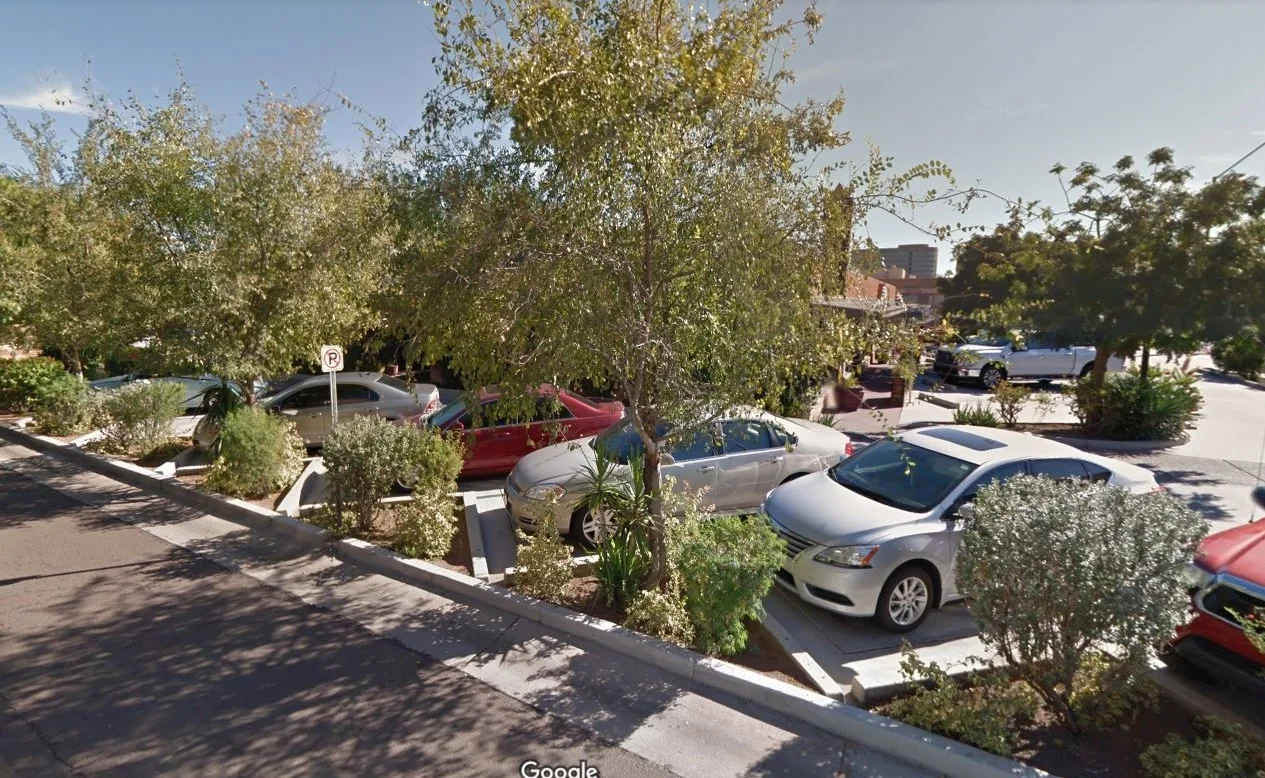
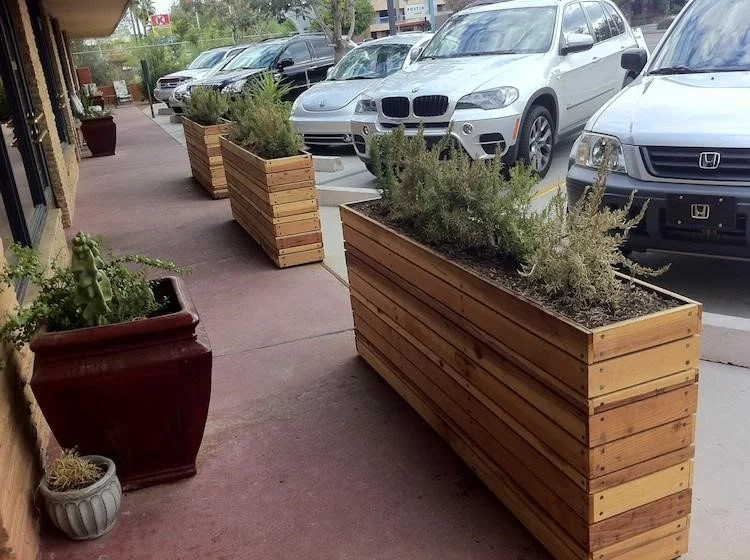
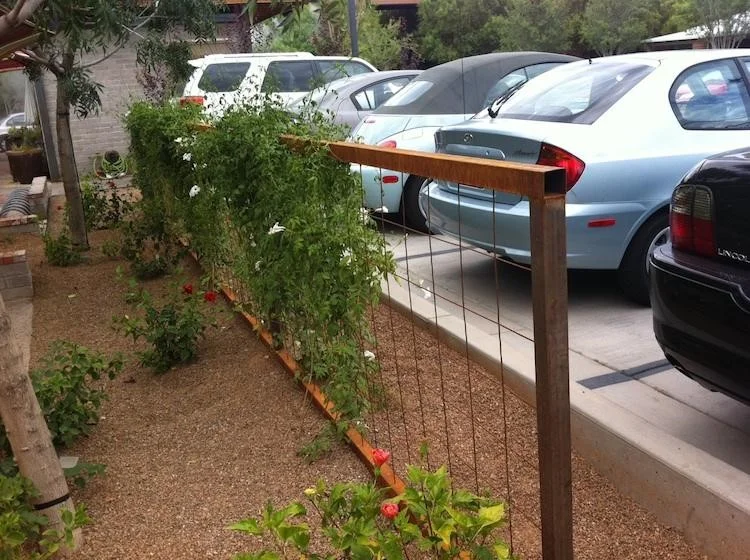
(Top) Planters were used to deἀne parking spots instead of paving for the Central Market Strip Center Conversion in Phoenix, AZ. Source: Google Streetview. (Bottom) Planter boxes and green screens are used to shape transitions between the parking lot and building. Source: Taz Loomans, author of Blooming Rock.
Grand River WorkPlace Green Parking Lot, Detroit, MI
Design: Living Lab, a collaborative design studio
Funding: Kresge Foundation grant
The Grand River WorkPlace is a co-working incubator and pop-up retail space that provides an affordable working environment for small business startups and freelancers. The space is located in a neighborhood commercial district northwest of central Detroit. Next door to WorkPlace was an underutilized vacant lot that was transformed into a vibrant, “green parking lot.” The goal of the project was to create an efficient and sustainable parking lot with usable gathering space for tenants.
The “green parking lot” has solid paving on the driving lanes and permeable pavers on the parking spots. This design, in combination with landscaping and a 1,000-gallon rain cistern, allows for water to be collected and retained on-site. The collected water from the cistern is used to irrigate the landscaping around the building. The permeable lot slows the rate at which water runs from the site. This example might sound simple on the surface. However, when considering the bigger picture, a green parking lot can do a lot for the surrounding community and environment.
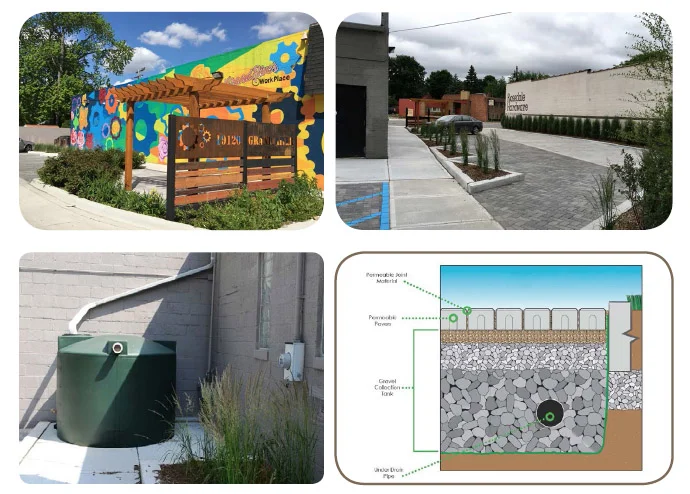
(Top left) Signage, landscaping, and covered seating were incorporated into the design of the parking lot. Source: http://livinglabdetroit.com/portfolio/grand-river-workspace-green-parking-lot/. (Top right) Permeable paving is used on the parking spots to slow the rate of water runoḀ from the site. Source: http://livinglabdetroit.com/portfolio/grand-river-workspace-green-parking-lot/. (Bottom left) A 1,000 gallon cistern collects rainwater from the roof, which is used to irrigate landscaping on site. Source: https://www.facebook.com/GrandmontRosedaleDevelopment/posts/10153856596024790. (Bottom right) Diagram of permeable paving system. Source: https://www.countymaterials.com/en/products/landscaping/permeable-paver-systems.
Jason MacDonald, landscape architect and principal from Living Lab, explained the reason behind the lot design to Texas Main Street staff. Detroit operates on a combined sewer system, where storm water runoff and sewage flow together in the same network. When it rains, this system quickly fills up to the point that it backs up into homes and businesses, which causes major issues city-wide. The goal of the permeable parking lot is to slow down the rate at which storm water drains from the site and eliminate it altogether if possible. The permeable pavers allow water to pass through the joints into the space below. The pavers rest on 32 inches of gravel, which act as a collection tank to hold the water. An underdrain that connects to the city’s sewer system is placed in the middle of the gravel and slowly siphons off water as the tank fills. In this example, the city required the drain due to local code and the inability of the soil underneath the lot to absorb water. In other places, the drain may not be needed and the water can be absorbed directly into the soil. The permeable paving system is able to hold a significant amount of water, which helps slow the rate of storm water runoff, and in turn, puts less pressure on the city’s sewer system.
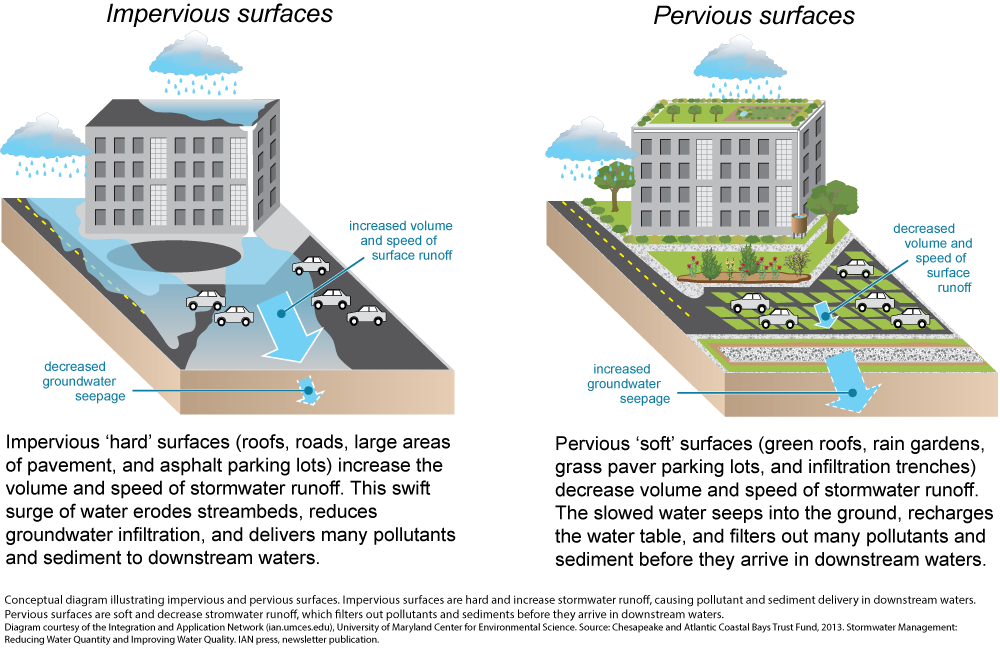
According to the EPA, “Storm water runoff is a major cause of water pollution in urban areas. When rain falls on our roofs, streets, and parking lots in cities and their suburbs, the water cannot soak into the ground as it should.” The storm water runoff that drains through gutters, sewers, and other engineered collection systems carries trash, bacteria, heavy metals, and other pollutants from the urban landscape, which can be harmful to nearby bodies of water where the runoff may drain. However, when rain falls on undeveloped sites, the water is absorbed and filtered by the plants and soil, making the runoff cleaner and less problematic.
Green parking lots and infrastructure, such as the Grand River WorkPlace example, use vegetation, soil, rain gardens, and other elements to restore some of the natural processes required to manage water and create healthier urban environments. If more parking lots used these simple tactics in their design, this would allow for cleaner air, cleaner water, flood protection, and more natural habitats for the entire community’s benefit.
Designing for Flood Prevention
Post Hurricane Harvey, storm water management and flood prevention are in the forefront of everyone’s minds. Many factors and uncontrollable
circumstances contributed to the devastating flood that occurred in Houston this past year. However, vast expanses of pavement and parking lots undeniably contributed to the problem. In his Atlantic Magazine article, “Houston’s Flood is a Design Problem,” Ian Bogost considers the many different factors that played into the catastrophic flood and explains how flood controls have been designed and applied in the city. He acknowledges the fact that development is inevitable and argues that the goal is not to prevent development, but to plan, design, and create better
development. He states that, “If good stormwater management means good, site-specific design, then ordinary people have a role to play, too. Residential homeowners who install a new cement patio or driveway might not even realize that they are channeling water down-grade to their neighbors, or overwhelming a local storm drain.”
In short, one sidewalk, one building, one part of downtown can affect its surroundings in major ways. A simple parking lot might not seem like a big deal until the impact on its surroundings are realized. Small changes to a lot’s design can result in positive outcomes both aesthetically and functionally as we have seen in the examples. The EPA provides several resources on its website that break down the components of green
infrastructure and parking lots to make it easier for cities to implement these concepts and educate their stakeholders. Learn more about green infrastructure, the EPA’s experimental permeable pavement parking lot, and also take a look at their “Green Parking Lot Resource Guide” available here the next time you are considering parking lots in your downtown.
Take the time to read Bogost’s full article on Houston. It goes into further detail of the concepts summarized here and his conclusions likely apply to your city, too. - https://www.theatlantic.com/technology/archive/2017/08/why-cities-flood/538251/