
INCREASE YOUR SALES BY CATERING TO KIDS
May 2014 Main Street Matters
Article written by Sarah Blankenship, Project Design Assistant, Texas Main Street Program, and mother of a 3 and 5 year old while trying to be a Main Street supporter

We all know that holding events with children downtown is good because it will bring the parents downtown. A lot of effort is given to bringing families to a downtown public place such as a pocket park, the courthouse lawn, or to the front entrance of a downtown business at a trick-or-treat event, but are the parents actually coming into the stores? The visuals into your store are very important. In a matter of seconds some parents will cringe at the idea of actually stepping inside the store based on the chaos their child(ren) might bring. On the flip side, a store owner or employee may be cringing back at a parent standing at the door with kids, strollers, diaper bags, etc. wondering if they and their merchandise will be able to survive the visit. While it is not the store’s responsibility to take care of, childproof, or entertain your child, if you make a space more comfortable for a parent, they will be more likely to frequent your store and ultimately increase sales.
Parents are a huge population of customers. The population of US moms with children under age 18 in the household was 35.7 million in 2012. (Source: eMarketer, 2013). Parents often shop out of necessity with children, some studies say up to 85 percent of the time, and it can add stress to their shopping experience. Stores frequently lose sales because the parents cannot concentrate on merchandise long enough to consider buying. Let’s face it, online shopping can be easier for many parents.
So what can be done? Of course, this will vary depending on age (of the child), but generally a parent wants to feel welcomed knowing that their child is safe and the store is safe from their child so they can browse. At the very least, an entrance must be wide enough to allow a stroller to enter; better yet, a double stroller. This, however, should not strictly be limited to strollers since the Americans with Disabilities Act states that the minimum width of a door is 32 inches to allow for wheelchairs.
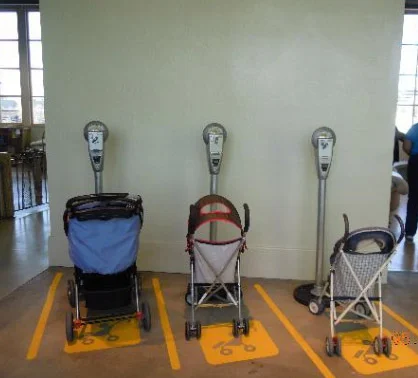
Stroller parking makes shopping easier for parents.
Avoid negative signs on the door that immediately tell parents “no unattended children, large bags, or strollers” as they convey the message that they should not bother to enter. Instead, create family-friendly signs or creative alternatives that meet your store’s preference for no strollers inside. How about making outlines on the sidewalk for stroller parking, or diaper-bag cubbies in the entrance of the shop that will make parents feel like a welcomed VIP rather than a hindrance. Consider child-friendly window decals for the storefront window and as a broader marketing campaign for a store or city.
Once inside, the aisles need to be wide enough for a parent to navigate around the entire store. Be mindful of what is at the bottom of displays for strollers and curious fingers. Arranging items at different heights is standard for merchandising; simply rethink what is put at the bottom heights. Non-breakable, non-staining items should be located at the bottom. Breakable items should be out of the reach of children.
Next, the goal is to purposely keep little minds and hands occupied on particular items and off the merchandise. Think waiting room-type items such as toys, books, puzzles, coloring books, televisions, electronic games, and play areas. The Espirit retail store, seen to the left, has a play item added directly to the end of the clothing rack. This is a great idea as the child can be right next to the shopping parent. It is important to put multiple toys throughout the store so the parent is not stuck in one particular area where the merchandise might not appeal to them. Periodic toy chests or baskets with books may be plenty sufficient. A central play area can work in a store, but enable parent visibility from all angles of the store. Try to incorporate multiple ages whenever possible and consider choking hazards and easy-to-sanitize items.
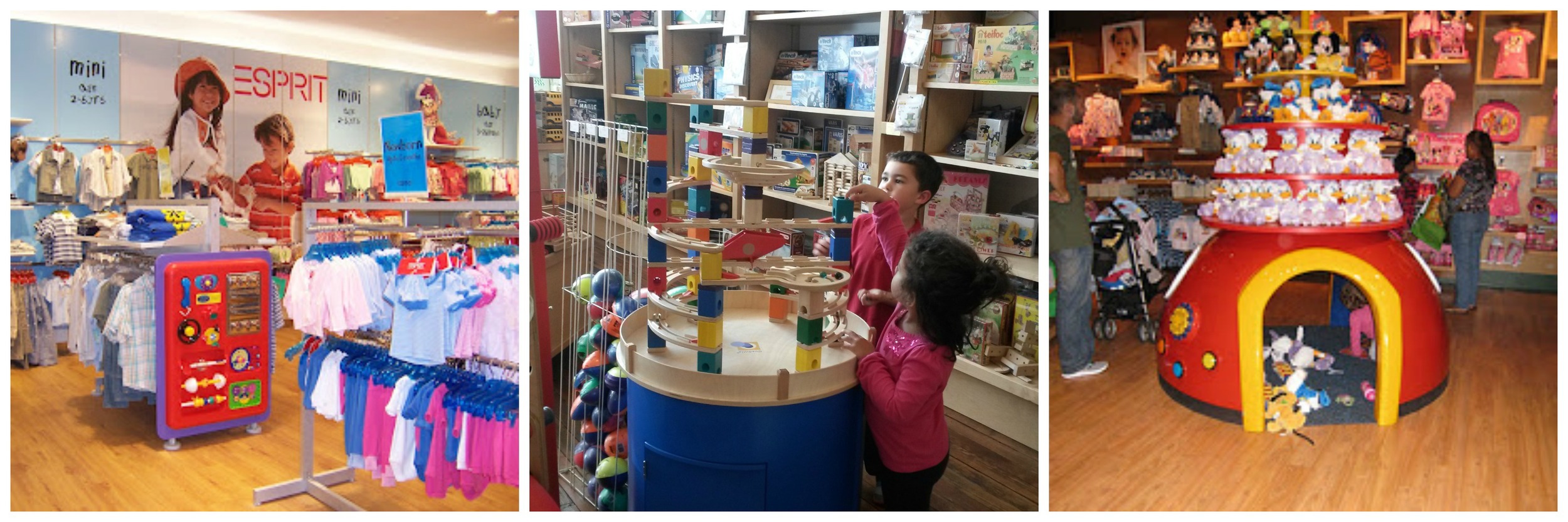
Child-friendly solutions for retail stores encourage parents to focus more on your products.
The photos above are from stores that sell children’s products. Don’t let children’s retail be the only place play areas are included. Incorporate play items into any spectrum, adult clothing, restaurants, hardware stores, etc. The toys could coincide with what is already being sold, and may lead to additional sources of sales. For example, in a kitchen store or restaurant, add a mini kitchen or planting area that is meant solely for children. At a hardware store, play tools and workbenches could sit right next to merchandise that dad may be considering.
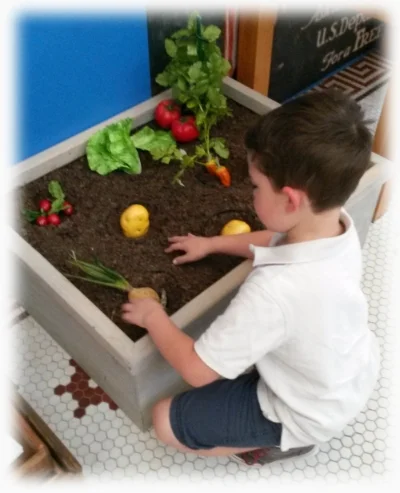
Gardening area for children inside a local shop.
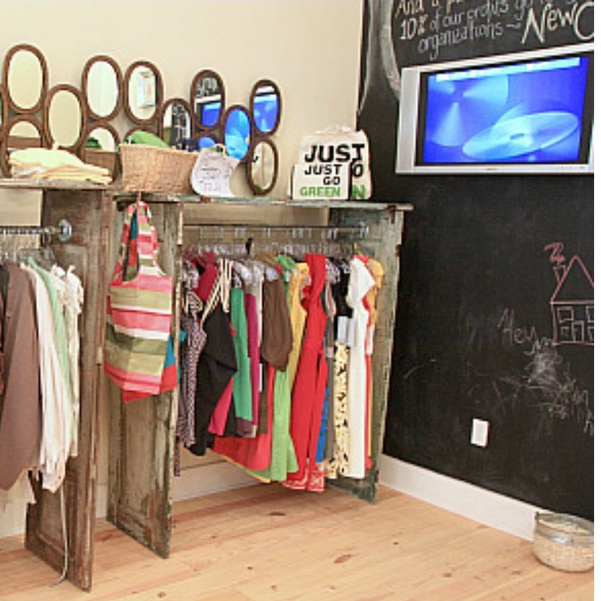
Chalkboards keep children occupied while parents shop.
Market research shows that mothers control approximately 85 percent of household spending. Moms aren’t the only ones staying at home with the kids these days. There are 25.8 million married fathers raising children under 18 in the United States, according to U.S. Census data, and 2 million single fathers doing the same. (Business.com 2014).While mom’s are responsible for a majority of the shopping, make sure to include dad, grandparents, and even non-traditional families.
Don’t forget the dressing room. Women are more likely to purchase clothing if they can try it on. Little ones are known to escape under dressing room doors, so consider doors that go all the way to the ground. Put items in the dressing room to entertain like a distorting mirror or a dress up station for little kids to be like mom.
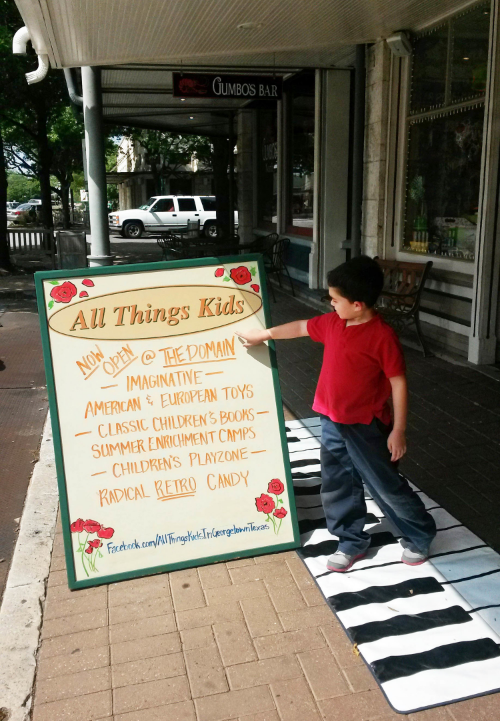
Kids sometimes cannot resist the urge to smudge sidewalk signs.
What kid isn’t tempted to smudge the chalk on the sandwich boards outside the store? Give them the chance to satisfy this temptation in the store. Add chalkboards or white erase boards on merchandise stands throughout the store for them to use. Markers or chalk can be requested at the counter or simply put in a cup holder out of toddler reach. Little ones can doodle while older kids are given a challenge that ties to the store, such as design a necklace or outfit. Offer prizes for best drawings and use great artwork for advertising. The check-out counter can be a great place to keep children busy coloring while their parents hand over the money.
Finally, teach staff how to deal with kids; to smile, get down at their level but not too close. Offer to help parents and direct them to things their kids might enjoy. Treats can be given, but keep in mind not every parent wants their kid to have candy; healthy snacks, stickers, or balloons could be a fun memorable delight for the child.
Always remember, kids are the customers of the future, and we want them to have good memories of shopping downtown.