CHANGING THE LANGUAGE OF PRESERVATION
July 2014 Main Street Matters
Article written by Brian O’Connor, Economic Development Specialist, Courthouse Square Initiative
It has often been said by property owners, developers, and real estate professionals that historic preservation is not a sound investment. After all, isn’t it less profitable to preserve a historic building than to construct a new one? Fluted columns and decorative cornices, while pleasing, cannot influence how many hamburgers a downtown merchant sells on Saturday night, right?
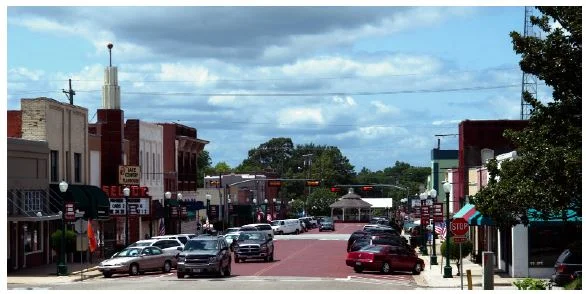
Downtown Mineola, a 25 year Main Street Program
However, contrary to popular opinion, historic preservation yields significant financial benefits for the local economy and can serve as a catalyst for future investment. There are countless instances where the rehabilitation of a historic building has stimulated the revitalization of a downtown. In other cases, a series of smaller rehabilitations are necessary to create the critical mass that returns a neighborhood to prosperity. Downtown property values in the City of Lampasas increased nearly 21 percent on average after restoration of its courthouse. Whereas, only after adopting an economic renewal plan for its downtown did the City of San Marcos experience success. Despite the contrast in methods, neighborhoods that were once depressed are now among the most vibrant and desirable.
Cities across Texas possess historic structures that, if fully leveraged, can be converted into competitive assets to attract business and investment. For the past 30 years, it was widely speculated that technology would eliminate the need for people to congregate in urban centers, sounding the death knell for downtowns. After all, workers would telecommute and video conference, leaving vacant miles of asphalt leading to languishing urban centers. To the contrary, today’s technological culture reveals how nearsighted we are.
Research has shown that the physical clustering of people is vital for the cultivation of advancing technologies and a must-have for attracting Richard Florida’s “Creative Class.” The changing demographic landscape suggests that now is the time to invest in preserving historic downtowns. The prototypical family, a married couple with school age children, is less than 25 percent of all households. College graduates are flocking to authentic downtowns that are seen as walkable, and visitor and bicycle friendly. The population of college-educated 25 to 34 year olds in urban centers has increased by 26 percent in the last decade, creating a workforce that adds to the economic vitality of downtowns. From empty-nesters to the elderly, individuals are increasingly seeking downtowns with easy access to hospitals, shopping, public transportation, and cultural amenities.
For too long, historic preservationists have defended their actions solely in aesthetic terms. Stated in non-use values for which traditional economic models were ill-suited to measure, their impact often came into question each budget cycle. The value of preservation need not be expressed only in quantitative terms; however, the context in which preservation is viewed needs to be revisited.
Preservationists should start by not separating the economic benefits from the historical and cultural rewards. Separating the intrinsic value of historic preservation from its financial capabilities is and will always be a losing proposition. Fortunately, these issues are not mutually exclusive. Today, preservation is slowly emerging beyond that of a calling, a movement, or a social cause. What historic preservation can and should be seen as is part of an investment strategy and business model for building vibrant, sustainable communities.
Unfortunately, in the race to attract business, some communities undermine the sustaining value of their historic structures; exchanging short-term returns at the expense of long-term results. As a result, they build fashionable but trendy places that are unsustainable because they have sacrificed that which made them unique. Therefore, let’s start the conversation by admitting that the preservation process may be slower. Let’s concede that the costs to preserve a historic structure can be higher than that of new construction; and yes, let’s openly acknowledge that the work may more difficult. However, anything worth doing, typically is.
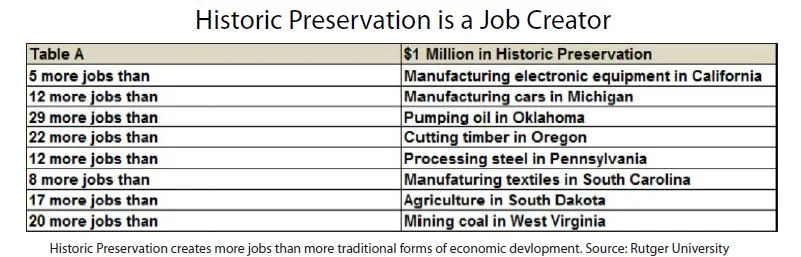
Fortunately, empirical evidence is available that historic preservation produces demonstrable public and private benefits. In the last decade, economic impact studies and cost-benefit analyses have demonstrated the economic benefits of historic preservation. Although there is not yet consensus on how benefits should be measured, historic preservation has distinguished itself in the area of jobs, property values, heritage tourism, and downtown revitalization. Studies conducted by Rutgers University (Table A) have shown that in many parts of the country, a $1 million investment in historic rehabilitation yields markedly better results in terms of employment, income, and state and local taxes than an equal investment in new construction or in other industry.
In cities across Texas, historic buildings are quietly contributing to robust local economies and distinctive livable communities including buildings that are of a diverse vintage that provides flexible, affordable space for entrepreneurs, and buildings that are of a scale ideally suited for walking, shopping, and social interaction. Evidence suggests that Americans may be growing tired of its exit-ramp economy with disposable office, commercial, and retail facilities located along suburban freeways in favor of authentic places.
New York City’s Independent Budget Office studied the effects of a local historic district designation on real-estate prices and found a 22.6 percent to 71.8 percent price premium associated with inclusion of a property in an historic district. A State of Florida economic impact study found that for every dollar invested in the state’s historic preservation efforts, two dollars are returned in direct revenues. Similar results undertaken for the State of New Jersey found that each $1 million spent on non-residential historic rehabilitation creates two more jobs than the same money spent on new construction. In the past year, economic impact studies specifically focused on Main Street have been done in Iowa, Michigan, and New Mexico and show similar results.
In the area of heritage tourism, an important piece for articulating the economic contributions of historic preservation, researchers found that heritage tourists stay 4.7 nights longer than the average tourist, and spend 78 percent more in restaurants than other travelers. In the State of Texas, state and local revenues supported by the travel industry represent about 8 percent of all state and local revenues (not including property taxes).
In 1976, Congress passed the 20 percent federal historic tax credit to promote the rehabilitation of income-producing historic properties. Since that time, it has leveraged over $106 billion in private investment, created 2.35 million jobs, and preserved more than 38,700 buildings for productive uses. However, despite such success, the US Congress is considering the elimination of the federal historic tax credit (HTC) to balance the budget.
The reality is that revitalizing any downtown typically requires some market intervention to disrupt the cycle of disinvestment. Preservation incentives from local, state, and federal governments can and should be used to prime-the-pump for private sector investment. However, the public discourse on the merits of historic preservation need to be radically and inextricably altered. Incentives to preserve historic structures need to be presented not as entitlements but rather as part of a proven investment strategy with indisputable returns for tax payers.
As we move into an economy of knowledge, innovation, and entrepreneurship, many downtowns are better utilizing historic structures through various business approaches. Municipal governments are collaborating with local colleges and universities to create downtown business incubators and satellite campuses that provide technical training to strengthen pathways to employment and enhance the local business mix. Public incentives are vitally important for revitalizing smaller Main Street communities that are often tasked with the unimaginable burden of stimulating the real estate market and restoring business confidence. Historic preservation, if properly articulated, could stand along with traditional economic development incentive programs that target science, technology, engineering and manufacturing clusters whose mission is clearly measured in terms of jobs, taxes, and investment.
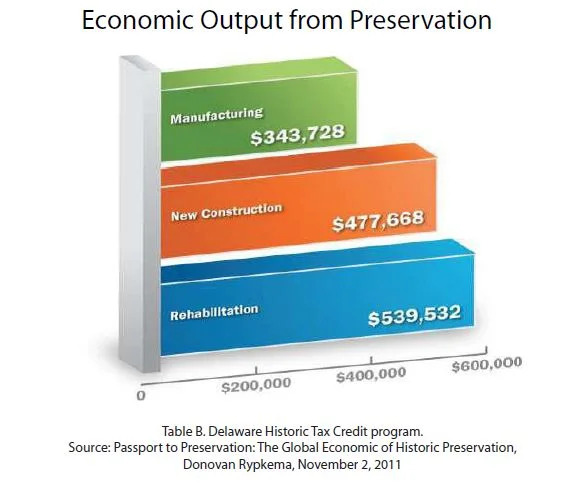
A 2010 study of the Delaware Historic Preservation Tax Credit program showed that $1 million of economic output from a local manufacturer generates nearly $344,000 in household income. A $1 million new construction project generates more than $477,000 in household income. But a $1 million invested in the rehabilitation of a historic building generates nearly $540,000 in household income in Delaware (see Table B).
However, the economic benefits of historic preservation can only be fully realized if networked with other elements that address the quality of the business mix, walkability, and aesthetics of public spaces.
In Washington, D.C., design improvements along a three-quarter mile corridor in Barracks Row, including patterned sidewalks and traffic signals, attracted 40 new businesses with nearly 200 jobs. Lancaster, California added pedestrian safety features as part of a downtown revitalization effort, including a pedestrian plaza, wider sidewalks, landscaping, and traffic calming. The project spurred $125 million in private investment, a 26 percent increase in sales tax revenue, and 800 new jobs, producing a 10-fold return on investment. In Mountain View, California, the expansion of space for sidewalk cafes and a street redesign for pedestrians were followed by private investment of $150 million, including residential, retail and offices, resulting in a vibrant downtown destination.
If the argument in favor of historic preservation ever hopes to appeal to the other side of the balance sheet, they’ll have to place more emphasis on jobs, taxes, and return on investment to garner political support and private sector confidence. Additionally, bankers, developers, investors, underwriters, as well as local government officials will need to be better informed of the enduring economic benefits of historic preservation. Fortunately, changing the tone of the conversation should be as simple as few economic activities have had a more impressive effect on the local economy than the rehabilitation of historic buildings.
However, let’s not forget, that historic preservation, at its very best, is a melding of architecture, history and culture, and entrepreneurship. Therefore, preservationists should readily embrace the real estate aspects of their work. Arguably, even historic buildings need to generate sales to support rents so as to maintain and improve them. The rich culture and diversity of downtowns will be assured if a stronger economic development argument is made to preserve historic places.
So the next time you are downtown enjoying dinner with friends, take a moment to look around. Take notice of the public spaces, the tree-lined streets and the intricate building features that surround you, and think how they just might add to the flavor of your burger.
Sources:
Contribution of Historic Preservation to Quality of Life of Floridians, University of Florida, September 2006
Passport to Preservation: The Global Economics of Historic Preservation
Donovan Rypkema, November 2, 2011
Historic Preservation’s Impact on Job Creation, Property Values and Environmental Sustainability. School of Urban and Public Affairs. University of Louisville, KY, July 23, 2009
Downtown Revitalization in Texas:
The intersection of the Main Street and Historic Courthouse Preservation Programs, Marie Oehlerking, Master’s Thesis Presented to the Faculty of the Graduate School of The University of Texas at Austin