
DESIGNING FOR ADA, BUT WHAT ABOUT OTHER DISABILITIES?
September 2016 Main Street Matters
Article written by Kimberly Klein, Administrative Technician, Texas Main Street Program
Handicapped access laws have been in effect in Texas for a long time. What this means is that there are very specific ways that things must be done.It is very crucial and important that we follow the ADA Standards for Accessible Design and Architectural Barriers Texas Accessibility Standards (TAS), in order to keep our downtowns accessible and citizens protected.
Although we constantly strive to keep our handicapped individuals safe, we may be forgetting the other disabilities that surround us daily. Common disabilities such as ADD/ADHD, Down Syndrome, autism, and dyslexia involve a new set of considerations other than more typically considered items like of ramps, door widths, and elevators. In a typical American community, 20 percent of the population has a disability (mental illness, developmental disability, blind, deaf/hard of hearing, physical disability). By engaging this large part of society, one ensures consensus and cooperation with the 80 percent, and buy-in from the whole community.
If you are designing for an outdoor space or indoor space, it is recommended you consult with a firm that specializes in “accessible design,” a design process in which the needs of people with disabilities are specifically considered. Some of the best Main Street cities across the nation are very mindful in creating accessible spaces for these individuals. If your community is not already doing this, consider researching architecture firms and interior designers, and how they effectively create safe and user-friendly spaces for individuals with specific disabilities. A majority of the firms researched for the purpose of this article cater to designing for children and adults with autism, but they also cater to a wide range of disabilities.
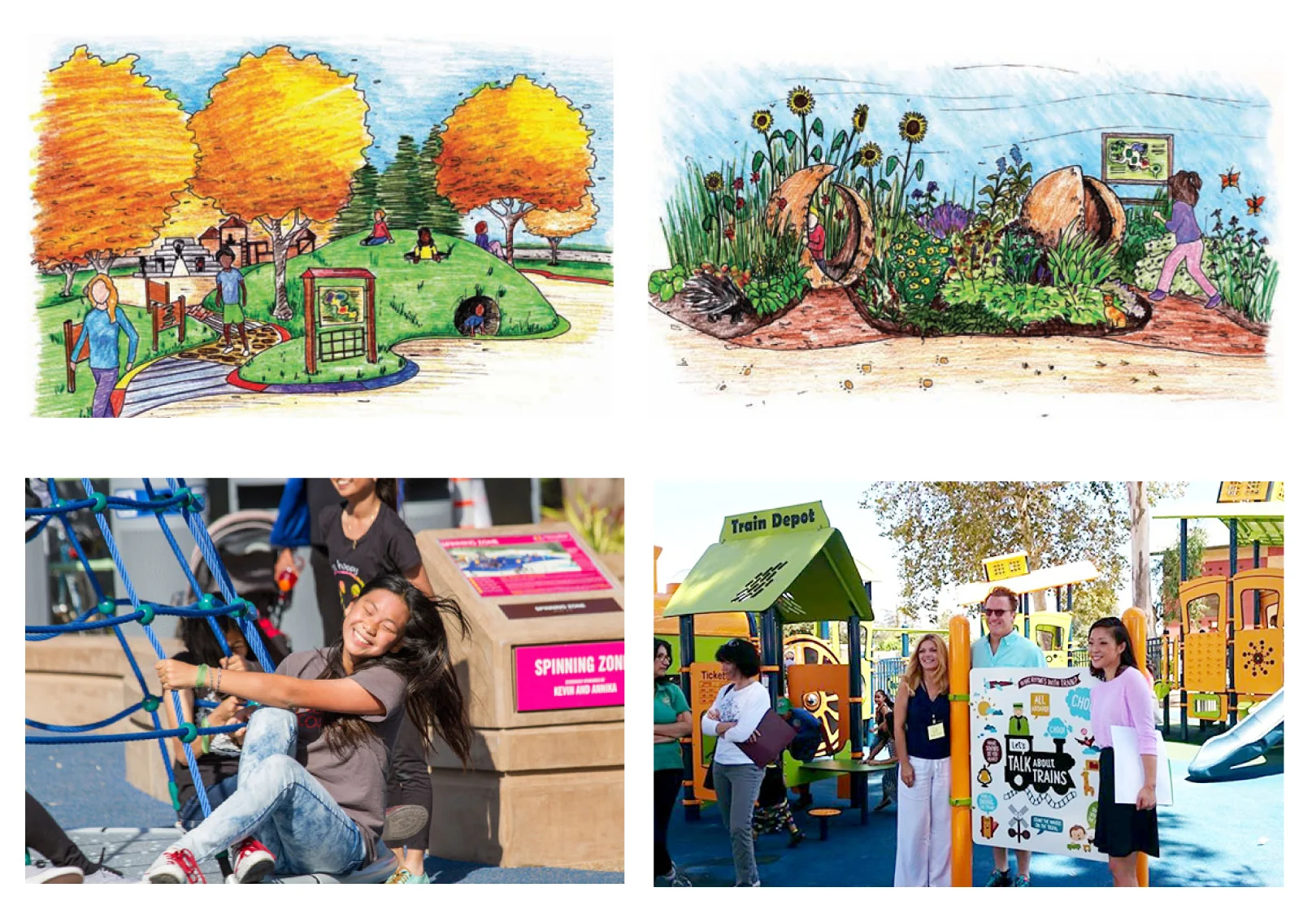
(Top left) Outdoor environments for children with autism could include transitions between spaces/activities, orientation maps, and elements of consistency. (Top right) Soothing areas and orientation maps can be incorporated into outdoor spaces for children with autism and other special needs. (Image(s) source) (Bottom) Examples of signage and visual aids that can be used in a playscape setting. A great example of a local playground is the Play for All Abilities Park located in Round Rock. Their park includes individual areas or “pods” that help children develop specific skills. (Image Source and Image Source)
Outdoor Spaces
Through their practice and expertise, specialist firms create outdoor environments ranging from playscapes, gardens, sensory gardens, and other outdoor living spaces. There are various ways of creating user-friendly outdoor spaces for children with autism. A few design practices include:
Avoiding toxic plants
Creating orientation maps, visual aids, and signage for both verbal and non-verbal individual(s)
Creating shaded areas
Keeping a consistent element
Creating transition spaces
Providing a clear edge along pathways
Creating soothing areas
To further explain some of these bullet points, avoiding toxic plants is highly important due to children exploring their world through taste. They will put everything in their mouth from plants to dirt to bugs. Some of the major plants you want to avoid are castor oil plant, common or pink oleander, yellow oleander, rhus or wax tree, coral tree, deadly nightshade, and white cedar tree. It’s very important to keep your playscapes and gardens safe and avoid using these plants. Please research these plants, to become aware of what they look like or what symptoms to look for if you think your child has come in contact with them.
Orientation maps, visual aids, and signage is another key component. Fifty percent of children with autism are non-verbal and use a picture exchange system to communicate with family, friends, and even their teachers. Therefore, it is very important to create key signage, so it can help children know what to expect. Most autistic children do not like surprises, so creating a visual map will help keep them calm and know what activity to expect next. Keeping consistent elements such as a perimeter wall (stonewall material) or landscaping (hedge), helps the space feel comfortable and predictable as well. It is also important to have your signage available in Braille for visually impaired individuals.
Soothing areas allow children to have allowed a place to escape and calm down when feeling overwhelmed. If a parent cannot console their child, having elements such as hammocks, suggesting a rocking sensation, or small tunnels that offer a tight, enclosed space, can help with this difficulty.
Another approach to outdoor spaces is creating gardens for adults and children to interact with. Concentrate on how gardening can enhance focus and attention and reduce anxiety for adults with autism.
Sensory gardens and can help children stimulate their senses without overwhelming them. Sensory gardens provide intimate spaces where young children can be immersed in the scents, textures and colors of plants and related elements. Along with specially selected plants, sensory gardens may also include elements such as wind chimes, wind socks, flags, and children’s art. Two popular forms of sensory gardens are sensory pathways and keyhole gardens.
“Sensory pathways can be constructed of smooth, flat, stepping stones or tree cookies with gaps wide enough for in-between planting. Stepping stones can be natural stone or concrete or made by children to include hand prints, leaf prints, shells, marbles, colored tile mosaics, or smooth glass. Glass blocks or clay bricks can be laid in the sensory pathway to add additional sensory richness and variety. Sensory pathways should be considered part of the larger pathway system and should not dead end. They can be installed as a narrow (18”-24”), short loop off the primary pathway or a broad (36”-72”) connection between settings.”
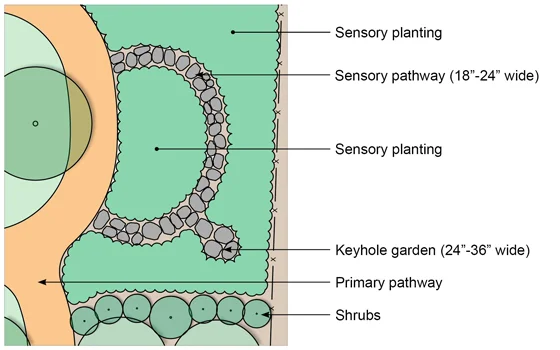
Example of a narrow (18”-24”), short loop off the primary pathway. (Image Source)
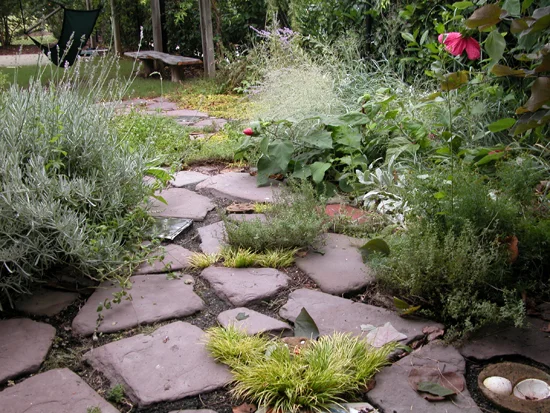
Example of a broad (36”-72”) connection between settings. (Image Source)
““Keyhole gardens provide an intimate space to rest while immersed in sensory plants. Keyhole gardens are shaped like a skeleton keyhole with a narrow entry and bulbous, interior space wide enough for a young child or two to sit and reach the plantings on either side (approximately 24” - 36” wide). Keyhole gardens can be installed as a subspace along a sensory path or be designed as a stand-alone setting.””
Indoor Spaces
Designing for individuals with disabilities is mostly seen through interior design practices, and they can become very complex due to each individual’s disability. When designing for interior spaces, a downtown store owner should make many considerations. It’s highly recommended to contact an interior design company that specializes in this field. Some of the recommendations include:
Noise control: Autistic patients are extremely sensitive to noise. Wall studs, dual ceiling and walls to ameliorate sound transmission, and carpeting and acoustic ceiling tiles absorb sound.
Careful use of color: Color is an important part of creating a less-institutionalized care setting. However, it cannot be too bold or “visually loud” to cause distraction or agitation.
Purposeful design: It is important to include a range of experiences for patients, but autistic kids can be sensitive to certain textures. Include a range of touchable materials, including rubber flooring, matted walls, and wood surfaces.
Some of the outdoor design practices listed earlier can also be used in interior spaces. Creating maps and visual aids, soothing areas, transition spaces, shaded areas, and clear edges along pathways are also useful indoors.
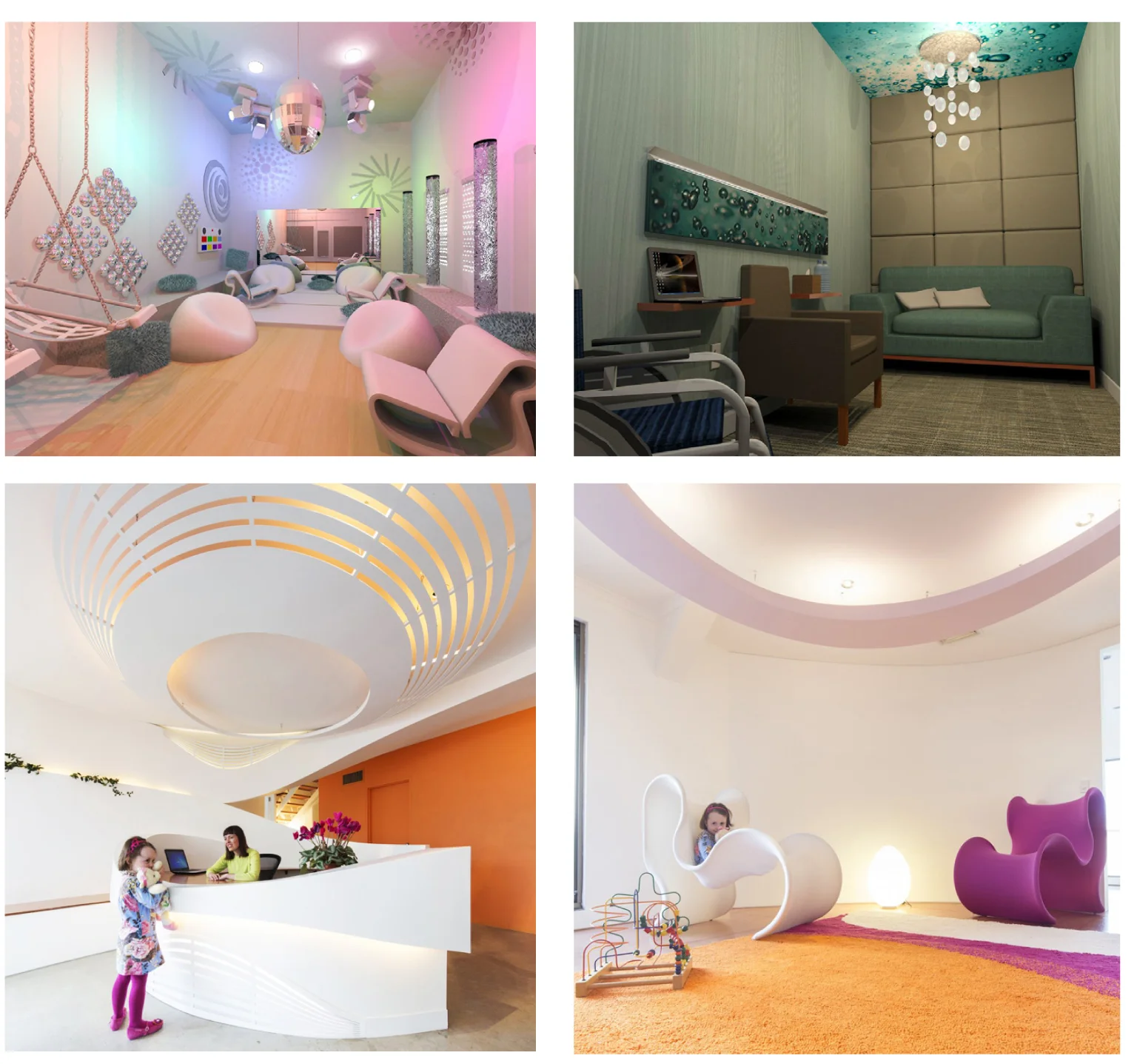
Examples of the guestrooms at the Autistic Facility Disney’s Magic Kingdom completed by Cheryl Jones (top) and Medical Center for Autistic Children completed by EnterArchitecture (bottom). (Image source and Image source)
A project completed by Cheryl Jones, an interior designer based in Fort Myers, Florida, showcases the guestrooms and multi-sensory rooms for the Autistic Disney’s Magic Kingdom. Special considerations were made to the acoustics and lighting, in order to help families soothe and calm an autistic child who may become overstimulated. The multi-sensory rooms even include areas of stimulation for those that need a rocking sensation.
Another project completed by Enter Architecture, a firm based in Australia, showcases a Medical Center for Autistic Children. Their color palette was very neutral and healing at the same time. There were soft furnishings and fun Fiocco “stocking” chairs to help create a soothing center and sensation.
Architects and interior designers have studied the programming process and executed designs for people with disabilities for years. They take the factors of ergonomics, age, gender, and physical disabilities into deep consideration when integrating them into solutions. It is just recently that headlines revealed growing concern about designing better environments and solutions to equip people with disabilities. If your community is not already practicing this, maybe it is time to think about making each individual in your community comfortable. Perhaps it is by making that new pocket park space, community garden, or playscape available to a different audience. Making good spaces for people with special needs makes great places for everyone.
Other good sources and articles to research are:
http://incfit.org/node/91
http://www.special-education-degree.net/30-most-impressive-accessible-and-inclusive-playgrounds/
http://www.kingwood.org.uk/
http://raisingchildren.net.au/articles/dangerous_plants_checklist.html
http://www.healthcaredesignmagazine.com/article/3-lessons-designing-autism
http://www.rockpapersquare.com/blog/2014/4/5/designing-for-users-with-autism-and-asd
http://www.designrulz.com/design/2013/05/modern-reception-for-autistic-children-medical-center-by-enter-architecture/