FOCUS ON MAIN STREET DESIGN
Bricks: Strength in Patterns
March 2013 Main Street Matters
Article written by Sarah Blankenship, Texas Main Street, Project Design Assistant
In January at the annual Main Street Manager training, Patrick Sparks, a structural engineer, was a featured guest speaker. In his presentation, he touched on brick patterns as a form of structural stability. This design article follows up on some of the information Sparks introduced to discuss and illustrate bricks and how they provide structural stability as well as interesting patterns.
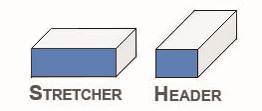
Brick faces (shown in blue below) are identified by their orientation. Most typically seen on the facade is the stretcher face of the brick with the long narrow side exposed. Turning the brick and laying it with the shorter side exposed is called a header brick.
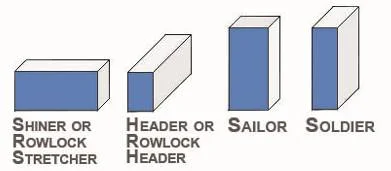
Other brick face orientations are:
Bricks are rather small by themselves, (standard U.S. size is 8 × 4 × 2¼ inches) but together in a wall they are given the responsibility of holding up huge buildings. Historically, brick walls were load bearing and were constructed thick to support the height of the building. The taller the building, the thicker the wall was at the base.
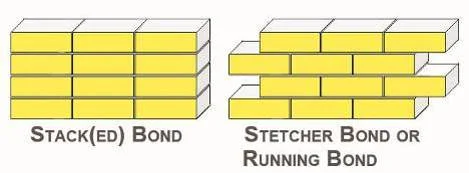
As many young people learned playing with building blocks, stacking same-size blocks on top of each other is not the strongest design choice, and often ended in a toppled tower (see Stacked Bond image). By staggering the bricks (see Stretcher Bond or Running Bond image), the weight is distributed over a wider area, avoiding a continuous, vertically aligned break. The basic brick pattern with the mortar lines matching up every other row emerges.
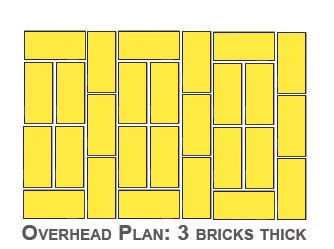
In order to get the brick walls thicker and stronger, the vertically stacked bricks were connected by changing the brick orientation. A layer of vertically-stacked brick is called a wythe, a horizontal row is called a course. The term wythe is commonly used to describe the depth of the wall. For example, a masonry wall comprised of three layers of brick from the exterior to interior would be three wythes thick.
The picture below illustrates the stretchers and headers used together. The row of headers ties the two wythes of brick together so that the entire depth of the wall acts as a unit. Tying the bricks together is important so that two or more layers don’t pull apart.
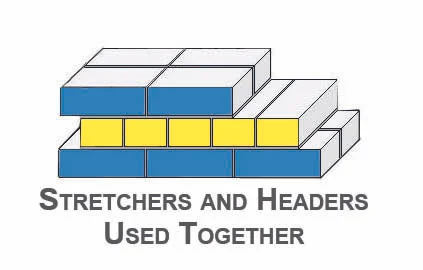
The overhead plan shows how changing brick orientation could be extended several courses for a very thick interconnected sturdy wall.
Water is always a potential problem for any building. With its porous composition, brick can draw rainwater or humidity into it, therefore into the walls. Problems arise if this water cannot escape. To aid in water drainage, cavity walls were introduced in the 19th century and gained widespread use in the 1920s. As its name describes, a cavity wall allows for a space in between brick wythes for water to evaporate or drain through the bottom of the wall through spaces in between the bricks. These spaces where the mortar is purposely left out are called weep holes. Strength is commonly added through metal ties that connect the interior and exterior brick wythes.
The following photo shows an exterior view of a brick wall with weep holes. This is not a case of a poor mortar job, so repointing for missing mortar in this area is not needed.

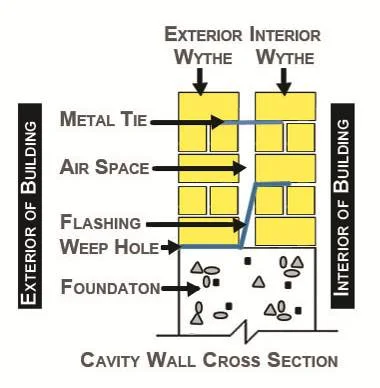
With technological advances, the inner brick wythe (seen in the cavity wall cross section) was commonly replaced with metal framing that could take the load a thick masonry wall historically would have taken. The inner cavity space became a popular area for adding insulation by the 1970s, and was commonly required in building codes by the 1990s. With framing taking the structural load, brick on the exterior façade could be added more as a cosmetic skin, leaving possibilities for new brickwork designs that were less focused on structural stability.
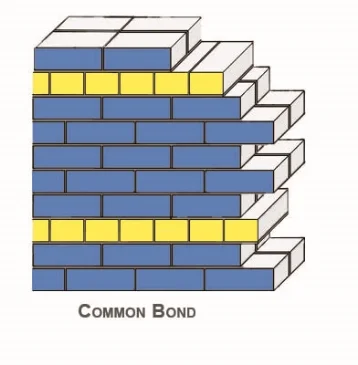
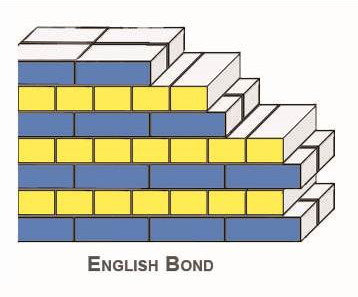
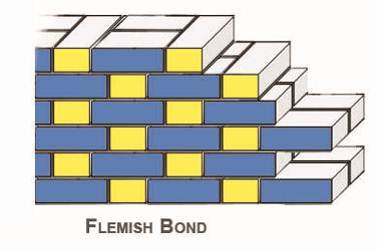
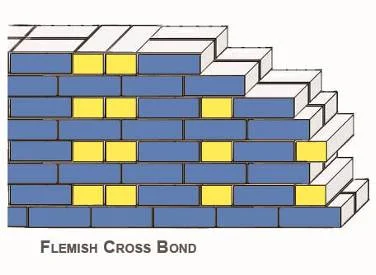
Below are a few of the traditional brick patterns with origins in structural stability that are still used today, even though they are commonly a mere cosmetic addition. Take a look next time you walk around downtown, you may notice these patterns, and perhaps even more elaborate ones.