
Improving TxDOT Streets in Downtown, TX
December 2017 Main Street Matters
Written by Riley Triggs, Architect, Texas Main Street Program
Usually the design processes the Texas Department of Transportation (TxDOT) uses for its roadways through downtowns does not allow for considerations beyond the curb line of the roadway. The process traditionally only took into account automobile needs—especially those having to do with mobility, which is engineering terminology for speed. The normal procedure is a “design and defend” process where TxDOT designs a
roadway, and then it defends the finished concept to the community affected. The method does not allow for community input until it is too late to incorporate substantial input in a meaningful way. This leads to contentious meetings and ultimately roadway projects imposed on an often-unreceptive community. To remedy this, TxDOT is the first state transportation agency to adopt a new process called Context Sensitive Solutions (CSS) that thoughtfully and deliberately identifies stakeholders, encourages early and continuous community involvement, and incorporates stakeholder input into the design at the beginning of a project.
Developed by the Institute of Transportation Engineers (ITE) in partnership with the Congress for New Urbanism (CNU) and in cooperation with
the Federal Highway Administration (FHWA) and the Environmental Protection Agency (EPA), the Context Sensitive Solutions (CSS) approach is an
interdisciplinary collaborative effort to involve all stakeholders in a project. The goal is to produce a roadway that “fits its physical setting and preserves scenic, aesthetic, historic and environmental resources, while maintaining safety and mobility.” (FHWA) In other words, it takes into account all of the stuff beyond the curb line that it didn’t before. CSS was adopted by TxDOT in 2009, but many people might not know it exists or what it entails.
Achieving a Context Sensitive Solution according to ITE involves a set of common tenets:
- Balance safety, mobility, community, and environmental goals
- Involve the public and stakeholders early and continuously
- Use an interdisciplinary design team tailored to project needs
- Address needs of all users
- Apply flexibility inherent in design standards and guidelines
- Incorporate aesthetics as an integral part of good design
CSS differs from the conventional TxDOT design process. Conventional street design is dominated by traffic demand and level-of-service objectives, while the CSS process is intended to identify critical factors and issues and use this information to establish the project’s objectives and design criteria. The process considers all community objectives so the resulting solution is based on a well thought-out and rationalized assessment of tradeoffs. Essentially it is trying to return streets to the way they were before automobilization. A significant part of this calls for thinking about people again and not just cars. The hallmark quality of CSS is that walkability is the main goal of street design rather than the fast
throughput of cars. By prioritizing the safety and comfort of people on foot with lower speed limits, shorter crosswalks, parallel parking, reduced lane widths, and two-way streets, there is an increase in neighborhood desirability and value through attracting better development with more housing and shopping and higher real estate values. The TxDOT Project Development Process Manual states that, “CSS principles exercise flexibility and creativity, preserve resources, and enhance the community,” which leads to a more holistic and sensible approach to streetscape
improvements.
Included in CSS are standards for different urban conditions. The most applicable for Main Street communities is their Urban Center Context for
creating good quality commercial streets. According to a report prepared for the New Jersey Department of Transportation (Scoring Formula for New Jersey’s Main Streets, Rutgers University, March 2003) and based on a visual preference survey, the attributes of a main street that positively affect how people view the street include:
- The proportion of street frontage with active commercial uses
- A low proportion of street frontage with dead space such as vacant lots, parking lots, and blank walls
- The proportion of the street frontage with parked cars generating activity, providing a buffer between traffic and the streetside and slowing traffic
- The proportion of the street with a tree canopy
- Width of sidewalk, with wider facilities providing more public space and greater levels of activity
- Visible curb extensions that provide for shorter crossing distances and space for plantings, street furniture, and traffic calming
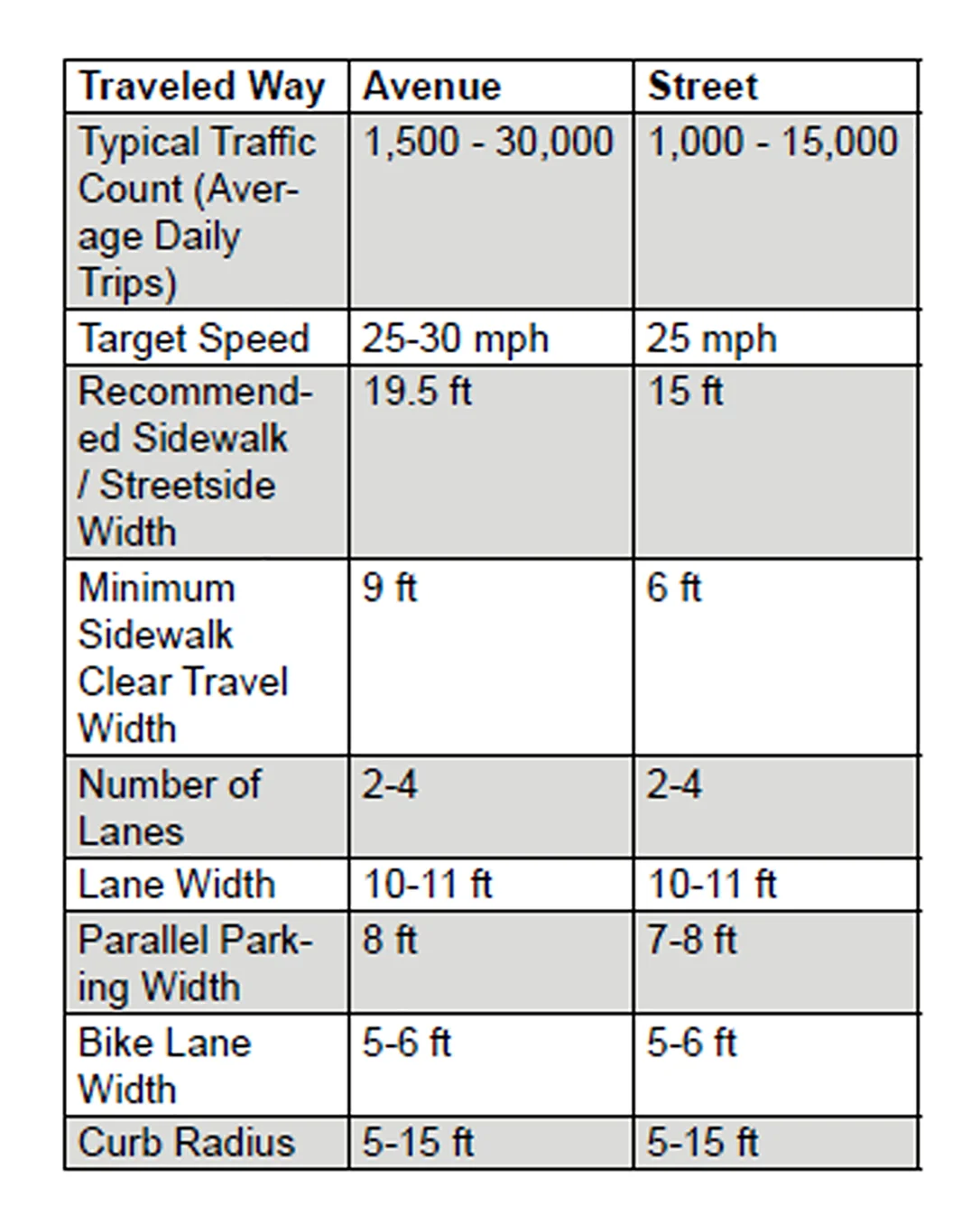
(Figure 1) Street Design Guidelines for Urban Cores. Source: Institute of Transportation Engineers http://library.ite.org/pub/e1cff43c-2354-d714-51d9-d82b39d4dbad
Attributes of a main street that negatively affect how people view the street include:
- A high proportion of street frontage with dead space such as vacant lots, parking lots, and blank walls (a negative response is associated with more blank walls)
- The number of travel lanes, where streets with more than two lanes are perceived as having higher speeds, more traffic, longer crossing distances, and a less attractive appearance
Guidelines applicable to typical Texas downtown situations are found in the CSS manual under Avenue and Streets in Urban Cores (Figure 1). They are very similar to each other, with the main difference being the width of right of way and volume of traffic being handled in each situation. Of note is that smaller lane widths and speed limits are appropriate for high volume situations up to 30,000 average daily trips per day. Above this volume, cities might consider petitioning TxDOT to relocate the route out of downtown depending on the particular situation. Desirable design factors then are determined by this volume to create an appropriate environment for people.
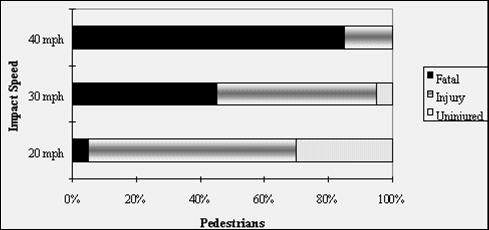
(Figure 2) Pedestrian survival rate by vehicle impact speed Source: FHWA http://safety.fhwa.dot.gov/ped_bike/pssp/background/psafety.cfm
Vehicle speed is of great concern in downtown streets. It is a major factor in determining the survivability rate of a vulnerable user such as a pedestrian or bicyclist. The character of the urban environment with its many visual distractions makes lower target speeds more appropriate.
Especially for pedestrians and bicyclists, minor increases in speed can profoundly affect crash survival rates (Figure 2). The difficulty in remedying this is that the usual street standards encourage speed.
For example, Paris, Texas has one-way couplets on US Business 82 and US 79/271 that meet at their town square with 3 one way lanes at 15 feet wide circling the plaza, which cuts off their major downtown feature, the Culbertson Fountain, from being accessible by people. It also creates the illusion of a higher speed thoroughfare, which leads to higher traffic speeds.
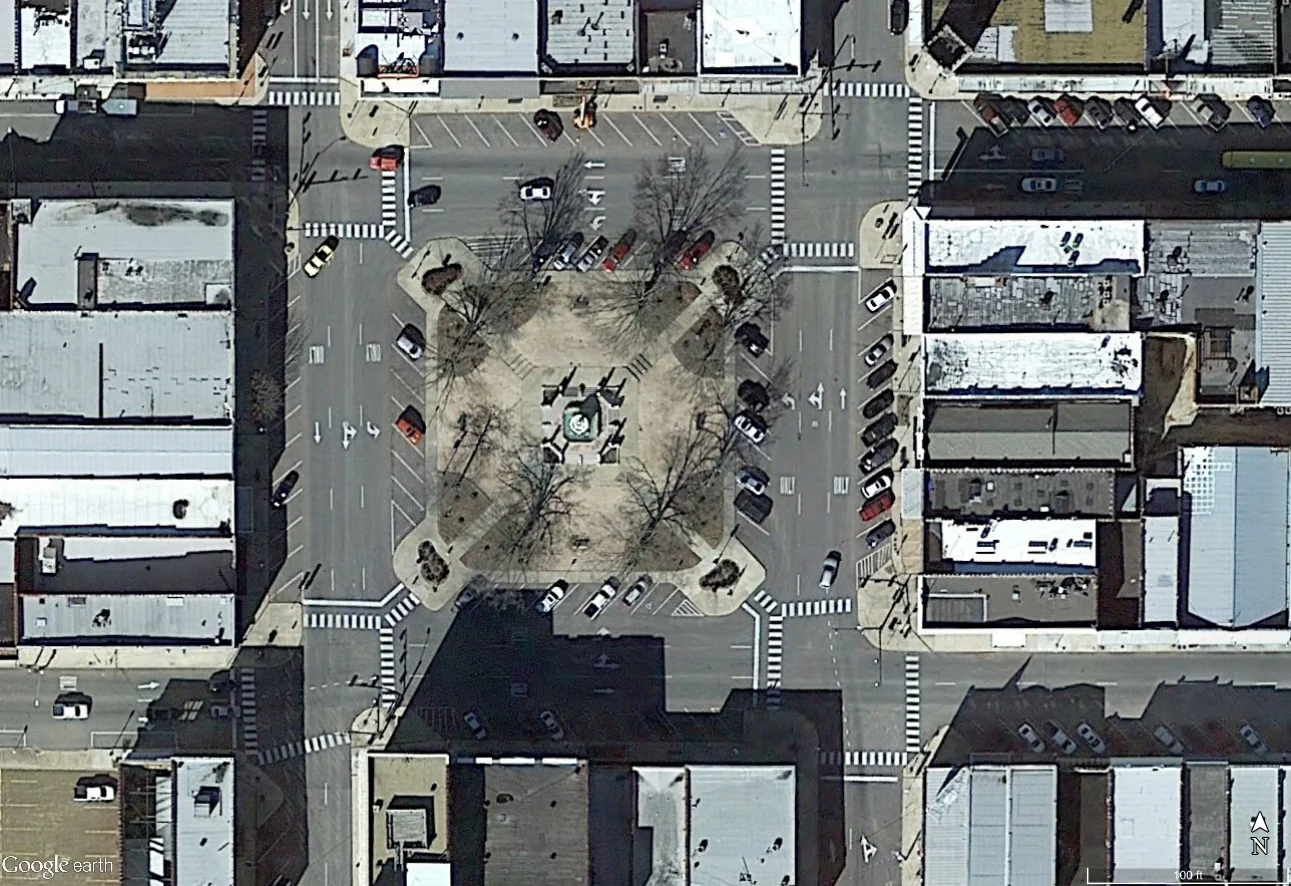
The Plaza in Paris, Texas isolated by one-way multi-lane streets. Source: Google Earth
For comparison, the Interstate Highway System standard for lane widths is 12 feet. The wide lanes in Paris are probably meant to accommodate large turning trucks at the intersections, but this creates a huge barrier of dangerous pavement for people to traverse, which limits pedestrian accessibility and directly hurts the economy of downtown. This suggests that the trucks should be routed to the existing highway bypass to allow for more urban-appropriate street configuration. In addition, how curbs are configured is also an important component of reducing speed and creating the CSS walkable environment.
Curb radii affect the crossing width of streets, and the comfort and safety of pedestrians, so it should be as small as possible. Flexibility in the design of curb return radii revolves around the need to minimize pedestrian crossing distance, the type of vehicle designed for, and the combination of dimensions that make up the effective width of the approach and receiving lanes and the curb return radius itself.
Recommended practices from ITE include the following:
- A curb return radius of 5 to 15 feet should be used where:
- High pedestrian volumes are present
- Volumes of turning vehicles are low
- The width of the receiving intersection approach can accommodate a turning passenger vehicle without encroachment into the opposing lane
- Large vehicles constitute a very low proportion of the turning vehicles
- Bicycle and parking lanes create additional space to accommodate the effective turning radius of vehicles
- Low turning speeds are required or desired
- Occasional encroachment of turning school bus, moving van, fire truck, or oversized delivery truck into an opposing lane is acceptable
- Curb radii may need to be larger where:
- Occasional encroachment of a turning bus, school bus, moving van, fire truck, or oversized delivery truck into the opposing
lane is not acceptable - Curb extensions are proposed or might be added in the future
- Receiving thoroughfare does not have parking or bicycle lanes and the receiving lane is less than 12 feet in width
- Occasional encroachment of a turning bus, school bus, moving van, fire truck, or oversized delivery truck into the opposing
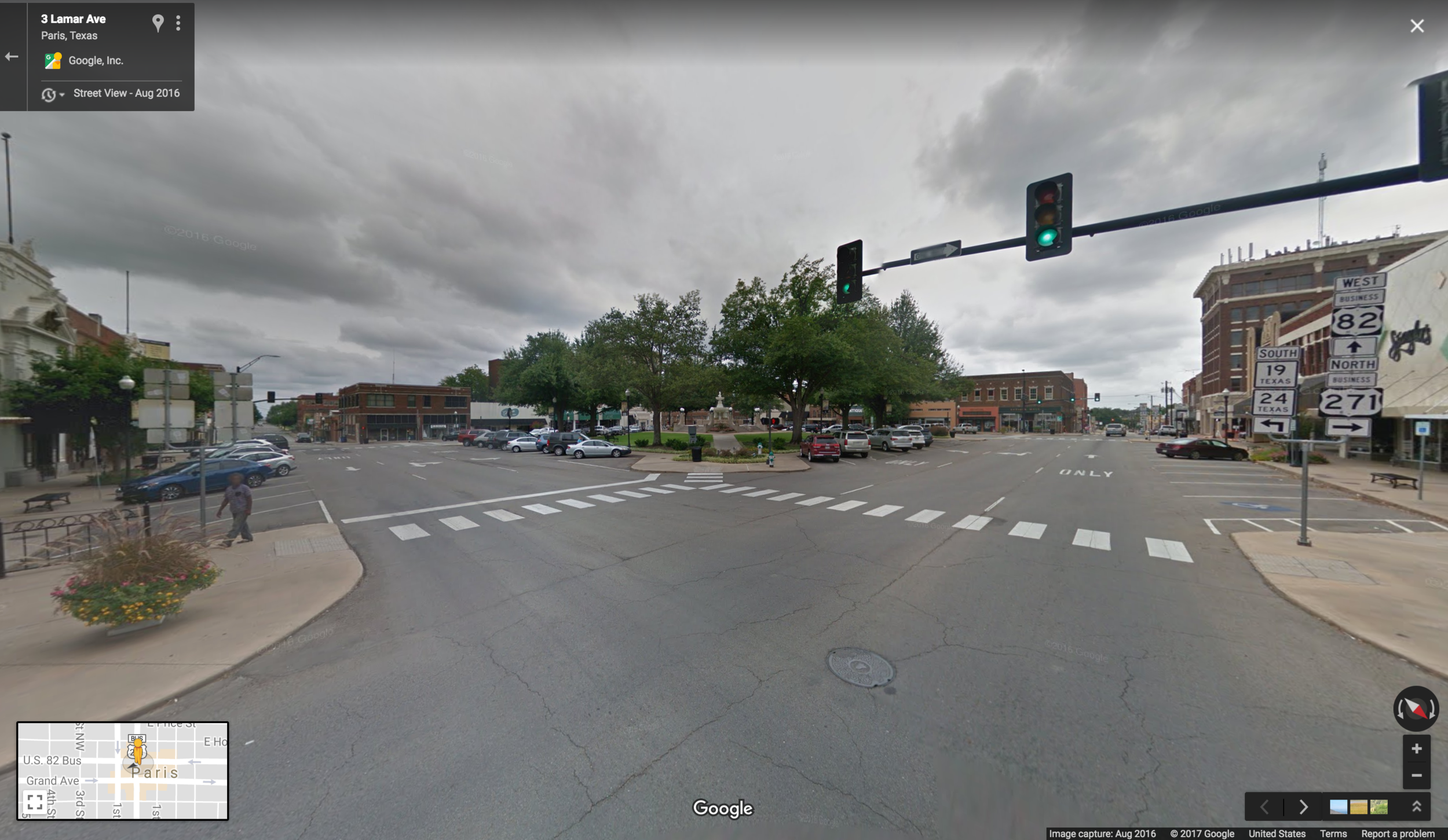
Car-centric wide one-way lanes, lengthy pedestrian crossings, and large curb radii create an inhospitable environment for people around the Plaza in Paris, TX. Source. Google Maps
To accomplish these better standards, TxDOT’s Project Development Process Manual suggests CSS as an alternative process for realizing projects. All TxDOT projects are eligible to employ this alternative except for maintenance and restoration projects. Each District Director of Transportation Planning and Development is responsible for which projects implement the CSS process in their district. To find your District Director visit https://www.txdot.gov/inside-txdot/district.html.
If employed, the CSS process first directs the district to identify stakeholders in the project area, and then to coordinate CSS workshops for partners and stakeholders to present the CSS method and to establish project visions, goals, objectives, issues, and opportunities. After establishing contacts and possibly creating teams, ongoing feedback is conducted to ensure that the project vision is maintained and that individual goals are being properly considered and met during the design development. Project stakeholders are encouraged to sponsor workshops and meetings throughout the project to maintain good communication with TxDOT.
Advantages to employing the good street making guidelines of CSS include reducing congestion by making walking a viable alternative to driving,
enhancing citizen safety through reduced accident death rates, expansion of economic opportunity through better connectivity and environment, and better air quality through reduced auto emissions. But these enhancements to the quality of Texas downtowns cannot occur if CSS is not used.
Other states have also employed CSS or similar standards in revitalizing their main street economies. Oregon created a set of guidelines specifically to address the importance of good street design in their historic districts with the Oregon Main Street Transportation Manual http://www.oregon.gov/LCD/TGM/docs/mainstreet.pdf. In 2002, Kentucky created the Kentucky Streetscape Design Guidelines for Historic Commercial Districts https://transportation.ky.gov/Local-Programs/Documents/Kentucky%20Streetscape%20Design%20Guidelines.pdf, which is geared toward sometimes – difficult situations of working with historic conditions to solve current problems like traffic volume and parking.
The Town Square Initiative (TSI) is exploring how to more fully take advantage of the CSS process for Texas downtowns. One possibility is encouraging TxDOT to adopt the CSS walkability standards as a downtown standard or a more targeted set of guidelines for historic communities as have Oregon and Kentucky. This would help Texas Main Street communities tremendously by removing the onus of having to fight for good
placemaking practices, which can be impossible because of limited staff, expertise, and political clout required to realize a non-standard solution. The result would be a much more people-friendly streetscape, a more economically viable city core, and ultimately lead to a preservation of the valuable historic fabric that we work to protect every day.
References
Designing Walkable Urban Thoroughfares: A Context Sensitive Approach manual: http://ecommerce.ite.org/IMIS/ItemDetail?iProductCode=RP-036A
Institute of Transportation Engineers Context Sensitive Solutions page: https://www.ite.org/css/
Federal Highway Administrations CSS page with case studies: https://www.fhwa.dot.gov/planning/css/ Examples of Context Sensitive Solutions across the country: http://onlinepubs.trb.org/onlinepubs/circulars/ec067.pdf
Oregon Main Street Transportation Manual http://www.oregon.gov/LCD/TGM/docs/mainstreet.pdf