
Why is it hard to live in Downtown, TX? Mixed-Use Building Code Issues in Historic
Buildings
November 2016 Main Street Matters
Article written by Riley Triggs, Architect, Town Square Initiative, Texas Main Street Program
In postwar America, zoning ordinances designed to separate differing uses combined with HUD and FHA financing programs that encouraged
low-density, detached single family dwellings to proliferate outside of our urban cores. This began the decline of downtown living because those
strategies served to move wealthier residents out of our cities and to concentrate poverty in urban centers. This lead to the general drop in care of
building stock, and downtown living acquired a stigma for citizens and governments alike. Higher property values and subsequently higher tax
bills put more pressure on living options downtown because lease rates were lower in the increasingly blighted downtowns. This compelled
property owners to leave buildings vacant and unmaintained rather than to seek tenants and to bear the costs of properly caring for their buildings
and having property values and taxes increase.
These conditions are largely still in effect today in many of our Texas Main Street towns, but with generations from Baby Boomers to Millennials
seeking affordable quality urban experiences, there is a potential market and a growing interest in reinhabiting and revitalizing our small town
Texas urban cores with upper story residential uses.
There are, however, even more barriers now to realizing a vision of livable, walkable, and revitalized downtowns than those that caused their underutilized state to begin with. This includes off-street parking requirements, deteriorating building stock, antiquated water and wastewater
systems, and absentee investor property owners. Another common and significant barrier to reinhabiting upper-story residential spaces in historic
downtown Texas are building codes that are intended to improve the general health and safety of our cities.
Some of the common codes and regulations that come into play when thinking about reoccupying second-story historic structures in Texas are the locally adopted building codes possibly with amendments for special fire districts, the Secretary of the Interior’s Standards for historically
designated structures, and the Texas Accessibility Standards (TAS) to comply with the Americans with Disabilities Act (ADA). This article will address
only the largest obstacle to upperstory residential units in historic structures, which is the building code.
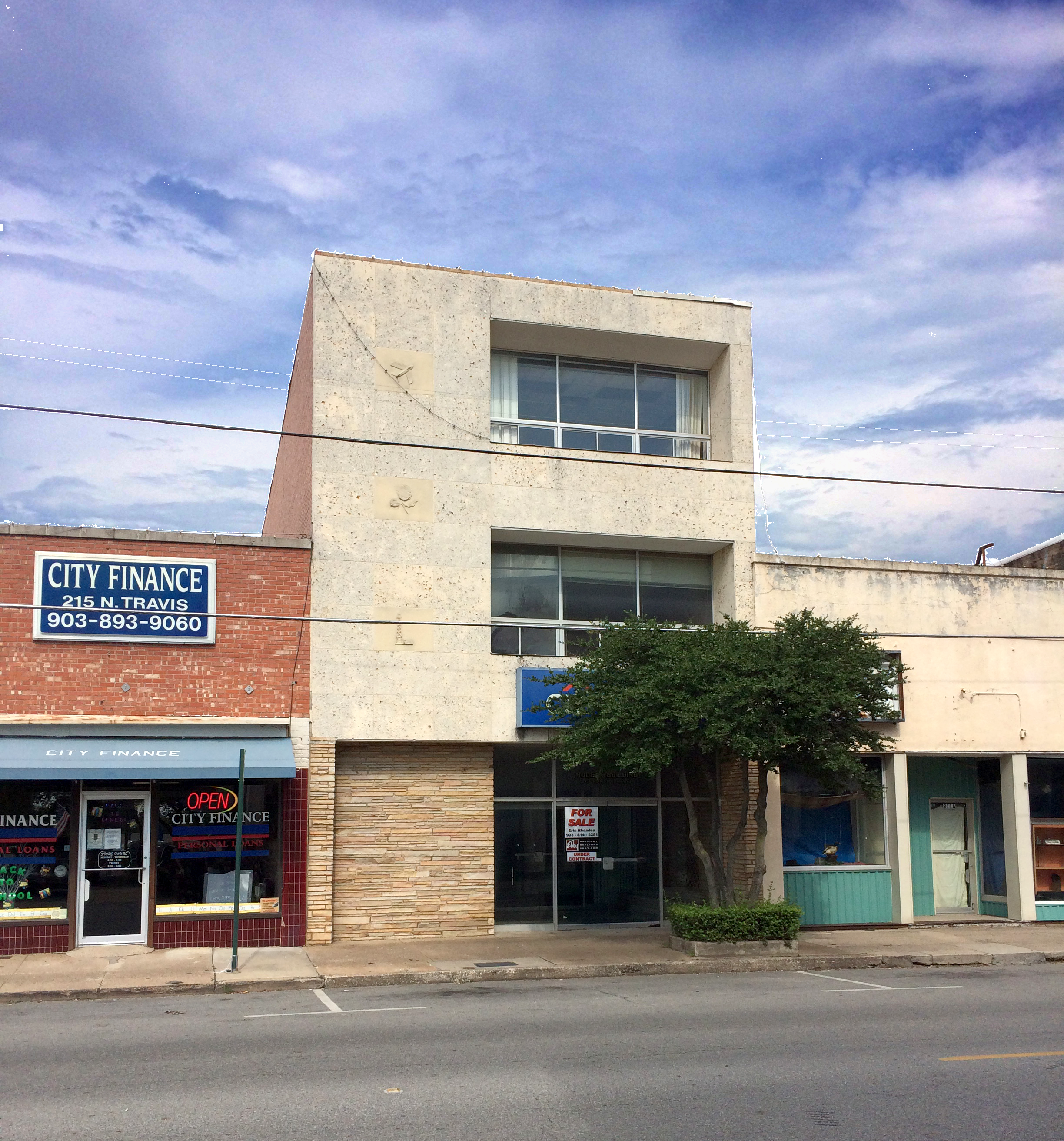
A small 1930s office building is being converted to upper-story residential units in Sherman.
Generally, building authorities in Texas have moved from the Southern Building Code (SBC) and the Uniform Building Code (UBC) to either the 2009 or 2012 International Building Code (IBC). In the IBC, mixed-use buildings, like having residential above a commercial use, are more stringent and difficult to deal with because of the differences in how aware people are to dangers according to the different ways they occupy a building.
The type of occupancy and use takes into account hazard levels of each activity and awareness of occupants to dangers. The commonly found mixes of occupancies in downtowns are referred to in the code as Groups A, B, M, and R. Generally found on the first floor are the commercial occupancies of Group A (with assembly type uses of people in restaurants, art galleries, community halls), Group B (with business uses like banks, professionals, dry cleaners) or Group M (uses of mercantile businesses like retail, drug stores, and markets) with Group R being the residential component on the upper stories creating the mixed-use situation. Typical downtown mixeduse residential is further classified as Group R-3 for not more than two dwellings and R-2 for more than two dwellings.
Usually residential occupancies in downtown fall under the commercial IBC code instead of the International Residential Code (IRC) because they are either attached dwellings–the buildings are physically attached to other buildings instead of freestanding detached dwellings or townhomes on individual properties- and/or because of the mixed-use occupancy in a single building. A building that is not attached to another structure and has an R-3 residential occupancy could be built under the IRC and not under a more stringent IBC. Unfortunately, this is a rare case in downtowns as most of the buildings are both attached to adjacent structures and are mixeduse. Additionally, if a building is in a specially designated fire district or other area, it may be mandated that the buildings be under the commercial IBC code regardless of their occupancy type and use.
Separation is required between different occupancies based on the relative level of danger and time to escape and fight fires in different use
situations. Separations are expressed at the time the particular type of construction resists a standardized fire test. The higher the separation rating, which ranges from one to four hours, the higher the cost of construction because of the increase in quantity and construction methods required to be used. In addition, the type of use dictates other safety measures. The mixed-use combination of these occupancies is what triggers a sequence of code issues.
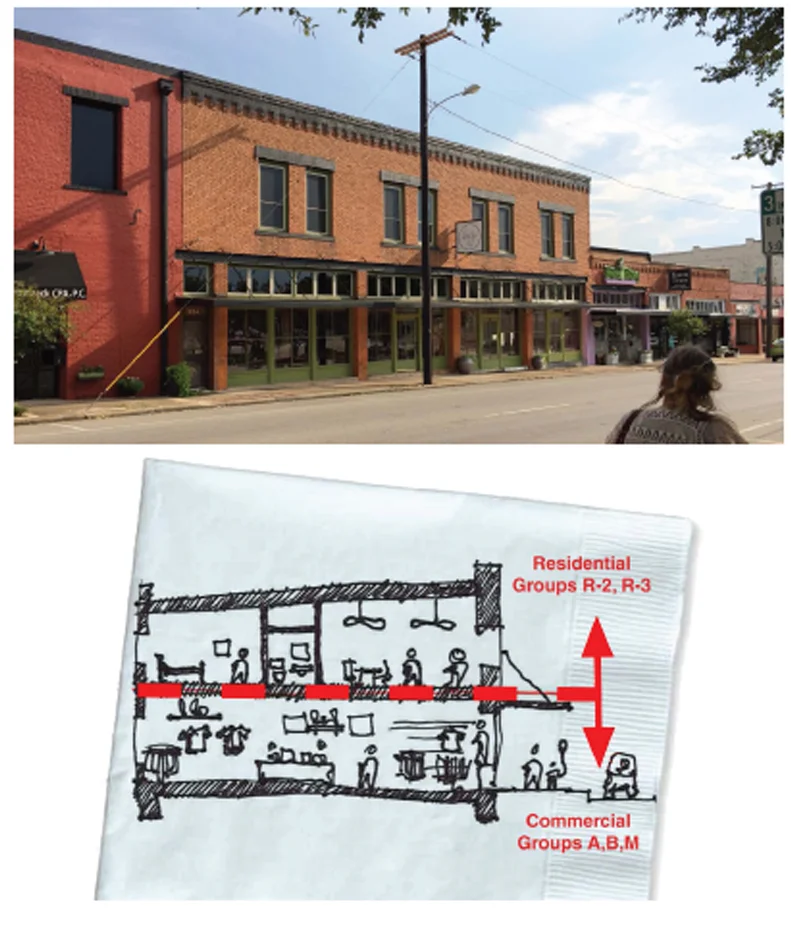
(Top) An empty second story space above an otherwise vibrant streetscape in Sherman. (Bottom) Typical mixed-use occupancies in Texas downtowns.
This difference in residential and commercial code and construction standards is a source of frustration for inexperienced building owners like those who wish to relocate from a single family home to downtown or residential developers expecting to be able to operate as they are accustomed to under the less-stringent IRC. The implications of being under the IBC are expensive, and the single largest code barrier for residential reinhabitation downtown is the requirement for a fire sprinkler that is initiated by the mixed-use nature of downtown and falling under the IBC instead of the IRC. This requirement comes from Chapter 9, Section 903 Automatic Fire Sprinklers of both the 2009 and 2012 International Fire Code, 903.2.8 Group R An automatic sprinkler system installed in accordance with Section 903.3 shall be provided throughout all buildings with a Group R fire area. The costs of fire sprinkler systems are usually not a problem in normal commercial situations, but buildings in typical small Texas downtowns command lower rent at the moment, which makes cost more of an issue–especially if it is unexpected. Usually at $1-$3 per square foot in new construction, costs can be anywhere from $2-$7 in existing commercial buildings, and in rare cases, retrofitting in sensitive historic structures can cost upwards of $10+ per square foot because of the increased care and difficulty of installation (National Fire Safety Association). For a normal existing downtown building that measures 50’ x 100’, that can add $20,000-$70,000 to a project, which can hinder the ability of small developers and small business owners to execute a renovation of upper story residential living.
This assumes that the existing city water lines are up to code and can handle the volume and pressure necessary for commercial sprinkler systems. If not, the cost to upgrade a line can be disproportional to the revenue generated by inhabiting the upper stories, which again can be a hurdle that leaves otherwise perfectly good buildings underutilized.
Further adding to the cost is the requirement for installation of fire alarms and sprinkler monitoring, which is also unfamiliar territory for many building owners. Along with this come requirements for dedicated phone lines and direct outside access to the alarm and sprinkler facilities for
inspections and fire rescue use during emergencies. Sprinkler and fire alarm costs are, however, somewhat balanced by reductions in insurance premiums, not to mention the increased health and safety of buildings and people in the entire city.
All of these items discussed are normal occurrences in today’s development and building world, but often owners of our downtown buildings are individuals with little or no experience in commercial development. Compounding the problem is that many of these owners do not retain the services of registered architects who would be able to set realistic expectations, address code requirements, and help navigate the permitting
process.
The cost savings of not hiring a professional are often immediately lost by delays, mistakes, and redoing or addressing code items late in the construction process, which add expense and frustration to the project.
This translates into lingering dissatisfaction with doing projects downtown, which ultimately discourages further projects and revitalization efforts in the entire downtown area, landing us back right where we started with vacant and underutilized buildings in our historic downtowns. To avoid
this cycle, Main Street managers should be able to communicate the following key code concerns for property owners—perhaps in a simple booklet and/or on your web page:
Typical code requirements and permitting process for your downtown, including contact information for local building and fire officials.
Realistic expectations for your property owners in terms of code requirements, enforcement penalties, and costs.
List of architects, engineers, contractors, and trade craftsmen who have worked in your downtown and/or have a specialization in historic commercial buildings.
Why it is important for buildings and downtowns to be fully utilized, and how this will translate into higher revenues and a better city.
Examples of successful projects and tips from experienced building owners on how to avoid common mistakes and pitfalls.
By better communicating and setting realistic expectations on the technical and permitting process side of reinhabiting downtown buildings, there is a much better chance of success on individual projects, which will encourage other building owners to follow suit. This will create a positive and infectious atmosphere of vitality that will carry over to business owners, customers, and residents leading to faster realization of revitalization efforts in your own Downtown, TX.