
Mural Considerations from a Design Perspective
July 2013 Main Street Matters
Article written by Audrey Holt, Project Design Assistant, Texas Main Street Program
A mural can be an exciting and beautiful addition to downtown when carefully planned and executed. Murals are desired for many reasons: to act as a gateway or entrance to downtown, to brighten and add color to a location, to advertise a business or product, to depict a city/region’s heritage, or to tell a story. When done well, a mural can accomplish many of these things as well as foster a sense of community involvement. Choosing the right surface, materials, and artists are key design issues to consider in ensuring a successful mural project.
Choosing the right surface
An ideal surface for a mural is an already plastered or stuccoed wall with a very smooth texture. If the existing texture is not very smooth, a mural that does not have a significant amount of small detail is suggested. In a simpler mural, the texture is not as important. It is possible to apply products to make the wall surface smoother in the higher detail areas. The wall should be cleaned (no sandblasting at all or power washing over 200 psi) and primed before the mural is begun. Ensure that after cleaning the surface is allowed to dry completely before priming or painting. A wall with loose paint or extensive cracking is not a good candidate, as these are indicative of serious issues that will likely carry over onto the mural, even if repaired before the mural is begun. If there is an existing coating on the surface that cannot be removed, proceed with caution as it may not be compatible with the paint to be used. It is usually a good idea to test the wall’s pH levels which measures the acidity or alkalinity of the surface if any issues are suspected. Inspect the wall to ensure that there are not visible moisture issues. If there are moisture issues on a wall, this moisture will be very detrimental to the longevity of a mural. Metal walls can also be a good candidate for a mural surface. Choosing a north facing, or otherwise shaded wall, will help minimize fading.
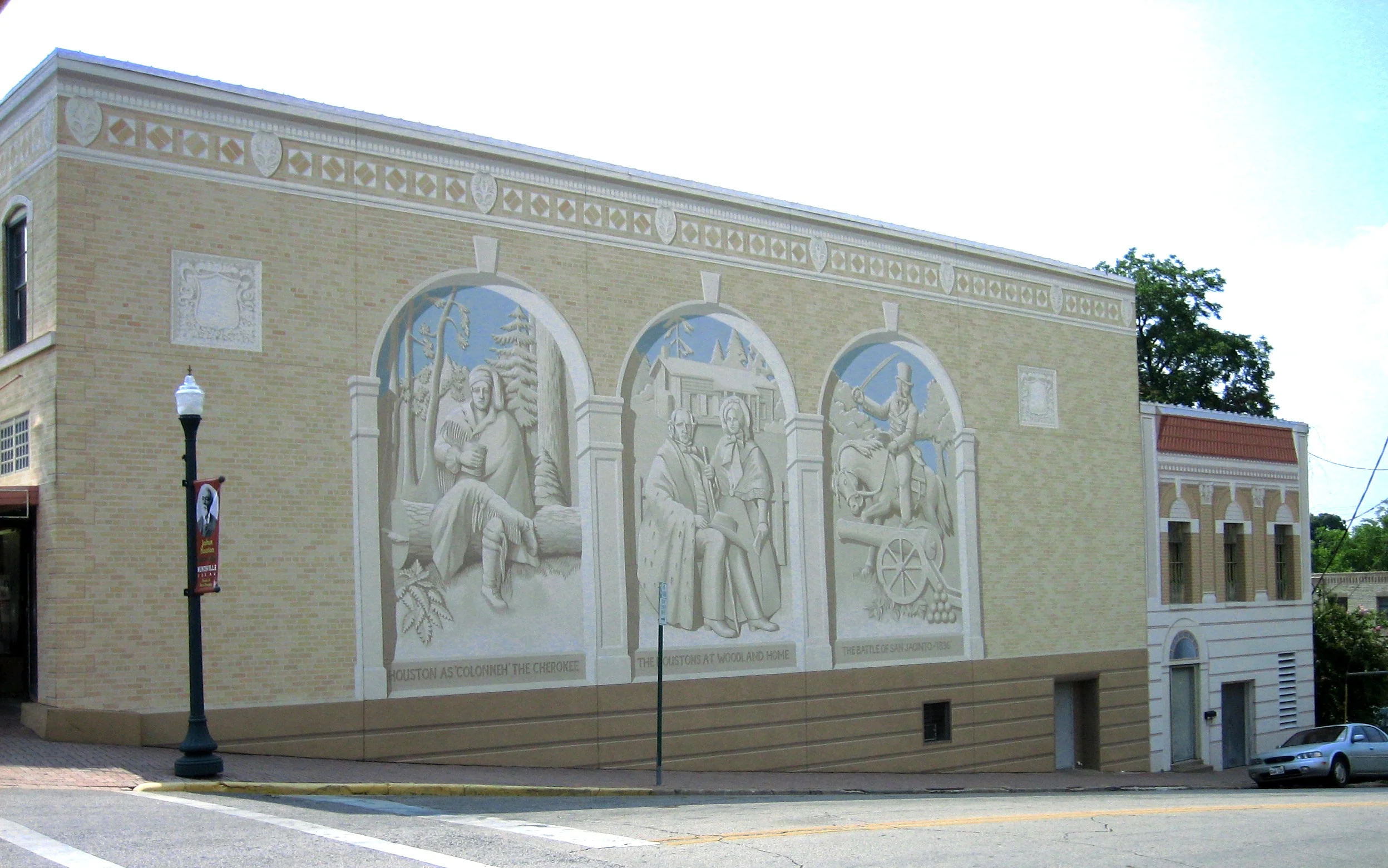
Murals can give an illusion of reality such as this Trompe l’oeil mural in downtown Huntsville.
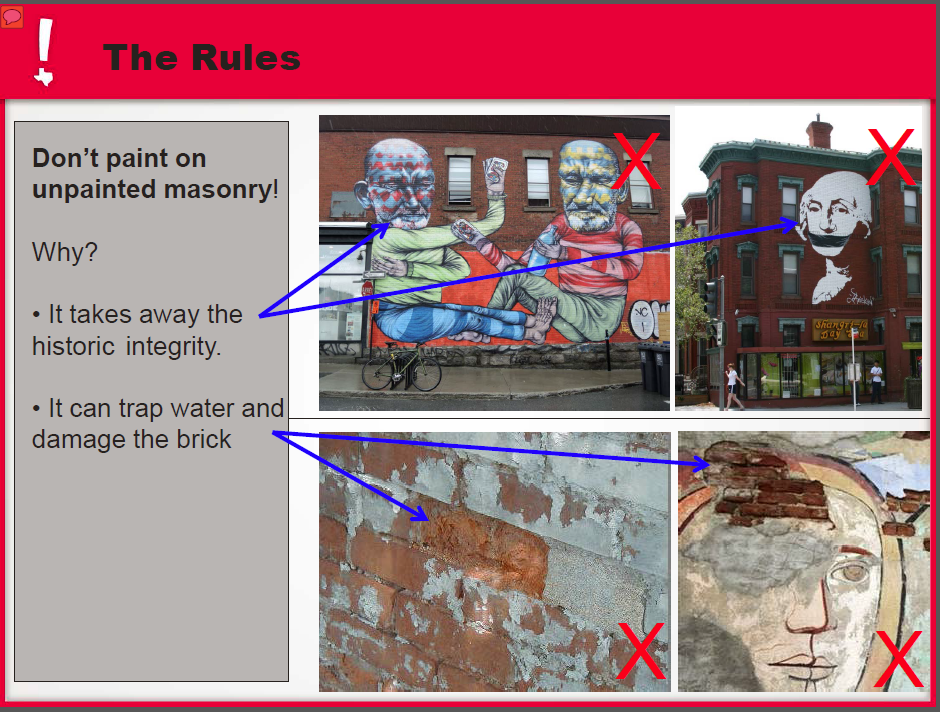
A brick surface that has not previously been painted should not have a mural painted on it. Painting masonry creates an ongoing maintenance problem and can potentially cause brick failure. Normally occurring moisture originating from within the building (showering, cooking, even breathing) makes its way through the brick on its way to the atmosphere. To allow for this, brick is designed to breathe so that moisture can pass through the brick and evaporate. When trapped by the layers of paint, moisture buildup causes paint to bubble and peel. After a relatively short period of time this paint failure necessitates the application of a new coat of paint. Moisture trapped within bricks will also directly cause the bricks themselves to deteriorate and fail. In a freeze, the trapped moisture will expand the brick, which can cause cracks as well as the surface of the brick to pop off, a process known as spalling. If a brick surface is already painted, it can be considered for a mural as long as the texture of the brick and the potential decreased longevity of the paint application is taken into account. If an unpainted brick surface is found to be a highly desirable location for a mural, as much surface area as possible should be left unpainted (see the Midland, TX example). This will allow the brick wall to still breathe through the unpainted areas.
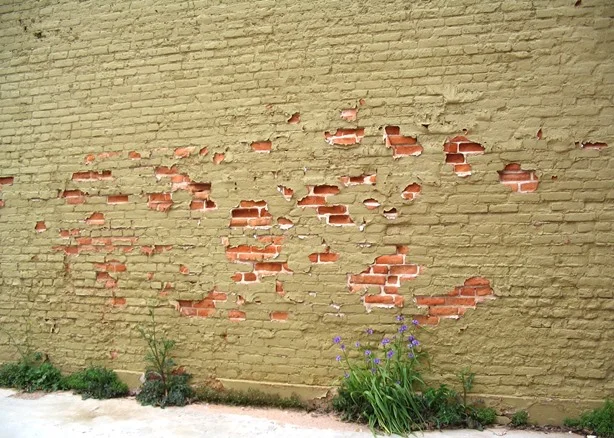
Prepare the surface correctly. Paint has created moisture issues and the surface of the brick has spalled off. Bastrop, TX
In many instances, painting the mural on panels and mounting them to the building is the recommended course of action (see the Bill Haley mural in the spotlight article.) This method leaves the masonry intact and does not risk the building’s envelope. Some widely available materials for these panels are marine plywood or sign painters’ boards, often known as Crezon board, or even aluminum skinned panels. Before beginning a project, these surfaces must be well prepared according to the manufacturer’s instructions, and primed with a compatible primer. The edges and joints of the panels must be sealed and flashed to ensure water does not infiltrate. Panels have an advantage in that they can be painted in a conditioned studio. Conversely, if the mural painting is to be a community event, mount the panel, or series of panels, to the building and start painting. Use an armature or mounting system with rust and corrosion proof metal fasteners to attach the mural panels to the wall. This sets the panels away from the building to allow air to circulate behind so that moisture issues are not created. Drilling into masonry can allow moisture to seep into the brick, and cause the brick, or even the wall, to fail, so fasteners should be installed only through the mortar joints of a masonry building.
Materials
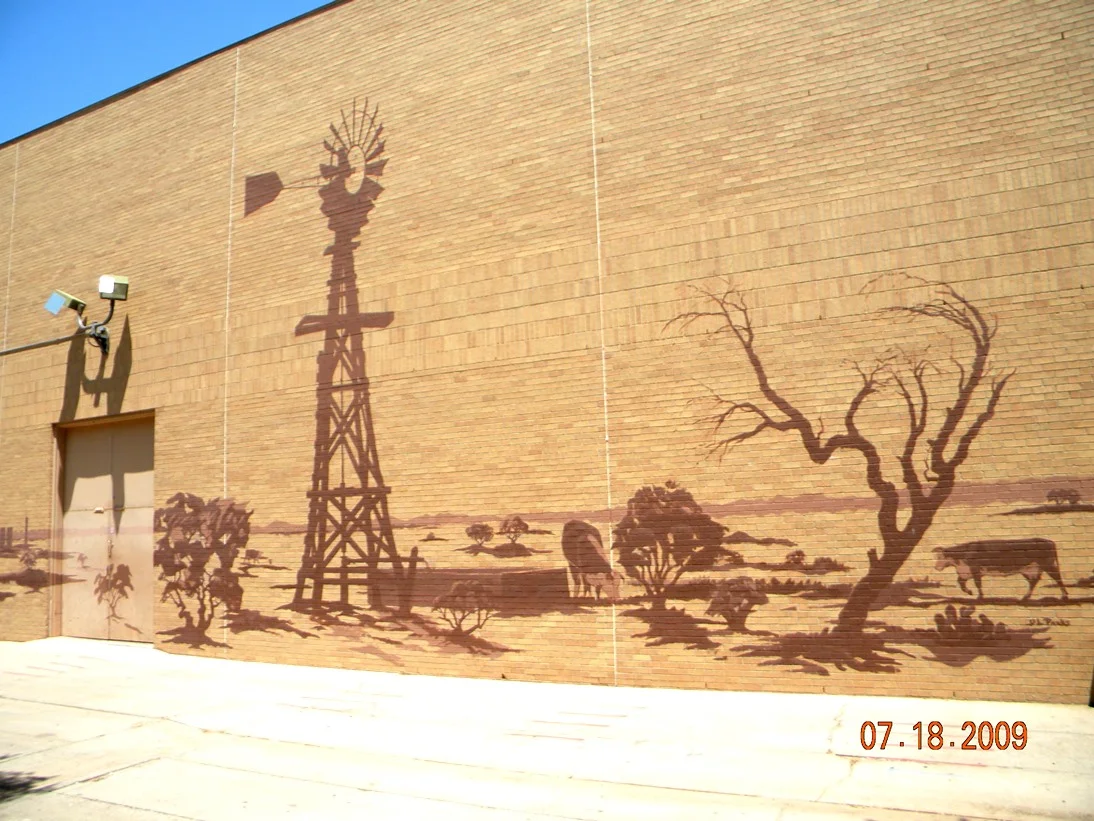
If painting on brick, do not paint the entire surface so that the brick can breathe. Midland, TX
High quality paint is recommended for exterior murals. Exterior house paint (acrylic latex) and artists’ quality acrylic paints are popular choices that come in a wide variety of colors, but that may have issues with fading. A harder medium can be added to increase durability. Silicate paints provide a more permanent bond with the surface, and are a good choice, although and industrial paints such as auto paint are options that can hold up well to the sun. The most important consideration is that the pigments have high light stability rating (lightfast rating of one is recommended) to limit fading. Titanium oxide white can decrease the colorfastness of the colors it is mixed with; therefore, it should never be used. Florescent paints are also not recommended because of the high potential for fading. Using all paints from the same manufacturer can ensure compatibility. Talking to mural artists and communities with existing murals about what products they have used helps provide accurate information on product longevity. Timing the mural so that the extreme weather conditions are avoided is necessary for proper and long lasting application. Too hot, too cold, or too humid weather conditions can decrease the lifespan of your mural. All colors and products used should be carefully documented in case they are needed for future touch ups, or in case of maintenance issues. Always look into health and safety issues related to the application of all products used for the mural, such as if a vapor mask is recommended. Local paint stores may donate the paint or materials in exchange for recognition. Stencils, charcoal and over-head projection are all design application tools that are helpful. Some of the necessary painting supplies are drop cloths, multiple width brushes, scaffolding or ladders (ensure proper harnessing is taken into account), access to clean water, small cups and large buckets to hold water, paint palettes and tape for straight lines.
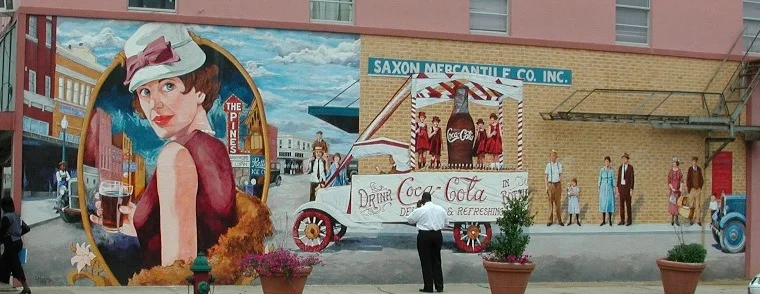
Coca Cola advertisement mural in downtown Lufkin, Texas Downtown Association award winner for mural series.
Once a mural is complete, sealers can provide protection for a mural. Before application, the pros and cons must be weighed. The most common reasons to desire a sealer are: to protect a mural from fading due to ultraviolet rays from the sun, to provide stain protection due to wear due to touch and dirt, and to allow for ease of cleaning if the mural becomes soiled or tagged with graffiti. Sealers can create very serious issues, such as yellowing, discoloration, clouding, peeling, and the trapping of moisture inside. If a sealer is decided upon it is important to use a breathable sealer that is chemically stable and compatible with the paint used. Before deciding upon a sealer, it is important to fully investigate the options. As when deciding upon paints, talk to other communities or mural artists who have used sealers, and get some recommendations of those applied on projects similar to yours. Contact the sealer’s manufacturer for information on the coating’s properties and recommended use. Test the sealer on a similar paint and surface, if possible, and assure that the manufacturer’s instructions are followed for proper application. It is better not to apply a sealer than to apply one that could damage your mural. It is also important to judge by the location and the amount of direct sunlight received on the mural area if a sealer is even necessary. A tree can be strategically placed to help with shading.
Choosing a design and artist
As mentioned in the Spotlight article, professional mural artists can be used. Another option is a community and volunteer lead mural. The design should have some cultural or historic relevance to the community or building. Designs should be presented to, and approved by, the Main Street Board. A rendering should be created to advertise what the final outcome will look like, as well as a basis for the mural itself. Advertising to the community allows the opportunity to ask for volunteers and increase community involvement.
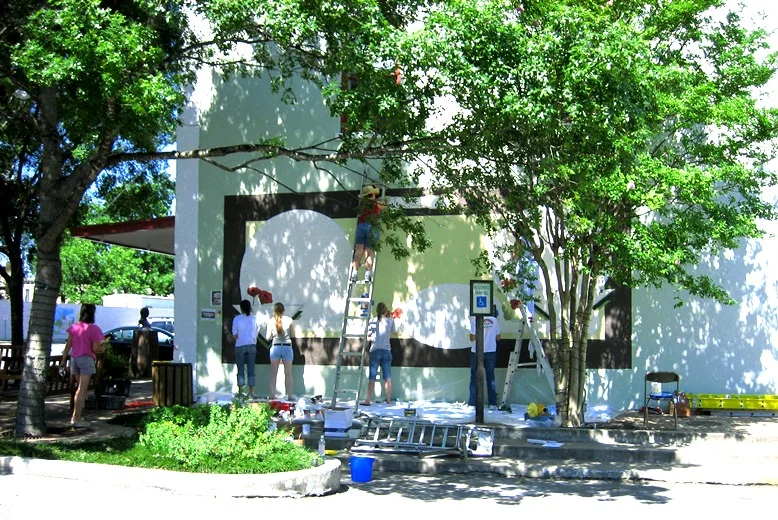
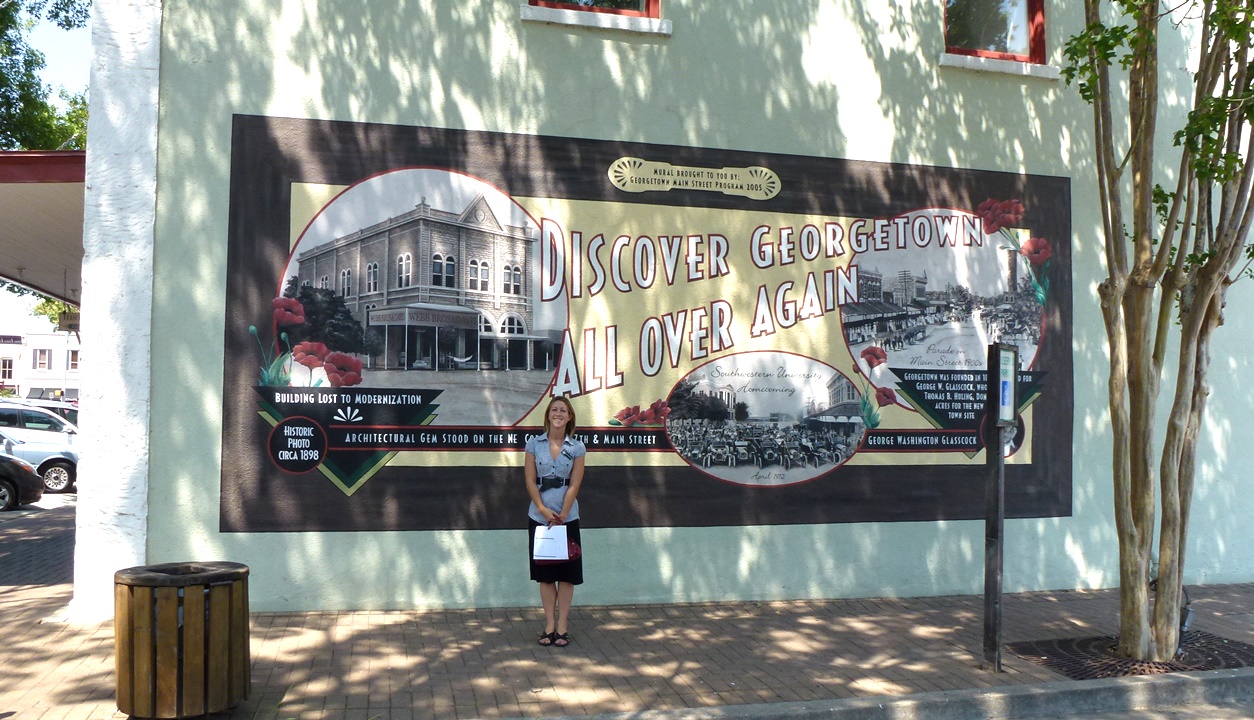
(top)Volunteers working on a community mural on an ideal shaded, stucco wall. Georgetown, TX; (bottom) Completed Georgetown mural “Discover Georgetown All Over Again” with coordinator and lead artist Sarah Jane Blankenship.
It helps to have one person in charge of the design and execution, and this person should be an accomplished artist. This person can be in charge of organizing the people painting and finishing the project. The person in charge of design should be able to identify the painters’ strengths and specific areas for them to paint based on their talents. However, you may find that these talents are revealed on site and you may want to switch them to different areas based on their talents. If volunteers are used, time blocks should be set up. You may find a few community artists that will ask if they can paint at their own pace, when the group is not working. This can be helpful if they are supervised or know the area they should work on. Kids are good press, but it can be difficult to get them to work for long periods of time, and quality should be carefully controlled. Two consecutive weekends organized for the community to work on the mural is a concentrated time that will keep the excitement level high. It is very possible it will not be done in two weekends, and the person in charge of the design and execution should expect to finish it, asking for additional help as needed. Document the entire process with photographs. Be sure to thank all volun-teers and artists at an official city meeting and present them with a token of thanks.
Webliography and sites to visit for more info:
www.cci-icc.gc.ca/caringfor-prendresoin-in-des/articles/murals/creating-eng.aspx
www.bikemural.org/muralprotection.html
MURALS IN HARLINGEN
For more information on Harlingen murals, mural artists, or other details involved in managing a mural program, contact Cheryl LaBerge, Downtown Manager (and article author), via email at cheryllaberge@myharlingen.us or by phone at 956.216.4910. Harlingen murals may be viewed on the website www.downtownharlingen.com.
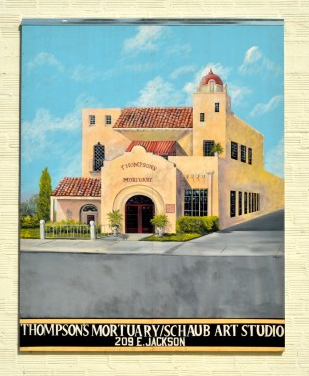
Thompson’s Mortuary/Schaub Art Studio featured in the Where the Past is Present mural collage.
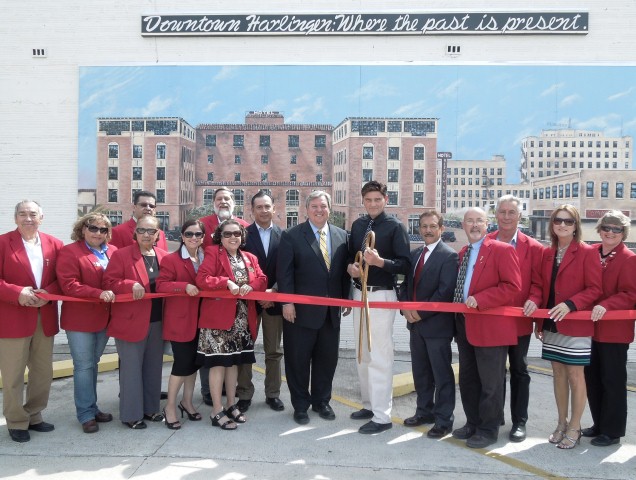
The ribbon cutting ceremony was held March 12.
With more than 20 murals downtown and many others citywide, murals have become a top tourist attraction for Harlingen. The Harlingen Downtown District has worked with partners to preserve, create, and promote murals since the 1980s. Mural maps, guides, and walking tours give locals and visi-tors yet another reason to spend time and, hopefully, money in restaurants, shops, and service businesses.
Murals help generate interest in and support for historic preservation, besides adding visual interest to plain walls and deterring graffiti. The colorful, larger-than-life-size format attracts attention. Downtown Harlingen deliberately commissions mural artists to tell stories and to celebrate aspects of the community’s history and culture.
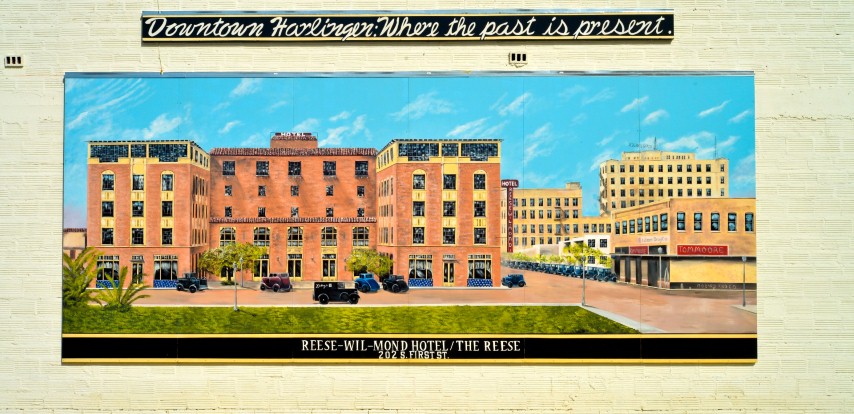
Downtown Harlingen: Where the Past is Present mural collage focuses on historic preservation and seven historic downtown buildings (two are featured) which have all been repurposed.
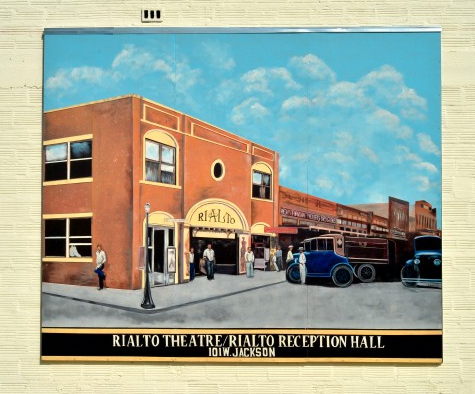
A good example is Downtown Harlingen: Where the Past is Present, a mural completed in March 2013, with funding in part from the Texas Historical Commission’s Texas Heritage Trails Program. It portrays the concept of adaptive reuse by showing seven repurposed down-town buildings as they looked previously, when open as a bank, hardware store, dress shop, post office, hotel, mortuary, and movie theatre. The mural (which is approximately 10 feet x 112 feet) was painted in full color by artist Brett Oberthaler from historic black-and-white photographs.
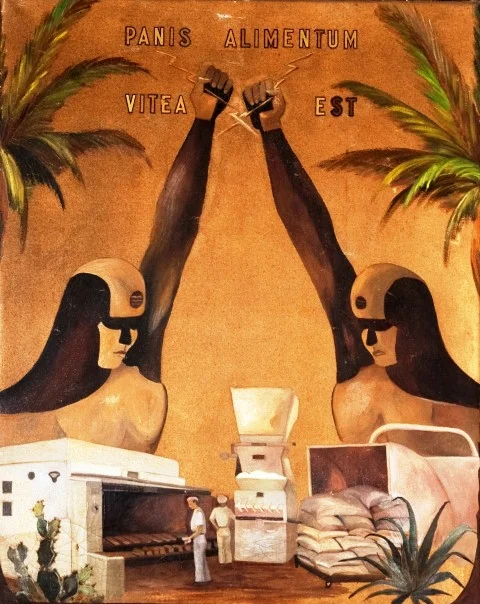
Story of Bread, detail of one section.
Oberthaler’s beautiful images make people notice and appreciate buildings they pass by every day and have taken for granted. Several Harlingen residents have commented that this new mural is their favorite because it prompts memories of “the way Harlingen used to be.” In the wake of publicity about the mural, more people are posting historic photos and old postcard images of Harlingen buildings on Facebook. Former residents are inquiring about properties and businesses they remember, and newcomers are asking what the buildings they work in used to be.
Downtown Harlingen also strives to preserve historic murals for future generations to enjoy. Three spectacular murals painted on canvas by the late Normah Knight had decorated walls inside Harlingen businesses for decades. In the 1980s, The Story of Bread (1948), the Development of the Rio Grande Valley (1951), and the Development of the Bottling Industry (1954), were carefully removed from the now defunct bakery, bank, and bottling plant where they hung and moved downtown, where they remain on public view.
In 2010, as part of Harlingen’s centennial celebration, a monumental mosaic mural was installed down-town entitled The History of Mexico and Mankind (see photos). This priceless work of art, consisting of 905 handcrafted tiles, was created in 1975 by the late Raúl Esparza Sanchez of Torreon, Coahuila (Mexico), for the California Museum of Science and Industry. Each of the nine panels depicts an aspect of Mexican legend and lore. How the mural was acquired and reassembled in Downtown Harlingen is a story in and of itself, involving many partners, chutzpah, and determination.
There is much to consider if you are thinking about a mural program to complement your historic preservation efforts. Here are tips that derive from years of experience:
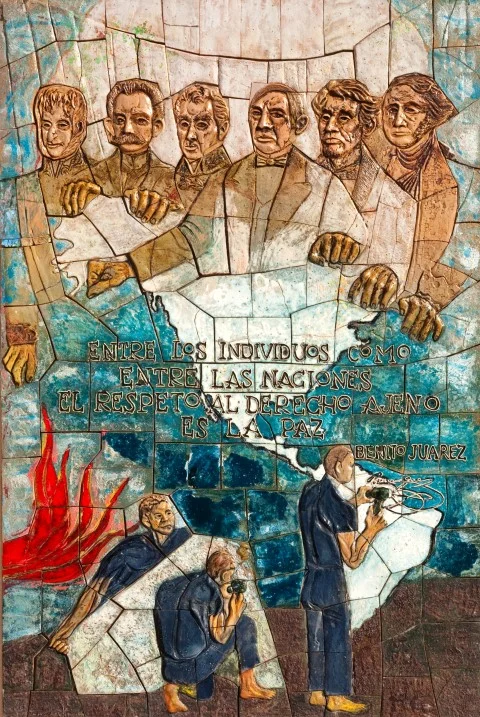
Detail of one panel in The History of Mexico and Mankind mosaic mural.
Goals
Be clear about what you want to accomplish with your mural program. Set goals, put them on paper, and stick with them. In 2003, when the Harlingen Convention and Visitors Bureau, Downtown District, Historical Preservation Society, and Keep Harlingen Beautiful joined together to create new murals, these partners set goals that addressed each organization’s respective needs. Ten years later, the partners have changed, but the goals endure: 1) to create more public artworks that attract visitors to Harlingen and entice them to spend more time exploring the city; 2) to revitalize downtown Harlingen and entice new merchants and more shoppers to the area; 3) to help preserve the history and heritage of the community; and 4) to beautify the city and add to the quality of life of citizens and visitors.
The goal is not just to make walls pretty. Nor is it to make political statements, or install works that shock or offend. Partner with organizations and individuals when goals align; wish them well when they don’t.
Subject Matter
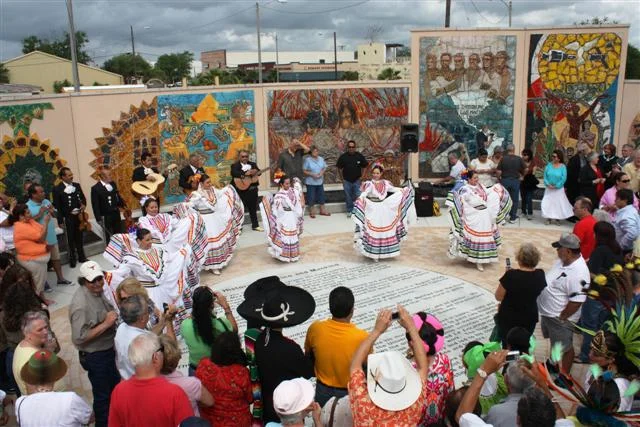
Centennial celebration at The History of Mexico and Mankind mural site.
Make a list of stories to tell about your community. Think about documenting key events, like downtown during World War II, or how people pulled together after a devastating hurricane or flood. The Harlingen mural entitled The Early Days (Jermain Steed, 2001) celebrates the coming of the railroad. Consider mural tributes to key individuals, organizations, prominent business people, or families. The mural, A Tribute to Bill Haley and His Comets (John Aretakis, 2003), memorializes Harlingen’s most famous resident, the legendary “Grandfather of Rock ‘n Roll.” Showcase your top agricultural products, sporting traditions like fishing, birding, hunting, or team sports. Tap into nostalgia with murals based on old photographs and postcards.
Locations

A Tribute to Bill Haley and His Com-ets, full mural on MDO board.
Walk and drive around the down-town district to identify walls where murals might be installed. Take pictures, measure, and note whether the walls are brick, block, concrete, stucco, or frame. Consider traffic patterns and walking tour routes. Talk with property and business owners to determine who is receptive to having murals on their buildings and on what topics.
Materials
Some Harlingen murals have been painted on Medium Density Over-lay (MDO) boards and affixed to buildings, rather than having artists paint directly on walls. This has been done for various reasons: to avoid damaging brick that had not been painted previously; to ensure that a work Downtown Harlingen owned could be removed from a building (private property) if it sold; and, to allow an artist to work indoors and at ground level rather than on a scaffold in the hot South Texas sun.
While artworks won’t last forever in the elements, be proactive in protecting them. An automotive clear coat (or two or three) is applied on the completed murals in Harlingen to retard ultraviolet rays. Flashing is installed along the top of the murals on MDO boards to prevent rain, mold, and mildew behind.
Money
If murals are a priority, allocate money in your budget for them. Engage partners who might help with cash or in-kind contribu-tions. Write grants if you have time to do so, and the ability to manage the record keeping and reporting the grant agency will re-quire. Develop a budget that is realistic and appropriate for the size of your project and your community.
No artist Downtown Harlingen ever hired was paid what they really should have been paid, if their time and talent is considered. But they understand the value in having a work on display downtown. It helps give artists credibility, build their portfolios, and gain other commissions. Do what you can to help them, acknowledge them, and promote them. Provide referrals when people call looking for mural artists for their projects.
Make clear how much money you have for the artist fee and what else your organization is able to pro-vide, such as work space, a paint budget, or MDO boards. If painting directly on a wall, who will be responsible for washing and priming it? Who will provide scaffolding and lighting? Where will the artist get electricity, if needed, and clean and store materials overnight? If an artist is willing to work within the stated parameters, fine. If not, so be it. Some mural artists price their services by the square foot. Those you likely can’t afford, especially if creating large works of 800, 1,200, or more than 2,000 square feet.
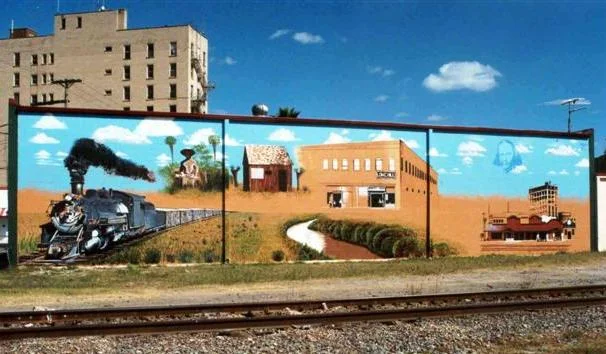
The Early Days mural faces the tracks on which the train arrived in 1904.
Artists
Working with artists can be fun and interesting; it also can be a challenge. As a project manager you likely are left-brained, organized, and detail-oriented. Many artists are the opposite. Even though there is an agreement on paper that clearly states your organization is the client, the project will be done to your satisfaction, and it needs to be fin-ished within a certain timeframe, an artist might not relish your con-structive input nor adhere to a schedule. It is important to keep focused on the goal and learn to be flexible. Set a payment schedule that provides the artist with an income stream as the project progresses, but reserve a good portion of the funds for payment once the work is completed. Meet with a prospective artist a few times before agreeing to a commission. Trust your instincts. If you sense any difficulty communicating or meet resistance to your ideas at the outset, it’s guaranteed to get worse. Select someone else.
Promotion
Promote every step of the way. Adopt the philosophy of “tell them what you are going to do, do it, and then tell them what you’ve done.” If you win a grant for the project, send out a press release when you get it, when you select the artist, select the location, approve the final design for the mural, etc. Post photos on Facebook of the artist at work. Call the local newspaper or TV station to do a story. Plan a gala celebration when it’s done and invite all of the project partners, the media, local elected officials, and the public. The Valley Morning Star ran a series entitled "Creative Re-use Brings Historic Buildings to Life" for three Sundays following the ribbon-cutting for the Downtown Harlingen mural. Colleagues at the ABC affiliate produced a three-minute feature story on the new mural, which aired during morning and evening newscasts March 28th. Get as much mileage out of the project as you can. Write stories like this one to share what you’ve learned and promote your community.