YOUR WEBSITE:
The World’s Window to Your Main Street
June 2014 Main Street Matters
Article written by Rebekka Adams, Assistant State Coordinator, Texas Main Street Program
In this on-demand world, it is now more important than ever to have information about your community and your Main Street online in an easy-to-find and easy-to-navigate format. For those of you that are able to in your organizational structure, a website dedicated just to your Main Street program not only helps promote what exists in your downtown, but also the opportunities that are to be found in downtown.
People are using the internet now more than ever to find local activities, events, and products and services that are in their own communities. According to Google, one in five searches contains local intent. This means that one fifth of people who are searching the web are looking for goods, services, and activities in their local community. In regards to shopping, 41 percent of people that make a purchase in a physical store actually researched online before they went into that store. These numbers do not account for tourists who are also searching for information online prior to visiting a community. Your website may be the first chance you have at making a good impression on a potential visitor (whether a local or a tourist).
As a Main Street manager, you may want to consider creating your own website for your downtown and your Main Street program. There are many things that a stand-alone website can accomplish, versus hosting a page about the program on an existing website. A dedicated website to your Main Street can give you:
More creative control
The ability to keep a consistent brand for your Main Street
Ability to optimize SEO (search engine optimization) to drive visitors directly to your downtown
Ability to add social media links which makes it easier to interact with your community
Ability to add updates and make changes on a consistent basis
Updates to policies or regulations from other platforms/social media will not affect your website
When considering a Main Street website, one must answer the following questions: What information do you have to share? What is the purpose of the website — educational, entertainment, resource, or a combination? Who is the target audience(s) for your website? What type of information are these audiences searching for? Once you have answered these questions, you can begin the web development process.
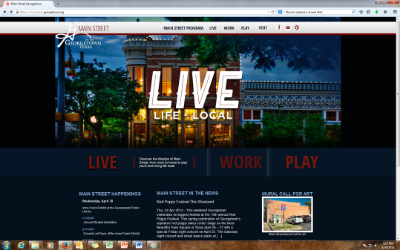
Georgetown Main Street website is an example of a website that is geared toward the public, including sections on live, work, play.
Ideas for components on your website:
Educational — a stand-alone website may better educate your visitors about your community. Compelling photographs and smart copy can work to set your community apart from your neighbors.
List of Events — You will have more control over marketing your special events, including allowing sponsorship advertising, which may not be allowed on a city-hosted or other website. Note that an actual calendar isn’t recommended unless you have events happening more than 15 days per month. A calendar with only one or two events per month looks empty. A list looks busier and more exciting to visitors.
Promotion of Downtown Businesses — Google claims that 51 percent of small businesses do not have their own websites. Help your businesses get found online by adding a downtown business directory.
Branding — Your website should be unique to your community and reflect your downtown/Main Street brand.
Business Recruitment — highlight market data that shows your community assets and why your community is a great place to locate a business.
Fun — most common citizens do not associate fun with local government. If they are looking for something special to do on Friday night, your best bet is that they are not looking on your city website. Make your website a resource for fun events and activities.
Maps — add a map to showcase how to get to and around your downtown.
Volunteer Recruitment — A call for volunteers to assist in special projects or events. You are even able to embed a contact form for volunteers to sign up directly on your website. Make it as easy as possible to involve people in your program.
Fundraising or sponsorships opportunities — often your donors and sponsors want more information on your program before handing over a check. Make this information available to all so you do not miss any opportunities.
If you have decided to start your own website, here are some tips for beginning the process: Gather all information before beginning the design, including all photos, logos, copy, and links to any external websites. If you integrate social media, you will need your user names and passwords to each of the integrated sites. You will also need to develop a flow chart that showcases how to navigate the site and where all of the above information will be located.
Make your homepage count. It is the first chance to make an impression on a visitor. You have seven seconds to make that first impression. Make sure it is visually appealing and easy to navigate. If your primary audience is visitors (from inside and outside your community), your homepage should reflect the information that they may be searching for — such as events, history, location (map), with links to your business directory, volunteer opportunities, etc. Note that nowadays, more than 50 percent of web traffic comes from mobile devices. This means that gone are the days of slideshows and flashy websites. Flash is no longer recommended as it slows down your page load time. If your page does not load within a few seconds, you will lose the visitor that is on a mobile device.
One other thing to note is that you do not have to pay thousands of dollars to build a website. There are several software programs that allow you to choose templates and add your own content. Work with your promotion and organization committees to research the best software for your Main Street website.
Remember to have fun with the process. Technology can be challenging and there is always a learning curve with any new software, but if you embrace your volunteers and work together to create a website, you can exhibit what is unique about your Main Street to the entire world.
Here are some examples of stand-alone Main Street websites that do a good job promoting their downtowns:
http://downtownabq.com/ Albuquerque, New Mexico
https://mainstreet.georgetown.org/ Georgetown, Texas
http://downtowngh.com/ Grand Haven, Michigan
http://www.downtownmelbourne.com/ Melbourne, Florida
http://www.niles.org/ Niles, California
http://rt66central.com/about.html Nob Hill, Albuquerque, New Mexico
http://www.iloveoldtown.org/ Old Town Lansing, Lansing, Michigan
http://www.riponmainst.com/riponmainst/ Ripon, Wisconsin
Use these examples as inspiration for your own Main Street website. Show the world what makes your downtown unique via the web.