
NEW TECHNOLOGY FOR HISTORIC STRUCTURES
December 2014 Main Street Matters
Article written by Marie Oehlerking, Project Design Assistant, Texas Main Street Program
From weather stripping to storm windows, there are many simple, inexpensive solutions to making historic buildings more sustainable. However, in Main Street, we have yet to tackle the innovative technology that could take them to the next level. We all know that the “greenest building is the one that already exists.” Numerous reports published by the National Trust and other preservation organizations have validated that statement time and again, but this “greenness” can be taken a step further with new technology like solar panels and green roofs. These innovations are daunting obstacles for many small business owners to face on their own. By understanding how new green technologies work and incorporating them into established incentive programs, Main Street has the opportunity to transform this hurdle into a benefit for the entire district.
Rainwater Harvesting
Collecting rainwater can be very beneficial to property owners depending on the size and shape of the system. Rainwater barrels pictured on page five are simply attached to the building’s pre-existing gutter system. Water from the downspout is diverted to the barrel through a hose or the end of the downspout can be modified to pour directly into the barrel. Some systems include filters at the top of the barrel to prevent large contaminants from entering the barrel. The stored water can then be used to water plants or clean sidewalks and windows.
Advanced rainwater systems can be connected to a building’s existing plumbing system and used in washing machines and to flush toilets. This type of system can function by either using gravity or a motorized pump. Gravity systems capture rainwater from the roof and gutters and divert it to a storage tank that is elevated from the ground by at least three feet. Water then flows freely from the tank through a pipe that is connected to the building’s plumbing system. A valve is included at the connection so that system can be switched to municipal utilities when rainwater is not available. Pump systems work in much the same way as gravity systems, however, the storage tank can be hidden underground and the electric pump pushes water into the plumbing system when needed.
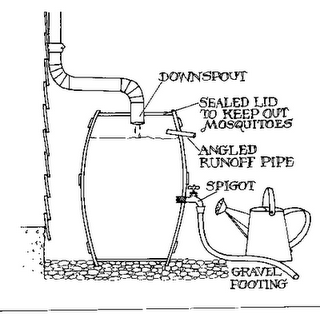
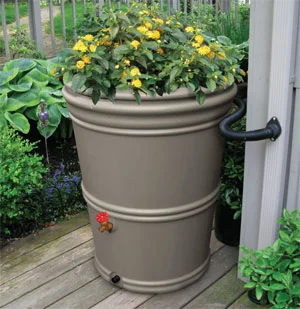
The benefit of rainwater collection is equivalent to the amount of investment. Water from rain barrels can be used to water plants in planters and hanging baskets at the front of a business. By simply adding landscaping to a storefront, curb appeal increases, which increases pedestrian traffic into the store. Older toilets can use anywhere from 3.5–7 gallons per flush, and on average use the highest percentage of water in a typical household over washing machines, dishwashers, and showers. For a commercial property, toilets are typically one of the few appliances that utilize water in the building. This means that by using a rainwater collection system, property owners cannot only save water, but save on their utility bills as well.
Rain barrel placed discreetly behind a historic home. Source.
The downside to rainwater collection systems is the big, ugly barrels that are needed to store water. In a historic building, barrels should be installed on the backside of the structure so that they do not compromise the overall appearance of the front façade. The following links provide general information and guidance on rainwater harvesting:
Texas Water Development Board
College of Charleston DIY Rain Barrel Guide
Solar Panels
Solar panels can be controversial when it comes to their application on historic buildings. Because they need to be strategically placed in order to capture the most sunlight, solar panels are often placed where they infringe on a building’s character-defining features. However, with some planning and coordination, solar panels can be extremely advantageous.
A photovoltaic system or PV system uses one or more solar panels to convert sunlight into electricity. A PV system can be comprised of the following:
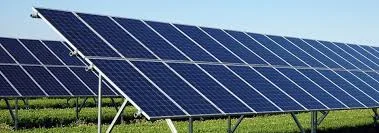
Freestanding Solar Array. Source.
Freestanding—panel array that is attached to the roof of a building or located on the ground and connected to the building through underground wiring.
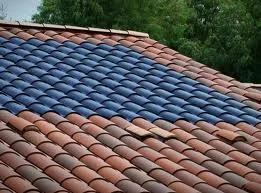
Solar Shingles. Source.
Solar Shingles—solar cells designed to look like conventional asphalt shingles that are incorporated into the roof structure of a building.
Both types of PV systems function in the same manner and produce the same amount of energy. However, for historic buildings, it is important to remember that solar shingles should never replace existing historic material. If existing shingles have failed, this can be a good opportunity to replace with a solar equivalent. Solar shingles need to be placed in a concentrated area; however, failed shingles maybe spread out in various places on the roof. Existing shingles in good condition can be relocated to patch lost material to open up a larger area for solar shingles.
According to NPS, solar panels “should be minimally visible to avoid altering the historic character of the building. Solar panels should not be visible from the public right of way such as nearby streets, sidewalks, or other public spaces.” Buildings with a flat roof or parapet are often the best candidates for a rooftop solar installation like the building below.
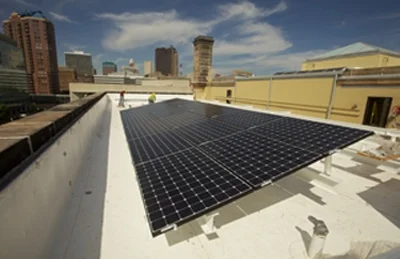
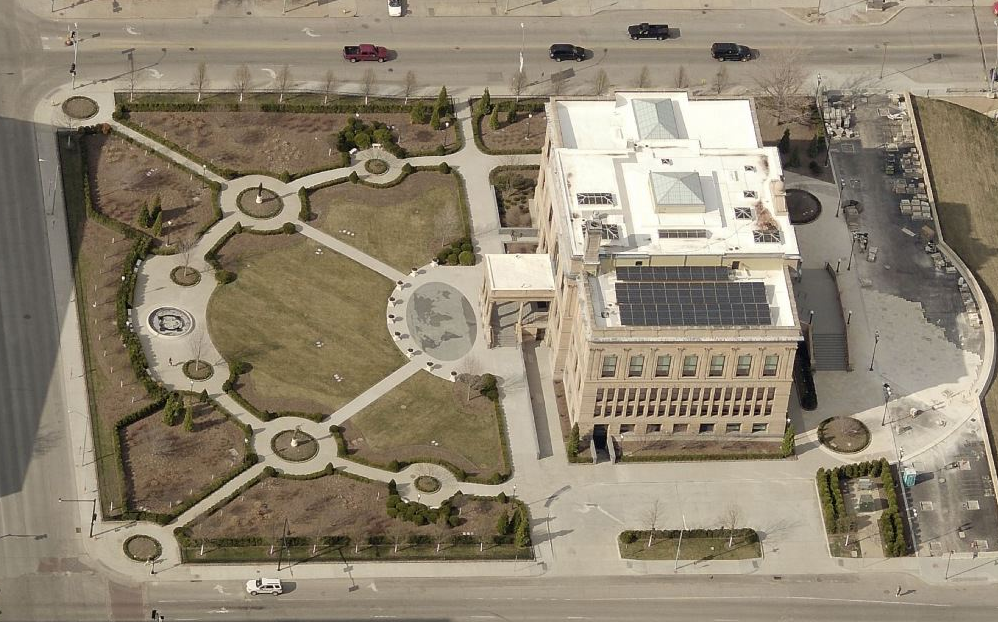
An example of well installed solar panels on a flat roof, World Food Prize Hall of Laureates, Des Moines, Iowa (right). Aerial view of solar panels (left). Source.
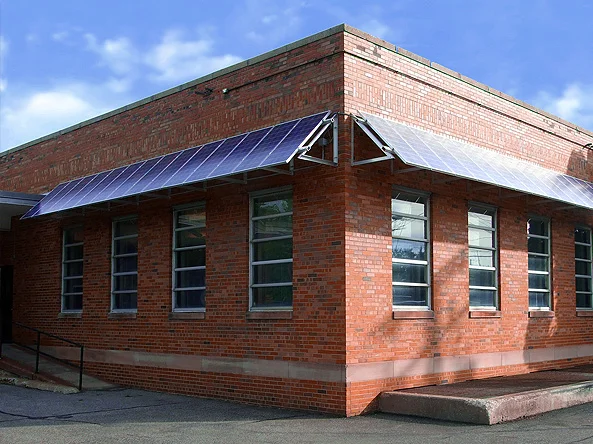
Solar panels as awnings. Source.
Solar panels can also be installed on the back façade of a building. Doty & Michael Architects converted a historic post office building into their studio space in Bedford, Ohio. In their project, the designers creatively used the solar panels as an awning on the rear of the building, simultaneously allowing for solar capture and solar shading. The NPS Guide ITS 52: Incorporating Solar Panels in a Rehabilitation Project provides general guidance on the do’s and don’ts of installing solar panels on a historic structure.
If solar panels cannot be properly fitted to a historic building, panels could potentially be installed in an alleyway or in an open space behind a cluster of buildings. Panels could also be located off-site and wired to a building using underground cables. These locations would not only hide the equipment from public view, but could also be accessed by several properties.
Creating a solar cooperative between several properties could reduce the initial installation cost, while reducing electricity costs in the long run. Solar panels can go beyond the building in other places as well. Smaller panels can be incorporated into parking meters, street lights, bus stops, outdoor benches, and bike rental equipment.
Green Roofs
Green roofs are popular components of many new green buildings, but can be very challenging to install on a historic structure. A green roof is a thin layer of vegetation planted over a waterproofing system that is installed on top of an existing flat or slightly sloped roof.
A green roof can greatly improve energy efficiency by reducing temperatures on the roof, help to cool the surrounding urban environment, filter air, collect and filter storm water, and provide urban amenities, including vegetable gardens, for building occupants. However, despite the potential benefits of a green roof, it greatly increases structural loads, which many historic buildings cannot handle. It is very important that a structural engineer is consulted to develop a green roof design.
Like solar panels, green roofs should not be visible from the public right of way. The Barton Group Headquarters in Glen Falls, New York is a great example of a green roof on a historic commercial building. The National Park Service also provides guidance on green roof installation. The NPS Guide, ITS 54: Installing Green Roofs on Historic Buildings, provides more information.
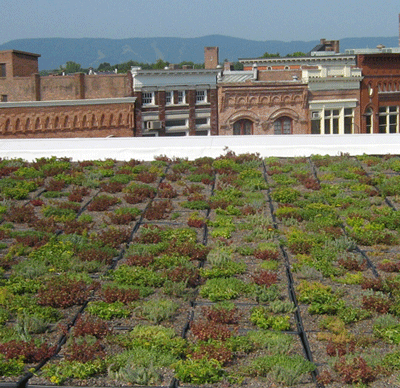
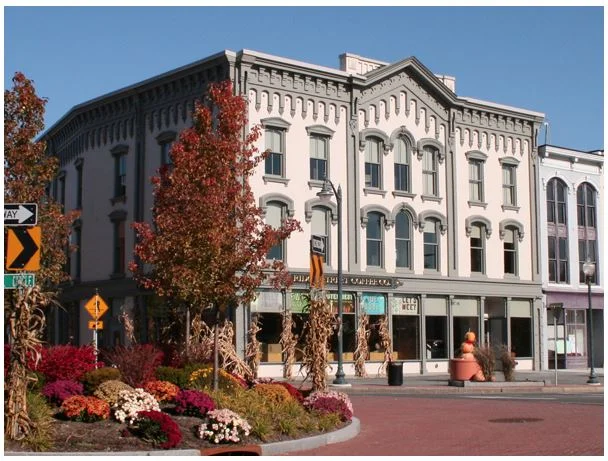
Barton Group Headquarters Green Roof. Source.
Wind Turbines
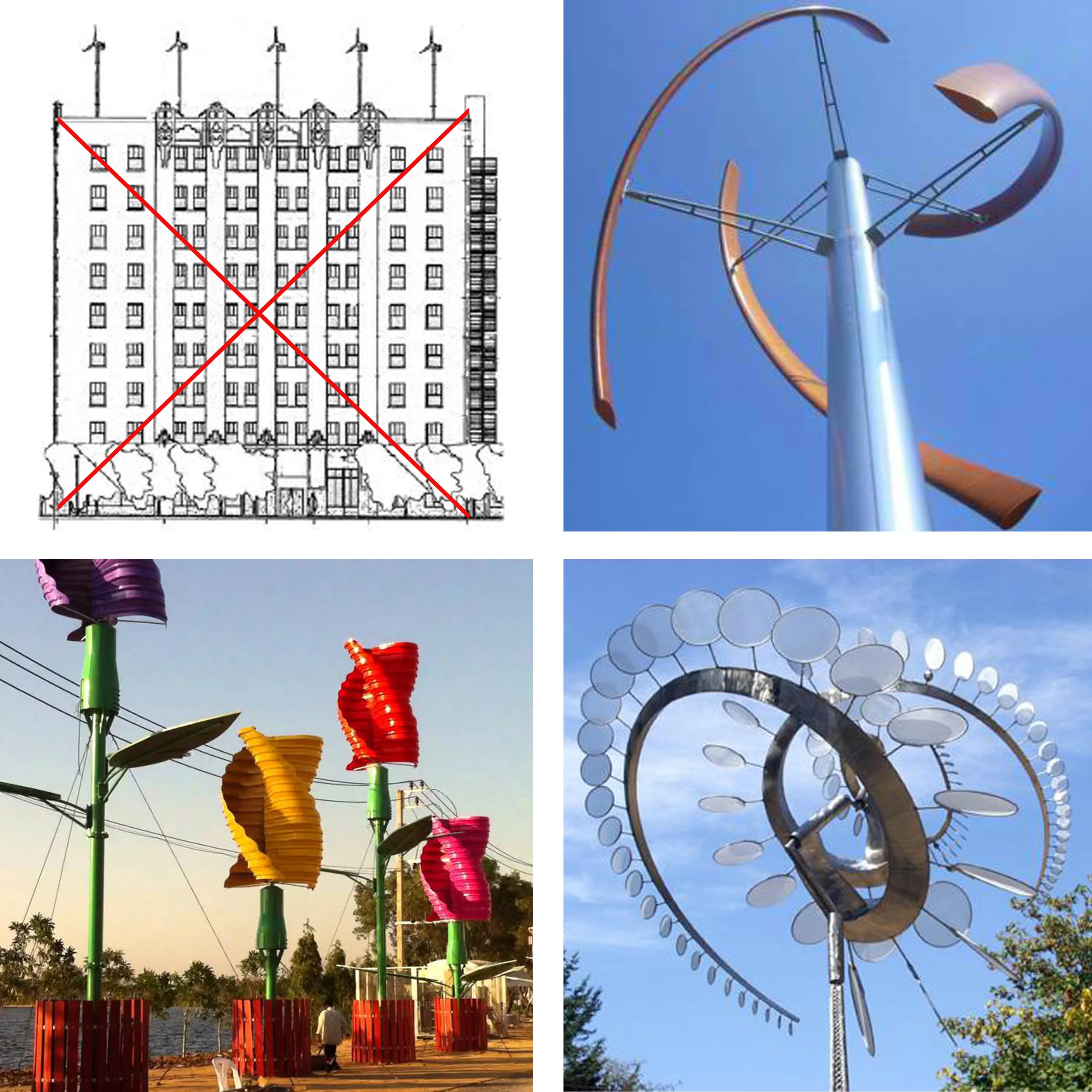
In some regions of the state, wind turbines have the potential to be a great source of renewable energy. However, turbines are tall and need to be in an open area to function properly. Unlike solar panels, placing wind turbines on the roof of a historic building is not recommended. The turbines will detract from the roof line and compromise the historic integrity of the structure.
However, turbines can be a great addition to a downtown public space or plaza. Wind turbines can function as sculpture and as an opportunity to educate the public on wind power. Placing the turbines in a central location allows access to multiple businesses within the Main Street district.

What can Main Street do?
Main Street must play a key role in bringing new green technologies to downtown. The first step in facilitating the process is to incorporate these technologies into the local historic district design guidelines. Denton, Waxahachie, and several other Main Street cities have already done so. The National Park Service has created an illustrated guide of their Rehabilitation Standards that specifically highlights how to incorporate green elements into rehab projects. Downtown planning guru, Nore Winter, also has a great article on this topic.
The second step in the process is to incentivize the installation of new technologies. The City of McKinney holds “build-a-rain-barrel” workshops on a regular basis to educate property owners on how to make the systems themselves. Other cities like Austin and Round Rock are offering rebates to encourage people to install rainwater collection systems. The amount of the rebate is based on the size of the tank or barrel installed. Austin offers $1.00 per pressurized gallon up to a maximum amount of $5,000. Main Street could incorporate new technologies into existing façade rehab grants or create a secondary grant program that builds on the preservation based incentive.
Other THC programs are already integrating green technologies in projects in several historic downtowns across the state. The Hood County Courthouse in Granbury and several other restored courthouses funded by the Texas Historic Courthouse Preservation Program have incorporated geothermal wells, another source of renewable energy, into their projects.
Incorporating green technologies into historic downtowns is the future of Main Street. Green technologies can be an intimidating topic, but by working together these innovations can benefit entire downtown districts. This general overview gives you some of the basics on green technologies, now it’s your turn to inspire people in your community to take the next step.
General Resources
- National Park Service Sustainability
- Illustrated Guidelines on Sustainability for Rehabilitating Historic Buildings
- Advisory Council on Historic Preservation Sustainability Links
- THC’s Position on Sustainability
- Maryland’s Sustainability Guide for Main Street