
ENCOURAGING RETAIL WITH ZONING REQUIREMENTS
September 2014 Main Street Matters
Article written by Emily Koller, Planner, Courthouse Square Initiative, Texas Historical Commission
Main Streets spend a lot of time combating the challenge of vacancies, but sometimes the problem is not a vacant prime retail space – the problem is that it is occupied! The buildings may be full, but not with “activity-generating” uses.*
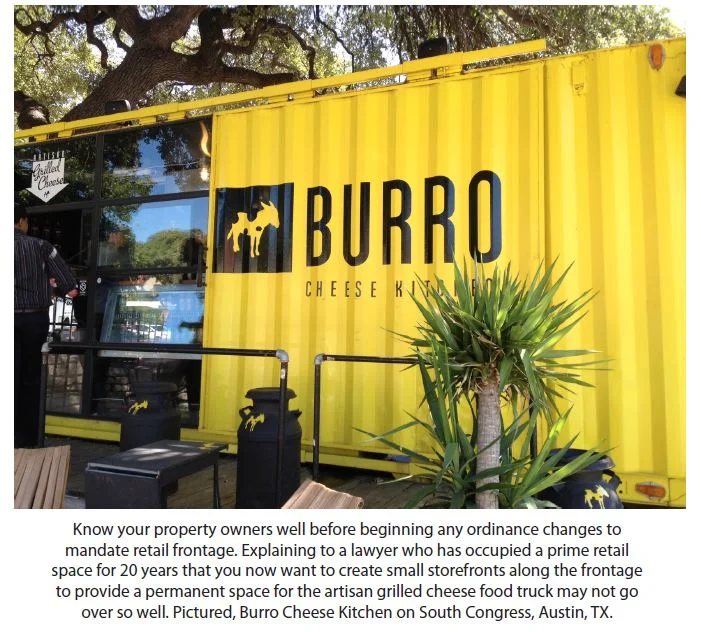
As a downtown transitions from basic stabilization and occupation of historic buildings to the desire for a more sophisticated retail and dining experience, municipalities may turn to land-use controls. Mandating retail space is utilized not only to create a vibrant, pedestrian-friendly downtown experience, but also to protect downtown sales tax revenue. Striking the right balance of uses is not easy—often those occupying the most attractive retail spaces are long-time professionals in law, accounting, and insurance. The tenants are likely the owners and may have been the only ones willing to rehabilitate and occupy the buildings decades prior. Explaining to a lawyer that you now want an artisan grilled cheese sandwich shop in his space might not go over so well.
Know Your Downtown Experience First
Achieving active retail uses directly speaks to a downtown’s ability to create an experience
that is believable to visitors while at the same time is inclusive of the local residents. Local retail may mean convenience stores with iced 40-ounce cans of beer and cigarettes, while the long-term community vision fancies a wine bar and humidor to attract overnight wedding parties. Is this retail dream realistic for your existing demographic, and is it a believable experience for visitors to your downtown?
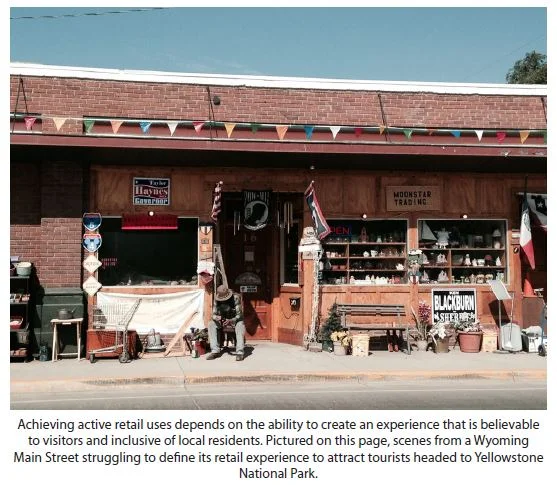
I recently returned from a quick vacation to my small hometown in Wyoming, population 1,853. Their Main Street is a state highway and also happens to be “on the road” to Yellowstone. The town serves its local population with professional services fairly well, but retail is dire. They are considering an application to the state Main Street program, and I spent time working with several committee members. One of the retailers complained about how quiet the evenings are and that we needed to work to increase activity and energy at night. But the local banker disagreed and presented a different perspective.
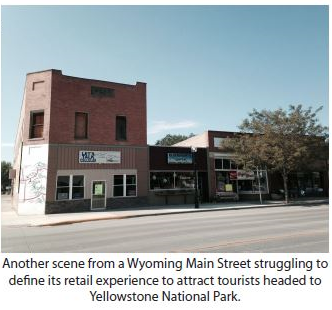
Daily he observes the opportunity of an incredible amount of tourist traffic coming and going from Yellowstone National Park (just shy of two hours away). Peak traffic hours are between 10 a.m. and 4 p.m., and he believed retail efforts should focus on capturing that traffic. He is right. The believable identity for this town is a pleasant and leisurely mid-day stop on the way to Yellowstone—a few quaint choices for lunch, a quick self-guided museum tour (take your pick between dinosaur history or aerial firefighting), and some time to browse interesting shops with local goods. This would create daytime energy and sales tax revenue while supplementing the existing local professional services still occupying Main Street.
Attempting to attract overnight guests to drink at a wine bar and spend money on other nightlife activities is less realistic. Travelers’ sights are set on the major destination a few hours away while locals likely would not support any place where a glass of wine costs more than a bottle at the grocery store.
In this instance new regulations to encourage retail development could be approached in several ways. The issues are primarily that the retail spaces are too large and the downtown identity is not clear. What is clear is that the office and professional uses are the only reason Main Street is not deserted, so it would be wise to not offend those business and property owners. Any new requirements should focus on either:
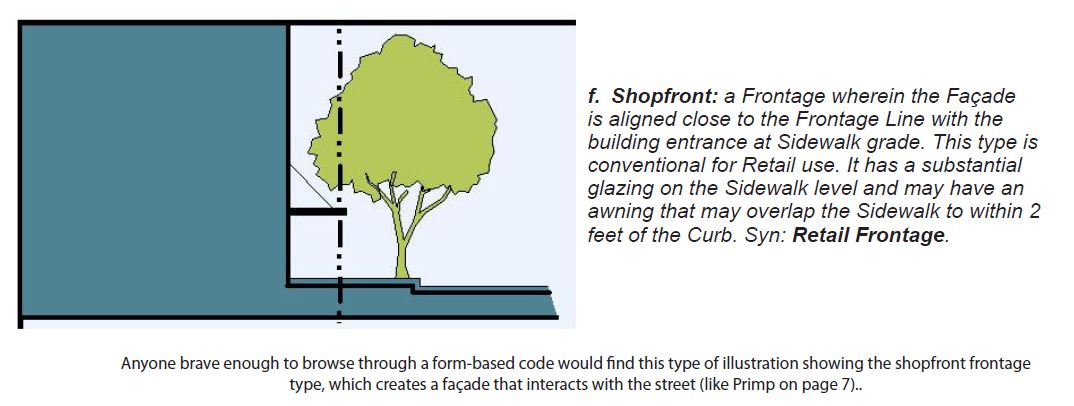
1) A design approach to create a shopfront aesthetic. The town might consider mandatory frontage types so that any renovations or exterior alterations require restoration or installation of awnings, transparent glass and transom windows. Sidewalk furniture could be allowed through a business-friendly permitting process and a future grant program
could assist with rehabilitation costs.
2) A more traditional retail district zoning classification to create smaller, more suitable spaces and concentrate them in key blocks. For example, a percentage of the building frontage along the street would be required for retail use, and office space would need to be located in the rear of buildings. Recruitment programs like a tourist season pop-up contest could help attract tenants.
How to Zone for Retail
Like the example above, there are two overarching principles used when considering zoning to achieve activity-generating uses. One approach relies on regulating design, while the other regulates permitted uses.
Design: Form-Based Codes (FBC)
Form-based codes heavily regulate the form and exterior design of a building rather than the use. They are especially concerned with how buildings relate to one another and how facades, or frontages, interface with the streetscape. FBCs encourage denser, mixed use development and emphasize a pedestrian-friendly high-quality public realm. The flexibility in use and predictability in design offered by a form-based code is particularly appealing to developers. For more information about form-based codes, the Form-Based Code Institute and Center for Applied Transect Studies provide the most comprehensive and accurate information.
The movement was initiated as a response to conventional zoning practice, which is seen as a major contributor towards the creation of sprawling, automobile oriented development patterns. A form-based code can be adopted as either the base zoning or as an overlay district and is used in cities across the country to guide downtown redevelopment plans. Many cities in Texas utilize form-based codes including Duncanville,
El Paso, Hutto, Rowlett, Roanoke, San Antonio, and San Marcos.
To encourage active uses in downtown, form-based codes typically require a shopfront frontage type, which is mandated on certain streets where retail is highly desirable. It does not prohibit an office use from being located there as long as their building frontage appears like a store front—built to the property line with proper signage, an awning or canopy, clear glazing, primary ground-floor entrances oriented to the public right-of-way, and parking in the rear. Sometimes these design features are referred to as an active edge. Form-based codes often require the same design features as a historic preservation ordinance; however, FBCs make no distinction between new or historic materials. The two can work well together.
Use: Traditional Districts
With a more traditional district approach, municipalities can define whichever uses they prefer in their downtown. Retail, commercial, and office uses are typically required on the ground-floor of central business district zoning codes, while office and residential are permitted on upper levels.
When a mix of uses is permitted in the district, different strategies can be utilized to specifically control the amount of retail. An overlay can be used to “incubate” businesses by concentrating them in one area. In larger downtowns, there can be a limited market for specialty retail, so it is common to concentrate retail wherever the most pedestrian activity is desired—along the Main Street, around a plaza or another landmark structure. For redeveloping downtowns, this tactic can also prove useful. Restricting the most desirable retail to a small area can help ensure success until a self-sustaining critical mass is established.
Development standards are also used to direct retail to defined parts of buildings. More common ones include a frontage width and depth requirement. For example, an ordinance might require non-corner properties dedicate 60 percent of the street frontage to a depth of 60 feet to specialty retail and restaurant uses only.
Finally, any land use policy that is working to incubate retail will also include language that permits urban style residential. Increasing the number of households living in and near downtown is the surest way to support downtown businesses and activate the street.
Questions to Ask
To move forward with a retail zoning requirement, start with asking your Main Street stakeholders the following questions:
1.) Is the problem the use of the building or how the building and the activity it generates interfaces with the street? Traditional zoning creates districts to regulate use, while form-based codes focus on the building design and its relationship to the sidewalk and street. Is the design of building contributing to the lack of vibrancy or it is truly the use? Knowing the answer to this question will help you know how to address the challenge.
2) How well do you understand the property owners in your desired prime retail area? Who do you perceive to be in the way of freeing up prime retail space? Are these in fact the owners and best stewards of your historic buildings? Starting with vacant spaces formerly used as retail is a much different challenge than working with existing occupied spaces filled with professional services and office uses. Changing or implementing new land use controls is a political process and will be a bumpy ride if you do not engage your property owners early and often.
3) Is your desired retail experience believable for visitors and inclusive of your local population? Zoning can control the size of the space, the type of use, the design of the building façade, etc. An insurance office may be happy to lease their first 40 feet of building depth, creating the perfect space for a candy store; whereas, mandating 100 percent ground floor retail may be too large of a space to attract the wine bar that is unlikely to locate there anyway.
If you have questions about using downtown zoning to achieve the right mix of uses, please contact emily.koller@thc.state.tx.us.