
Substitute Materials
Compiled August 2017
Substitute materials within design guidelines was a recent topic on the National Alliance of Preservation Commissions (NAPC) listserv. Below are links to documents discussed that may be helpful in developing your design guidelines.
National Park Service Resources
Most, if not all, of the Preservation Briefs created by NPS cover replacement materials. Below are just a few examples.
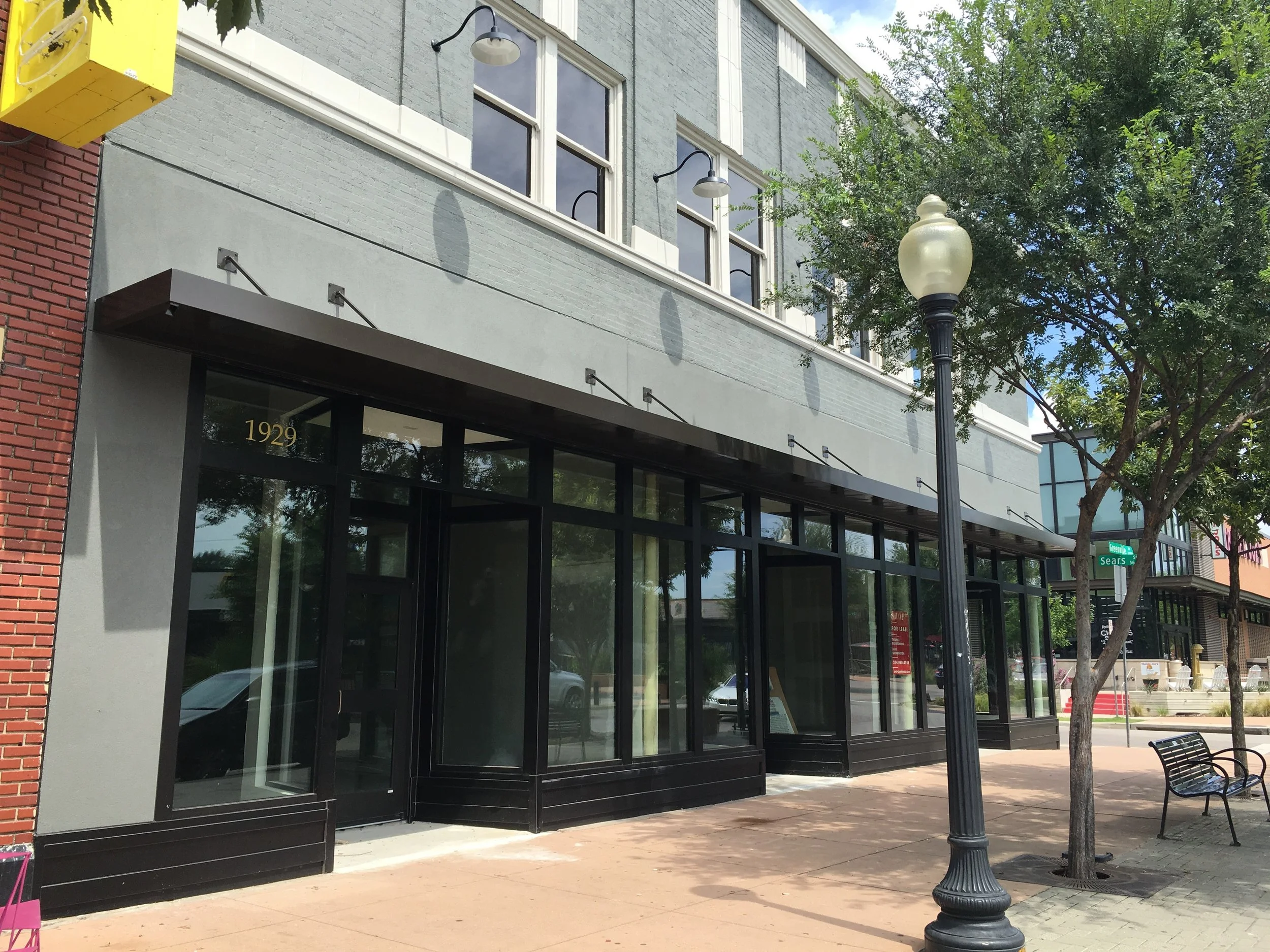
Replacement storefront in Lower Greenville district of Dallas, Tx. The new storefront mimics historic proportions, but is constructed out of metal parts. The original storefront had been removed years before.
- Brief #16 - The Use of Substitute Materials on Historic Building Exteriors
- Brief #11 - Rehabilitating Historic Storefronts - See "Designing Replacement Storefronts" section
- Brief #4 - Roofing for Historic Buildings - See "Repair or Replace," "Replacing the Historic Roofing Material," and "Alternative Materials" Sections
- Brief #8 - Aluminum and Vinyl Siding on Historic Buildings
Interpreting the Secretary of the Interior Standards
- Illustrated Guide for the Secretary of the Interior's Standards for the Treatment of Historic Properties
- Rehab Yes/No Learning Program
- Rehab Yes No. 1 - If exterior materials can't be repaired, DO find suitable replacement materials.
- Rehab No No. 1 - If historic features are deteriorated and missing, DON'T end up with an all new building.
Decision Making Resources
By Dan Becker, City and Regional Planning Division Manager, Dept. of City Planning, Raleigh, NC
and Jack Williams, Hoshide Williams, Architects, Seattle, WA
- Article Part I - "Developing a Materials Evaluation Methodology."
- Article Part II - "A Sustainability Framework for the Local Consideration of Alternative or Substitute Materials."
- Alternative Materials Decision Making Chart
Maryland:
- Baltimore City-The Baltimore City Commission for Historical and Architectural Preservation created “Alternative Material” Design Guidelines in our revisions to our design guidelines two years ago. We have regular inquiries about alternative materials and we wanted to create a process for review of each material and project rather than a simple yes/no list. A link to those guidelines is here: http://chap.baltimorecity.gov/sites/default/files/07.18.2017%20-%20CHAP%20Design%20Guidelines.pdf
Michigan:
A presentation put together for the Michigan Historic Preservation Commission annual conference: Alternative Materials Presentation
The FIRST question is what is the condition of the original material? Severely deteriorated? Mildly deteriorated? Missing altogether?
If the original material is present – it should be repaired of rehabilitated if feasible (Secretary of the Interior Standard #6)
If it needs to be replaced because of the level of deterioration or the piece is missing look to SoI #6: the new feature shall match the old in design, color, texture, and other visual qualities and, where possible, materials. The proposed new material a good visual match. The applicant should provide a sample for review and the decisions are case-by-case.
New York:
- Pittsford - The entire village of Pittsford, NY is a local district, including a post-WWII subdivision and individual post-WWII infill houses. The village updated its guidelines in 2010, largely to give owners and the architectural review board specific guidance for treatment of these newer buildings. The guidelines are available here: http://www.villageofpittsford.org/government/aprb/designstandards.asp - see particularly Section 5A, which includes information about common styles, followed by design guidelines (starting on p. 94 and p. 100) that describe how to approach alterations, including substitute materials.
Oklahoma:
- Oklahoma City - From Kathryn Friddle:
Our guidelines call out situations where substitute materials may be appropriate (rear elevations, additions, for example), and where they are basically never appropriate. I think an applicant would have to prove that the historic material was just no longer available to get a substitute approved.
Within the areas where substitute materials “may” be allowed, we have some that are specifically identified as allowed (Hardie Plank on rear elevations, additions), some that are specifically identified as NOT allowed (vinyl siding), and then more general language about “approximating the historic material” that we reference if something not addressed by the guidelines is proposed. Usually in these cases applications will bring an actual sample of the product to the Commission meeting.
We repeatedly acknowledge that, when a substitute material is approved that is not otherwise addressed in the guidelines, it is on a case-by-case basis, and then staff keeps a running list of things that we want to eventually add to the guidelines as appropriate.
- https://www.okc.gov/home/showdocument?id=5780
Pennsylvania:
- Mercerburg's Historic District- http://www.mercersburg.org/boro/historic
The Section on Exterior Wood & Siding is particularly relevant in its discussion of cement fiberboard as a replacement material. - Borough of Mechanicsburg-http://mechanicsburgborough.org/wp-content/uploads/2013/10/HARB-guidelines.pdf
The Mechanicsburg “Reference Guide for Property Owners” has some easy graphics that summarize the pros and cons of using modern materials for roofing, flashing, and siding. - If the focus is on windows, Preservation Pennsylvania recently published Considering the Repair, Retrofit, and Replacement of Historic Windows (http://www.preservationpa.org/page.asp?id=66). It advocates repairing historic windows, but it includes recommendations for selecting appropriate replacements and discusses several alternative materials.