
NOW SHOWING:
Restoration of Historic Theater Marquees
November 2014 Main Street Matters
Article written by Marie Oehlerking, Project Design Assistant, Texas Main Street Program
Live theaters, opera houses, and movie palaces are the entertainment centers of many historic downtowns. Like the shows that played on the stage or screen, these buildings were constructed to put on a performance of their own through their luxurious interiors and ornate facades. Many theaters were designed to make people forget about their daily lives and envelope them in fantasy worlds. No element was spared from this song and dance including the building’s signage and exterior advertisements.
The marquee was often the most important and distinctive feature of a theater. Its main function was to advertise upcoming shows and events. However, the marquee also created a visual landmark, extending from the façade, so that the building stood out physically and aesthetically from all others on the street and drew patrons inside.
Before the turn of the 20th century, live theaters and early movie theaters called nickelodeons advertised their shows with hand-painted signs or printed, paper posters pasted on the exterior of the building. Between 1910 and the late 1920s, marquees were dark, flat, delicately decorated sources of detailed information. Only large theaters in big cities could afford to custom order electrical signs made out of channeled bulb letters. Changeable letter boards were introduced in 1916. This signage method was so practical that it survived changing times and is still used by many theaters today.
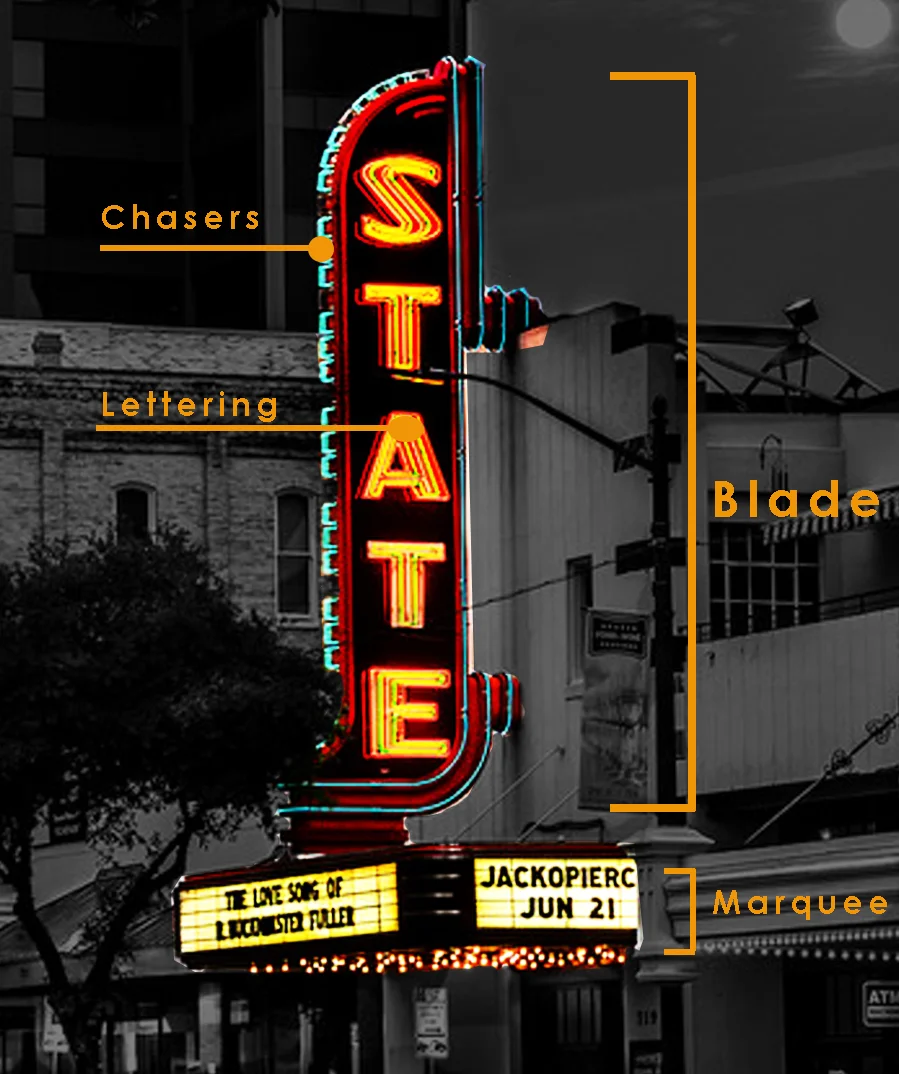
Components of a Theater Marquee – State Theater, Austin, Texas Source: Flickr, Jims_Photos.
By the 1930s, marquees were transformed into what some have called “electric tiaras.” Many theaters introduced a vertical blade sign that announced the theater beneath. During the day, its height drew attention; at night the structure was enhanced with neon stripes and glowing balls of moving lights known as “flashers,” and “chasers.” The automobile gave rise to changes in the shape and size of the marquee as well to make the sign more readable from the street. What started as a small rectangle letter board transformed into a large trapezoid that projected from the façade.
Electric and neon signs were used ontinuously through the 1940s and 50s only growing in size. In many theaters, the marquee became the façade, extending the full width and height of the structure.
Marquees Today
Most theater marquees that still exist today in Texas Main Street cities are the “electric tiaras” of the mid-20th century. These marquees are important landmarks and should be restored and maintained just like the buildings they are attached to. However, the restoration process can be daunting due to the size and unusual materials used to construct the signs. The diagram above explains the major components of a typical theater marquee and the materials used to make them.
Blade—projecting vertical sign typically made of metal shell coated in colored porcelain enamel or other durable coating.
Chaser or Flasher Lights—lighting along the profile of the blade typically made of neon tubes or colorful light bulbs
Lettering—neon tubes or colorful light bulbs were often used to form the blade’s letters. Channel letters could also be used. The base of the letter’s shape is made of sheet metal that is covered with plastic on one side. Lights could be on the interior or exterior of the plastic.
Marquee—backlit plastic sheets with metal grid to hold letters. Lettering was also made of plastic and could be flat or three dimensional
Restoration
Reviving a historic theater marquee requires a specialized craftsman, time, and money. The National Park Service Preservation Brief Number 25 provides general guidance on the restoration process. The League of Historic American Theatres’ Rescue and Rehab Manual also gives advice on how to carry out and fund this type of project. See the Preservation of Historic Signs.
Several sign companies throughout the state specialize in historic theater marquees and/or neon signs. Before
hiring a sign professional, several steps should be taken:
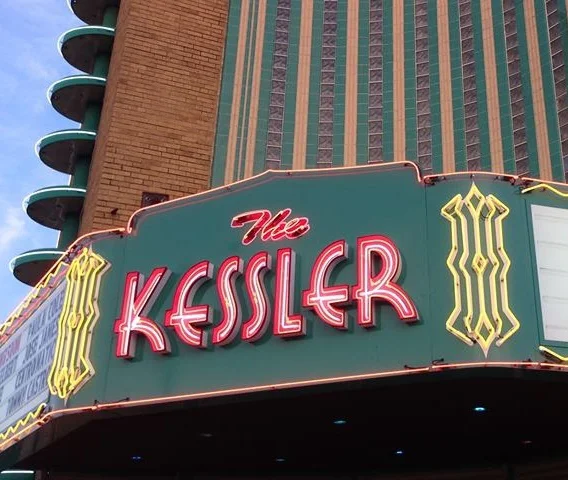
Example Channel Letter Sign – The Kessler Theater, Dallas, Texas
Source: Flickr.
- Do your research. Review the sources above, find examples of other good projects, and talk to the Main Street design staff first to fully prepare yourself.
- Review potential companies’ project portfolios to determine what kind of work they have done in the past
- Talk with the company’s past clients and get their opinion on the company’s capabilities
- Discuss the process with the sign company and obtain a full understanding of how they will go about restoring the sign.
Several Texas Main Streets have undertaken a marquee restoration with brilliant results. The following case study from Amarillo highlights their process and funding campaign.
CASE STUDY: RESTORATION PARAMOUNT THEATER, AMARILLO
Article written by Beth Duke, Executive Director, Center City of Amarillo, a Texas Main Street Program
Question: How do you resurrect a 33-and-a-half-foot historic neon sign?
Answer: One bulb at a time—even if the sign contains 847 light bulbs.
Throughout the history of downtown Amarillo, the Paramount Theater located at Ninth Avenue and Polk Street was a gateway to a thriving downtown entertainment and retail area. The Paramount Theater was just one of the pre-World War II theaters that drew crowds to downtown with sometimes lavish movie premieres and always-cool air conditioning. Noted theater architect W. Scott Dunne of Dallas designed the Paramount Theater, which was built by Charles S. Lambie in 1932.
The building’s terra cotta-clad exterior remains one of the shining examples of what has been called “Pueblo Deco” architecture. This unique architectural style combines striking silhouettes of the Art Deco movement with a Southwestern flair.
The Paramount building has survived, but the Paramount Theater did not. In the 1970s, the theater closed. During the renovation to transform the space into modern offices, crews uncovered a backstage area complete with small dressing rooms and curtain riggings that dated back to the theater’s vaudeville days. Evidence of the theater was scattered and sold as downtown made way for the 1970s’ version of progress.
The Paramount Theater sign found life in yet another trend—disco. Club owner Lowell Stapf installed the sign at his Paramount Club at Third Avenue and Osage Street. The Paramount Club, with its trademark two-story jukebox, was just another chapter in the saga of the sign.
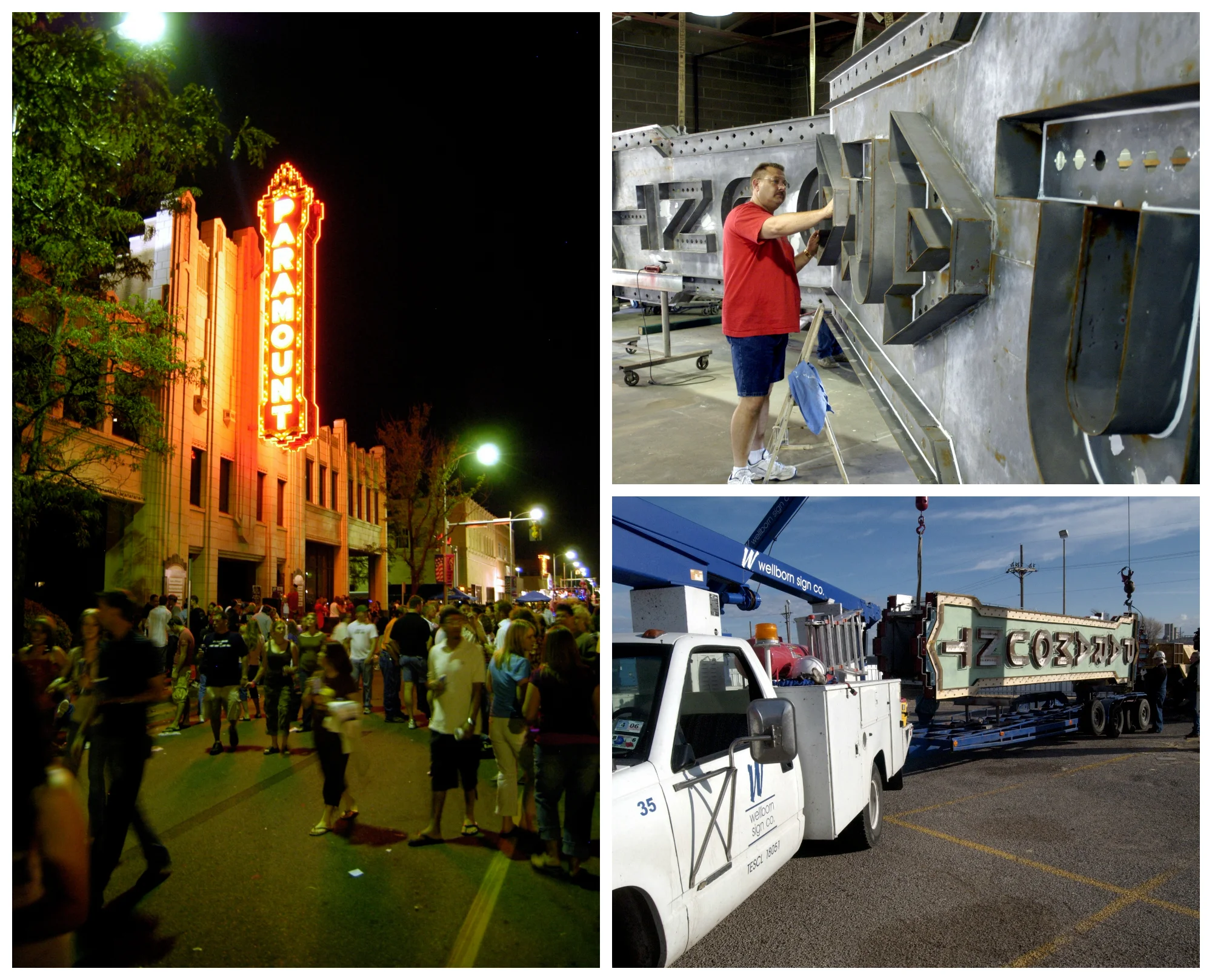

Restored Paramount sign (left), painting the sign (top right), and moving the sign
(bottom right). Source: Ralph Duke, photographer.
Fast forward to 2006. Wes Reeves, president of the Amarillo Historical Preservation Foundation had a dream to bring the Paramount sign back to Polk Street. Reeves was also a corporate spokesman for Xcel Energy Co. and a board member for Center City of Amarillo, our Main Street organization. He recalled an old annual report from Xcel’s predecessor company, Southwestern Public Service Company. The report showcased nighttime photos of Polk Street, calling it one of the best lit downtowns in the country with enough neon to rival the Nevada cities of Reno or Las Vegas. Through a series of negotiations, Reeves and his historical foundation team persuaded Stapf to sell the sign to the foundation.
Then came the hard part: restoring the sign to its past glory. Reeves was no novice when it comes to saving history. He earned his experience through saving other significant structures including the downtown “Ritz” theater in his hometown of Wellington. In that project, Reeves worked with Wellborn Sign Co. of Amarillo. Wellborn’s work gained national recognition for the Wellington restoration. Now it was time to tackle the Paramount sign. Amazingly, the Paramount sign still worked when technicians electrified it on a test run in the Wellborn Sign Co. shop. But years of exposure to the Panhandle climate meant that every electrical connection needed to be rebuilt.
To pay for the almost $80,000 project, the board of Center City of Amarillo gave the Amarillo Historical Preservation Foundation a lead gift of $40,000. To raise the other half of the money, Center City and the foundation embarked on the “Buy A Bulb” campaign. The campaign encouraged people to buy a bulb for $50. For the next few months, donations large and small came in as people voted with their money to save the Paramount sign. The campaign worked for several reasons:
- Most people could afford to give $50 to save a piece of history
- The sign represented a piece of historical architecture that almost everyone could enjoy
- The Paramount sign was an icon and a landmark
- The sign became a tangible example of Center City’s dedication to downtown revitalization and historic preservation
In all, the campaign raised about $25,000 in four months. Center City wanted to light the sign in ceremonies at the annual Polk Street Block Party on Aug. 19, 2006. To meet that deadline, the foundation needed more money quickly. At the end of the campaign the Amarillo National Bank and the Sybil Harrington Trust each donated $10,000 to make the Paramount sign dream come true. At 10 p.m. on Aug. 19, 2006, Amarillo Mayor Debra McCartt led a countdown for the 20,000 people at the Polk Street Block Party. The sign once again illuminated historic Polk Street—one bulb at a time.
When we restored the Paramount sign, we told our community that this might not be our biggest project, but it would be a catalyst. Looking back across eight years, the Paramount sign has become a symbol for downtown revitalization. Several businesses have added their own neon and lights, bringing new life to downtown.