
Economic Vitality Indicators for Main Street Communities
September 2019 Main Street Matters
By Alan Cox, Economic Development Specialist, TSI, TMSP
Over the next several months, the Texas Main Street Program (TMSP) will be conducting research and analysis on a variety of indicators to help Main Street managers make the case for their local efforts as well as provide additional guidance for where they might be most successful. A review of academic literature about factors leading to the economic vitality of communities reveals that among the most important are relative proximity to a major metropolitan area, presence of an institution of higher education, location in an energy-producing region, and access to amenities—natural or otherwise. Obviously, most of the above factors are beyond your control. That said, we should take note that a vibrant downtown is counted within the amenity category.
Additional research indicates that healthy downtowns have a measurable positive influence in general categories: talent attraction, entrepreneurship, and taxes. The TMSP wanted to test whether these broad factors were also applicable to our participating communities, so we decided to look for indicators that would allow us to compare you to the state as a whole and selected 1) domestic migration, 2) self-employment, and 3) taxable retail sales. So, what did the data tell us?
Talent
Using data from the U.S. Census’ 2012-2017 American Community Survey (ACS) 5-Year Estimates, we were able to calculate the total population of our network, as well as the number of persons estimated to have moved to them from elsewhere in the country, and then compare them to the rest of the state.
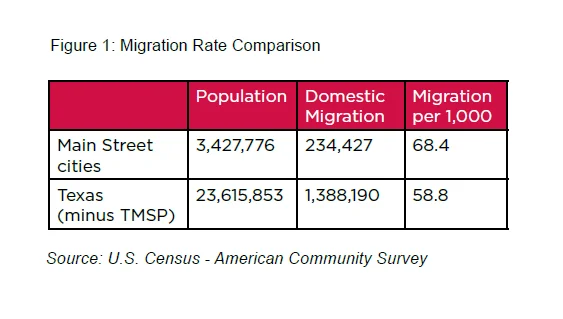
These data indicate that Main Street cities did attract new residents at a higher rate than the remainder of the state, which is an impressive feat given that Texas has been one of top destinations for new residents over the past decade. What the numbers say is that for every 1,000 residents living in a Texas Main Street community, about 68 of them moved to town during the comparison period. At the same time, only 59 out of 1,000 residents living outside the Main Street program were recent domestic migrants, which shows there was a significant gap between our communities and all the rest.
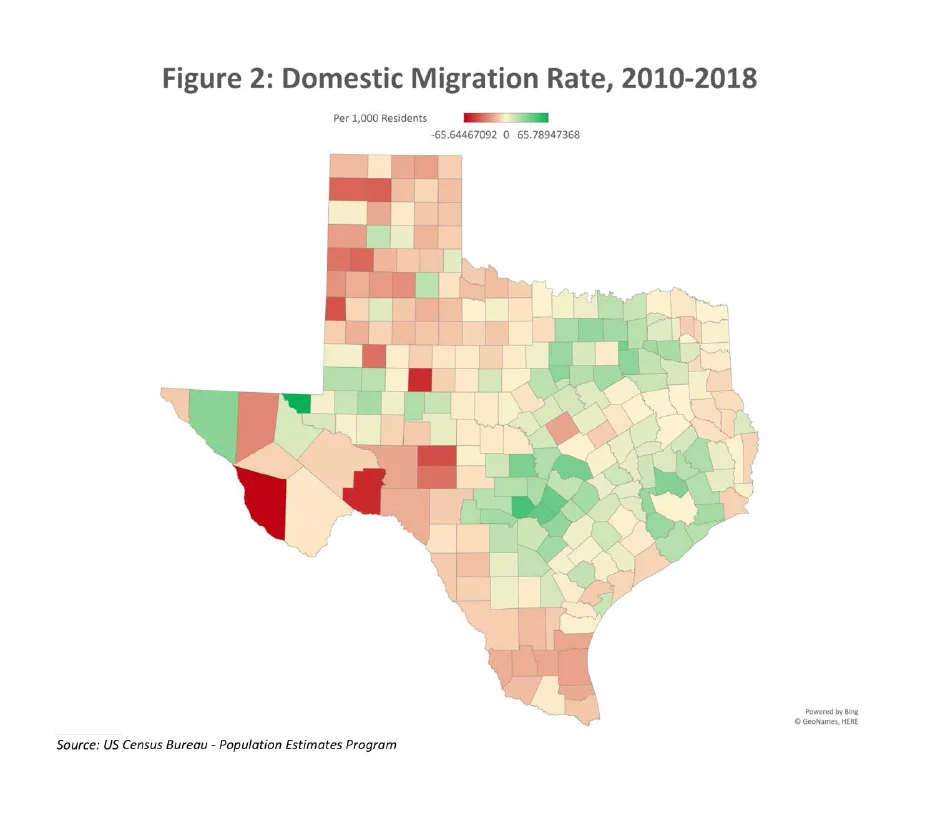
While not a perfect comparison, we also wanted to look at the more recent estimates from the Census at the county level, which is calculated by a separate program to provide a better idea of where domestic migration is occurring at the most rapid pace, which supports several of the growth factors listed above, such as proximity to natural amenities and large population centers.
Entrepreneurship
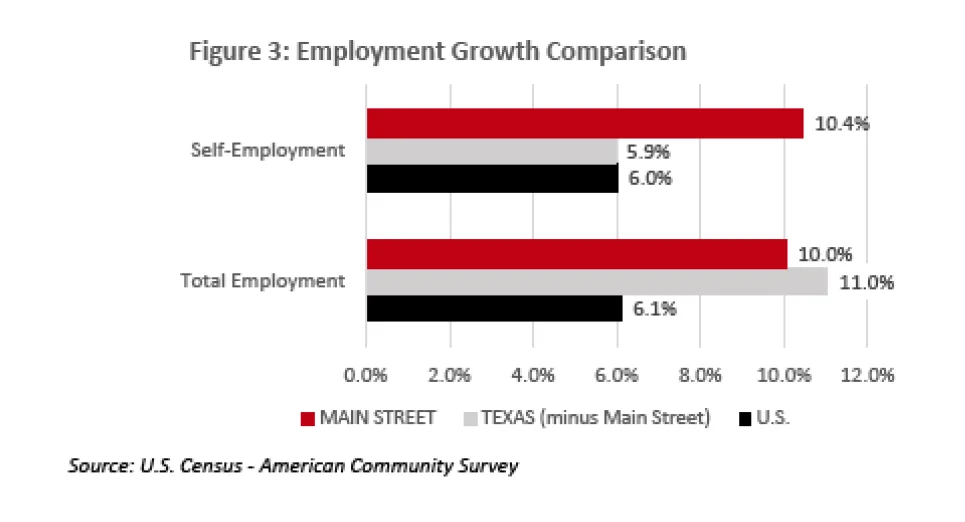
Also using the ACS 5-Year Estimates, the TMSP wanted to compare the growth in entrepreneurship in our communities versus those in the rest of the state (Note: While the ACS is not the most widely used source for employment figures, it is the only one that provides these specific figures at the city or ZIP code level).
It is certainly no secret that since the recovery from the Great Recession, Texas has been a job-producing machine. This is thanks to continued growth in energy, technology, and logistics among other industries and is reflected in the 11 percent statewide employment growth rate (6.1 percent nationally). Employment growth among our Main Street cities was not quite as fast as the rest of the state, but it still increased at a very strong 10 percent rate.
Where our Main Street communities really shined was in the increase in the number of self-employed persons. From 2012 to 2017, the Census estimates that self-employment increased 10.4 percent in our network, which almost doubles national and statewide growth.
Retail
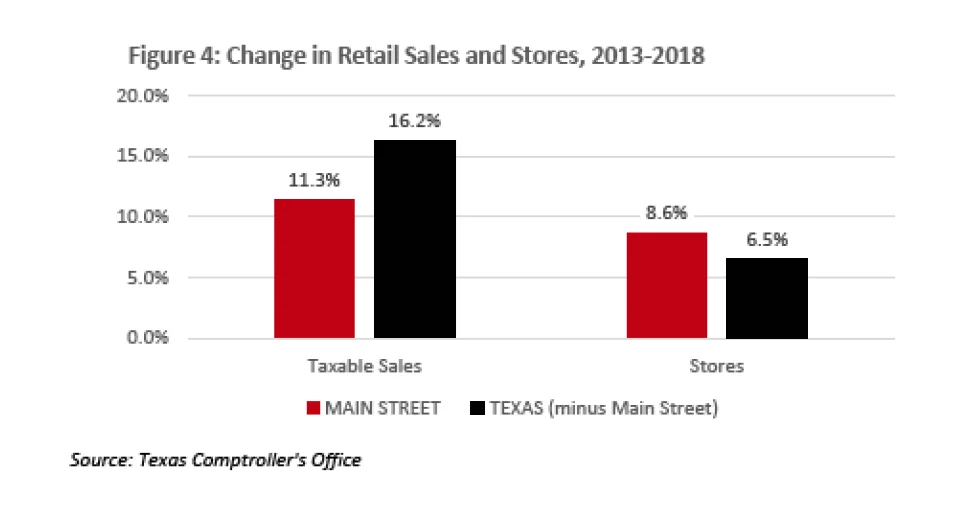
Finally, we decided to examine taxable retail sales in our network versus the rest of the state, as well as the number of retail outlets. Here, we found that taxable sales grew faster outside the Main Street network, increasing 16.2 percent compared to a healthy 11.3 percent jump within the network.
While that might offer some discouragement, it should also be noted that the growth in the number of retail stores was faster in Main Street communities (8.6 percent) than areas outside of them (6.5 percent). This would imply whatever growth in sales that is occurring is been spread more widely among various stores than outside the network.
Conclusion
Over the past few years, communities that participate in the Texas Main Street network outperformed the rest of a rapidly growing state based on domestic migration, new self-employed residents, and increase in the number of retail outlets. None of these data alone show that the Main Street program is solely responsible for these indicators of economic vitality. However, taken together, they provide tantalizing evidence that there is at least a positive correlation between community development efforts that focus on enhancing the amenities, such as downtown, and overall economic vitality.
The TMSP will continue to monitor these indicators but will also explore other data on an ongoing basis to help you, our partners, in building support for your program and uncovering insights that might enhance your chances for local success.