Texas Main Street Reaches 4 Billion in Reinvestment $ (2018)
By Debra Drescher
August 31, 2018
Managers,
In last month’s Main Street Matters, 12-month reinvestments by the public and private sectors into Texas’ current Main Street communities were shared. They showed once again that Main Street revitalization benefits not only individual communities, but also has positive impact on the state’s economy. You can see that blurb on page 3 of the July/August issue.
What wasn’t shared at that time was reaching an important milestone in the Main Street movement in Texas: We reached the $4 billion mark in overall public and private dollars reinvested in Texas’ current and former Main Street communities!
The bulk of that number comes from currently active programs that report reinvestment activity in their Main Street districts quarterly. About $3.3 billion of that overall cumulative number comes from your 87 currently designated programs. Like you know, Texas’ designated Main Street communities range in population from about 2,000 to well over 300,000 and are spread all across the state. About one-third of your programs have maintained their designations and their local Main Street activity for 20 years or more! This includes Grapevine, Lufkin, Corsicana, Goliad, Mount Vernon, Mineola, Pittsburg, Elgin, and others. Their tenure is a strong testament to the potential for economic return a community can achieve over time when downtown is a part of the local economic development effort and, more broadly, a part of the community vision. More than half of the $4.1 billion cumulative number has come from the private investment into downtown through rehabilitation projects, new construction in historic Main Street districts, and the value of real estate transactions. (Note: these numbers have not been adjusted for inflation like the Main Street figures in the Texas Historical Commission’s 2015 Economic Impact Study were.)
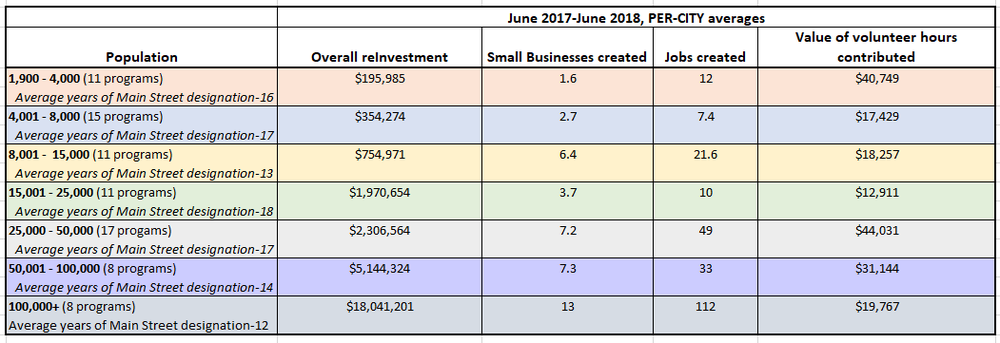
I thought you might be interested in seeing overall numbers broken down by populations. They are broken down in a manner to have a good subset to share. You may find this information helpful to help your own stakeholders realize Main Street’s full value; in addition to reiterating the message that a community’s greatest economic benefit can come from within – a focus on small business development and recognition that the historic downtown is one of your town’s greatest assets. The message also aligns with the revised Main Street Approach in which measurable economic outcomes are key to Community Transformation Strategies.
It is important to remember the typical stages of Main Street development, as originally developed by the National Main Street Center many years ago but still relevant today:
Catalyst phase: During this phase, in which the revitalization program is created, the organization builds collaborative partnerships; develops basic revitalization skills; and establishes a credible presence in the community. About the first 5 years.
Growth phase: Most of the major reinvestment needed in the historic commercial district takes place during this period. To about 12 years.
Management phase: In this stage, the organization constantly monitors the marketplace and helps the district make necessary economic adjustments; ensures that the district is well maintained; and continues to stimulate physical improvements and economic innovations. Ongoing after maturity.
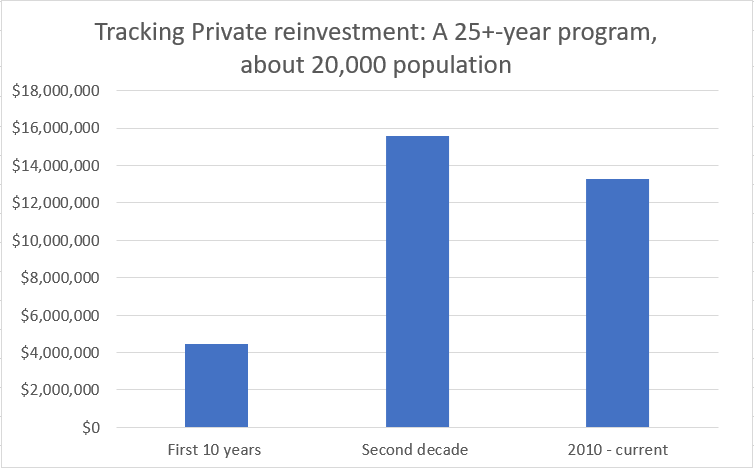
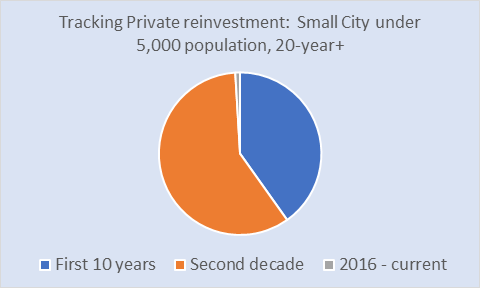
Every community that has come into the Texas network since 1981 when we were founded has been required to submit reinvestment data. Thus, we are able to look at your basic information and track reinvestment trends. Below are a few examples from programs in the network that show progress aligned with the revitalization phases mentioned above.