VISUAL MERCHANDISING FOR MAIN STREET MERCHANTS
February 2015 Main Street Matters
Article written by Kimberly Klein, Administrative Technician, Texas Main Street Program, Texas Historical Commission
Here’s the scenario: you and your best friend have decided to take the plunge; you are about to open up your own retail shop. Let’s pretend that neither of you are especially creative and don’t know where to begin. You start pondering how you are going to make your retail space look good, lure in potential customers, and persuade people to hand over their hard-earned money for your products. In this article we will explore some of the bare-bone basics you need to know for effective visual merchandising.
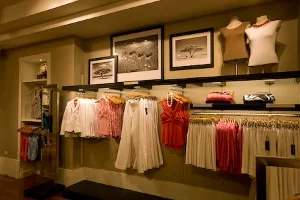
Target customer - The first thing you want to do is begin with your target customer in mind. Knowing your target customer and incorporating their lifestyle interests is going to help you tremendously in creating effective merchandising displays. A good example of a major chain is Banana Republic. They have done an effective job laying out their stores and displays to address the 18-24 year old young adults starting out their careers. Various types of displays and mannequins depict the young adults in sleek office-friendly clothing. The merchandise is highlighted by track lighting or spotlighting, while the furniture, display holders, wall color and wall art are in used in soft, natural tones.
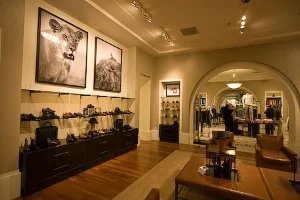
Store Interior Examples from http://www.theglobalphotographer.com/the-global-photographer/2008/5/29/banana-republic-store-interior.html
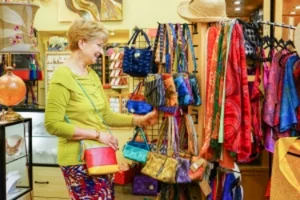
A good example of a local shop, The Escape, located in Georgetown does a fabulous job of laying out their stores and displays. Their target audience isn’t a specific age range, but showcases types of products homeowners would want to display in their home. Just like Banana Republic, the furniture, display holders, and wall color are in soft, natural tones. Accent colors, perhaps used in vases, wall art, and scarfs are brighter and grab the customer’s attention.
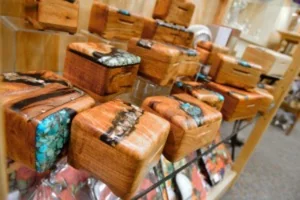
Visual Clues -There are so many visual cues you can utilize to communicate your message—from using colors, lighting, balance, and focus to direct where your customer looks and for how long. See this handout for a more detailed description on different visual cues you can use. The handout covers all the many ways you can visually create that first impression, top-quality signage, and displays for your business.
Creating an experience - Visual cues are essential, but don’t forget about sound, touch, smell, and taste to create a full experience for your store. Stores like to manipulate all of your senses so you’ll spend more money. In the industry this is commonly known as Sensory Branding. With sound, depending on what type of crowd you want to draw, play the music they would enjoy. With touch, allow your customers to touch, feel, and try out the items before a purchase is made. Smell is considered to be one of the most important senses, due to playing such an important role in memory, mood, and emotion. There is a whole concept referred to as “Scent Marketing.” Resources like http://www.air-aroma.com/scent-marketing and Scentmarketing.org are great tools that show how various industries play with this concept. For example, if feminine scents like vanilla or lavender are used in a clothing store, people are more inclined to buy women’s clothes. If a more manly scent is used, something woodsy or earthy, people are more inclined to purchase men’s clothes. With consumables, a little taste test can help with a larger sale.
Finding Sources of Inspiration - Major national chain stores pay big bucks for window display and interior layout designers and most have strict rules about contracting out or sharing their trends. However, the new retailer on Main Street can still learn a lot and get inspiration from visiting these stores and studying their techniques, in addition to visiting successful independent retailers.
There are also many forums and blogs that share current trends, such as these: http://thewindowdisplayblog.com/, http://retaildesignblog.net/, http://www.shopify.com/blog/12706185-a-fool-proof-guide-to-creating-window-displays-that-turn-heads-and-drive-foot-traffic, and http://www.boutiquewindow.com/blog/articles/why-window-displays-matter/#.VL_9ekfF98E.
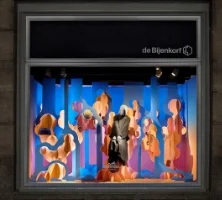
Example window display from retaildesignblog.com. Note the color and use of cut paper/foam for the backdrop.
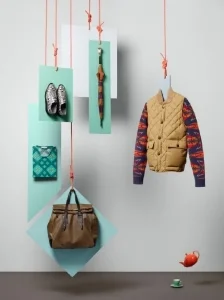
Pinterest is another great resource for images and projects you can do yourself. Start by searching “inexpensive window displays” and you’ll be amazed with what can be done with paper, string, paint, and found objects: http://www.pinterest.com/search/?q=inexpensive%20window%20displays.
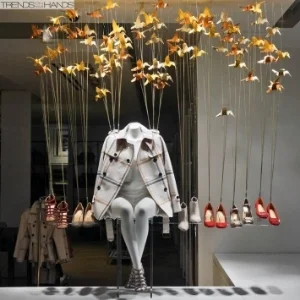
Pinterest Examples
Take a site visit to your own downtown stores or neighboring Main Street cities. Lufkin partnered with their newspaper for an inexpensive material for window displays; an opportunity for a creative window display contest that required a significant part of the design (at least 75 percent) to be made of newspaper and the Lufkin Daily News header had to be easily seen at least once. Here is one of the examples of the window displays featuring the Lufkin Daily News as a table runner.
With these tips, hopefully you and your best friend will have lots of fun creating a destination store that is visually interesting and an engaging experience for customers.
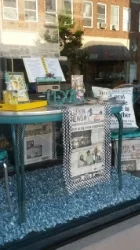
Window Display in Lufkin, Texas