
PER UNIT, PER BEDROOM, OR NOT ALL? MANAGING OFF-STREET PARKING REQUIREMENTS
August 2016 Main Street Matters
Article written by Emily Koller, Planner, Town Square Initiative,Texas Main Street Program
Parking is a subject in the Main Street field that will never go away. It presents challenges in every size downtown—from quiet communities with business owners parking all day directly in front of their shop, to busy university towns trying to reduce the number of students with cars through innovative development regulations. After several good questions from our Texas network, it struck me that many of our cities are at different stages in managing parking requirements but the general solutions are the same. The primary question is this:
How do you effectively manage off-street parking requirements that will not serve as a deterrent to redevelopment and will also promote good long-term planning?
We often see cities struggling over parking issues before there is much of a demand. When activity begins to pick up, the instinct can be—we need more parking!
This reaction should be curbed a bit. No pun intended. Why? Because whether you are just beginning your revitalization journey or have reached full occupancy, the parking solutions are similar. Downtowns are places for people not cars, and parking policy should support this goal.
In downtowns beginning their revitalization journey, reduced off-street parking requirements can be used as an incentive to make it easier for developers to convert vacant buildings into reactivated mixed use projects. At the other end of the scale are progressive parking policies in urban areas that allow significantly fewer parking spaces or zero on-site altogether in order to reduce the dependency on cars and driving. This provides environmental benefits with reduced greenhouse gas emissions and is also a favorable solution for developers because the construction costs are far less. In 2014, downtown parking expert Donald Shoup estimated the average cost of an above ground parking garage space to be $24,000.
The parking objectives in many of our cities are somewhere in between these two extremes. I reviewed the parking policies for some of our mid-size communities in order to better understand current practices and I was particularly focused on new residential uses in the downtown core:
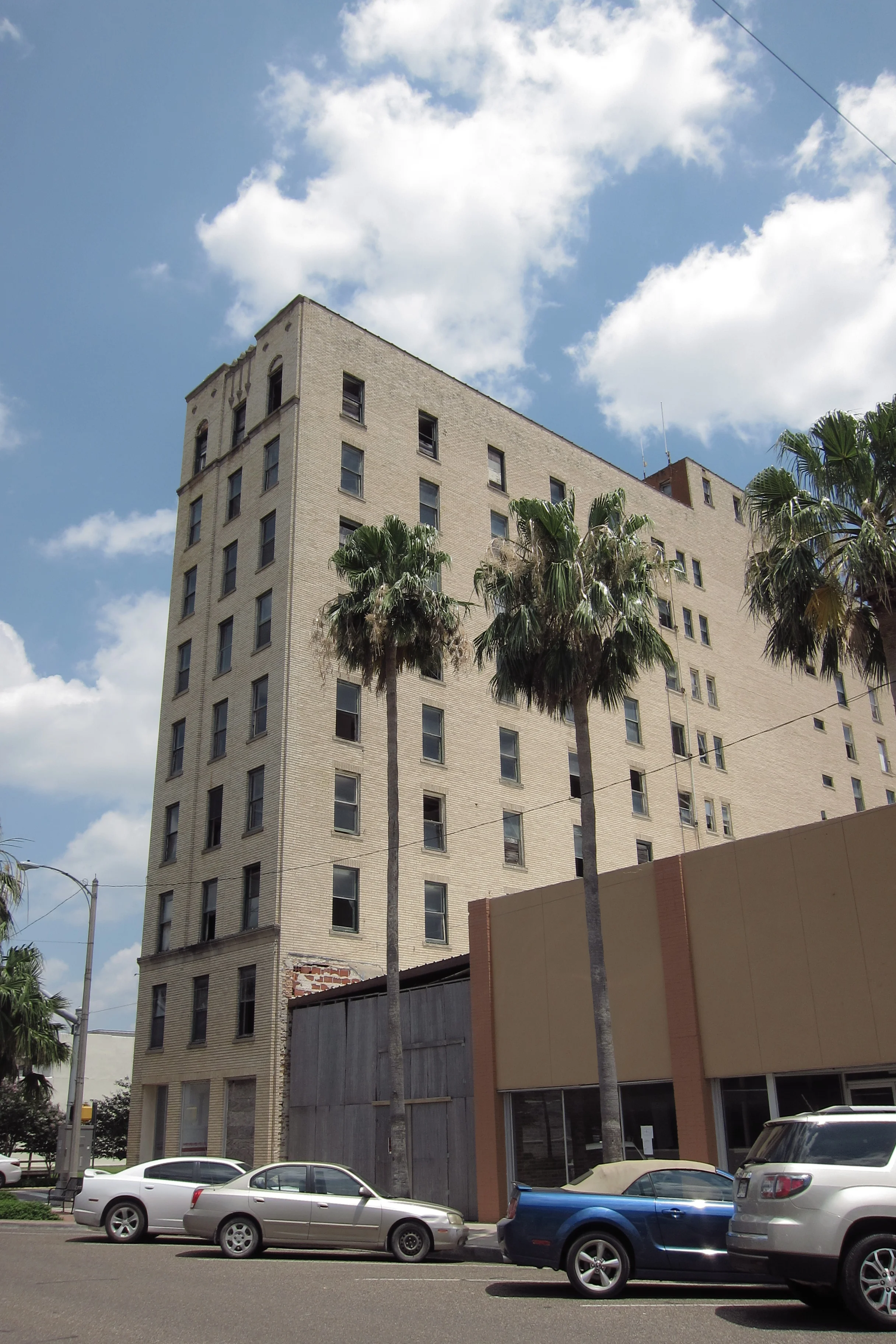
Harlingen: Flexible parking regulations can help make major redevelopment projects, such as the Baxter Hotel in Harlingen, more feasible to interested developers.
Amarillo: Amarillo requires one off-street parking space per unit for new multi-family in the Central Business District.
Denton: Denton’s Land Development Code provides an exemption for parking in the Central Business District for development or redevelopment of all non-residential uses. Residential development or redevelopment is exempted in the CBD if 10 or fewer dwelling units are proposed. For larger multi-family projects, projects are required to provide parking based on the type of unit. One-to-three bedroom unit requirements range between 1.5-2 spaces per unit, while 4-bedroom + units are required to provide one space per bedroom. This is a result of the student residential construction trend of large complexes with four to six bedroom units, which are individually leased (ie. four bedroom unit equals four leases).
Kerrville: In Kerrville’s Downtown Core, a conversion to a new use will not require additional off-street parking, unless the project includes an addition. New residential requires two spaces per dwelling unit.
McKinney: McKinney has a form-based code in place and in the Downtown Historic Core they require new residential uses include one off-street parking space per dwelling unit; however, shared parking can be used to meet the requirement. New non-residential uses are not required to provide parking. Existing building conversions into both non-residential and residential uses are not required to provide off-street parking.
Nacogdoches: In the Central Business District, off-street parking space for all buildings is required at the ratio of one space for each 2,000 square feet of floor area. However, if the computed number is less than ten, none is required.
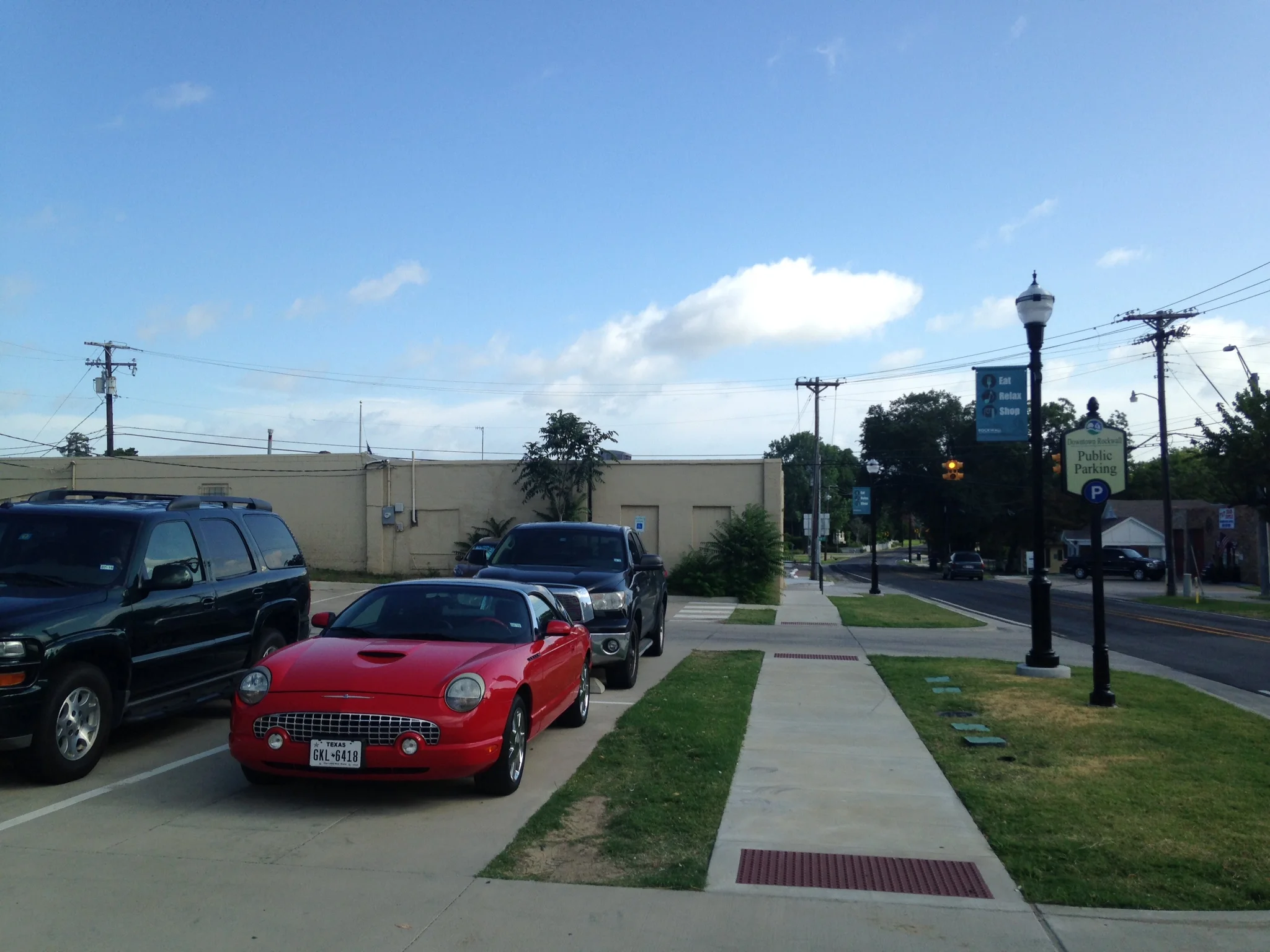
Rockwall’s downtown code allows a property owner in the historic core to lease off-street spots in city-owned lots like this or provide a cash-in-lieu payment.
Rockwall: Rockwall requires 1.5 spaces for studios/one-bedroom units, 2 spaces for 2-bedroom units and 2.5 spaces for 3 or more bedroom units. The city, however, offers many alternatives to meeting the parking needs for new projects. Required spaces for ground floor restaurant and retail uses are credited back to the project. The total can then be met on-site, curb-side, by lease from the city or by payment of cash-in-lieu. Properties in the historic core are also offered a “discount” on a lease fee or cash-in-lieu payment.
San Marcos: San Marcos also has a form-based code and encourages high density mixed use development in downtown. The code offers reductions for projects within ½ mile of a planned transit-oriented development as well as the ability to use off-site spaces within 1000 feet. The rehabilitation of existing buildings does not require the provision of new parking and most new development in the Central Business Area is not required to provide parking; however, new multi-family projects require one space per bedroom plus 5% for visitors anywhere in downtown. This is a relatively recent amendment in reaction to new large-scale student residential projects. Previously the code called for one space per dwelling unit for residential uses.
Waxahachie: Waxahachie has no parking requirements for its “Central Area,” the downtown zoning district. However, the city recently built a large public parking facility to ease parking demand generated by the county facilities and new redevelopment projects.
I was curious about other cities that seem to always come up in “great downtown” conversations including Lafayette, Louisiana, Mississippi and Oxford. Lafayette’s downtown code is newly adopted and does not require off-street parking for buildings that are five stories or less. Oxford exempts commercial uses from new parking and requires one off-street parking space for each newly built residential unit.
These examples demonstrate the following trends:
- Conversion of existing buildings into a new use typically does not trigger additional parking requirements in downtown.
- New residential construction is typically required to provide off-street parking while commercial uses are not.
- The average off-street parking requirement for a residential use is between one and two spaces per unit. The most recently adopted codes suggest one space per dwelling unit is an accepted standard.
- In college towns, construction trends for lease-by-the-bedroom projects force cities to require one space per bedroom.
Should you be interested in pursuing more ways to incentivize developers with parking reductions or, depending on your strategy, encourage “car-light” downtown living, here are some code suggestions:
- Do not require additional off-street parking for a change of use within the existing floor area.
- Exempt additions up to 1,000 square feet or 25% of existing gross floor area, whichever is less.
- Allow parking spaces to be provided off-site within a comfortable walking distance, such as 800-1000 feet using an alternative parking plan/agreement. Rockwall permits property owners to lease spaces from a city-owned lot.
- Allow existing on-street spaces to count for retail/commercial space requirements.
- Require new construction projects install bike parking at a reasonable ratio, such as one space per 2,000 square feet of gross commercial space.
- Consider reducing or waiving parking requirements through a fee-in-lieu program. In Berkeley, CA, the fees go to support transit, but in Texas, it would make sense to support public parking facilities.
- Consider “unbundling” the purchase/rental of housing units from the purchase/rental of car parking. Each type of unit and parking space is priced and sold/leased independently.
- Manage on-street residential parking through a residential permit parking program. If your city chooses to not require new residential development to accommodate all residents with off-street parking, consider a residential parking permit program where you can direct downtown residents to certain streets away from businesses.
- Plan far in advance for public parking lots and garages— identify suitable lots and budget for parking management.
Sources:
“Smarter Parking Codes to Promote Smart Growth” by Neha Bhatt http://www.smartgrowthamerica.org/2014/08/12/smarter-parking-codes-to-promote-smart-growth/
“The High Costs of Minimum Parking Requirements” by Donald Shoup http://shoup.bol.ucla.edu/HighCost.pdf