
Parking is an issue that so many Main Street programs and small downtowns in general have dealt with for a long time. Unfortunately, there is not a one-size-fits-all solution. However, the information below can start you on your way to conquering parking in your downtown.
Scenario: Some merchants allow employees to park in front of their store, which bothers the neighboring businesses.
1. Possible Action steps.
a. Analyze the situation - Has a meeting with merchants and/or any other type of communication on this previously been done? If not, you may find that just telling them that this situation exists and it is hurting everyone, including themselves, may help deal with the situation. If they are aware of how their behavior is impacting downtown and they have chosen to ignore it, then the way to deal with the issue is different – you might need to provide data on just how the situation is a problem. Maybe do a survey of the businesses who are complaining and collect some data/specifics on the negative impact they are seeing etc;, the importance of the downtown community working together for the benefit of all etc.
You might consider hiring a parking planning firm to perform an on-street parking management analysis. A reputable firm would break-down each parking stall by the number of daily visitors and each visitors retail spending per visit. They would determine the number of patrons per hour to determine the cost for the parking stall being occupied by a downtown employee. Your parking situation comes down to an opportunity costs not simply how it inconveniences patrons. Perhaps, if merchants were aware of the lost potential retail revenue they would think differently about parking curbside. The two examples below discuss how much a parking space is worth.
Click images to enlarge.
b. Identify public parking - Is there available public parking all around downtown? Create a parking map, parking kiosk, signage etc.. Many cities have also identified public parking online in such formats as shopping guides. Below are examples of both:
Click images to enlarge.
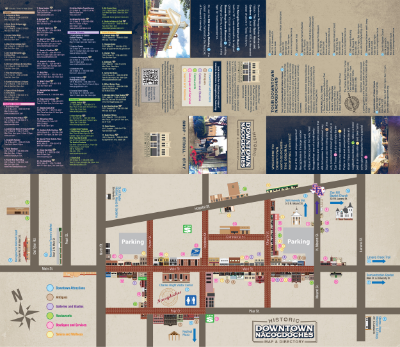
Download map here.
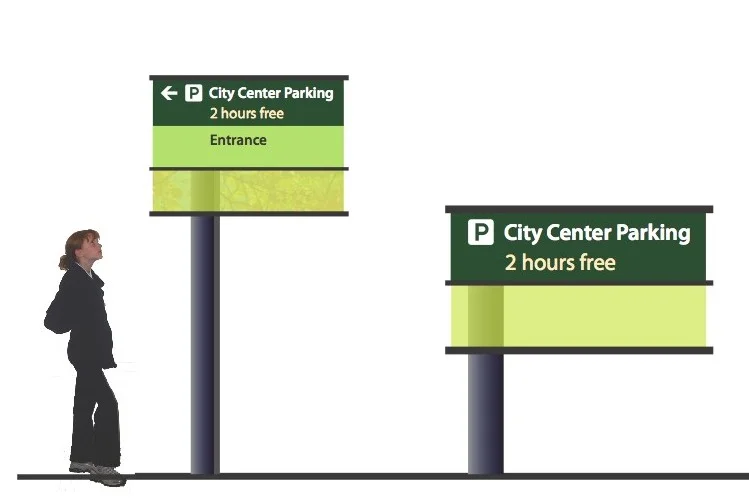
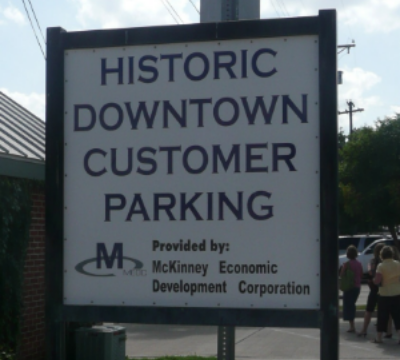
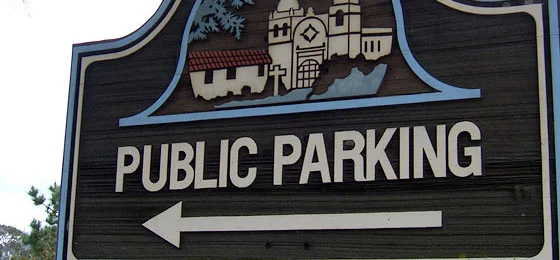
2. Meters. Two-hour parking etc.
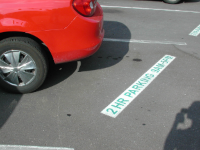
Meters are not recommended as the first action step until you have a good handle on how big the problem really is, through a survey or other method of data collection you might use to determine this. Is it a widespread problem or is it just a few businesses or a single block where the situation exists? If so, you might be able to deal with it in a smaller, more direct manner by talking to those who are directly the culprits. Some things to remember if you opt for the meters/two-hours etc.:
a. There is a cost attached to this – both the financial cost for meters and the cost of staff time for enforcement. In a small town this might be prohibitive.
b. On the enforcement side, you have to remember that this avenue allows you to ticket the culprits, but you’ll also be ticketing customers…..
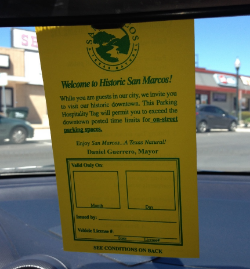
c. You man consider providing a hospitality tag. This will require continual training of merchant and city staff to be proactive about asking visitors/customers if they need a Hospitality tag.
San Marcos, along with the hospitality tag (seen right), also created an employee parking program and worked with a property owner of a vacant building to provide a free and large parking lot for downtown employees. They also increased parking enforcement for their two hour limit, even tracking cars that moved a few spaces every two hours.
Parking Lot Comparison:
There is a common spatial misconception about how far away a parking spot is to a downtown store. Some think, If they can't park right in front of the store the distance as too far to walk and there is a parking issue. Some cities have used Walmart as an example to try and change people's perception. The point being that the Walmart store can encompass most of a downtown and the parking lot is even further, meaning you walk much further in Walmart than downtown. It is not a perceived parking problem because all of the parking spots are located in front of the store whereas in downtown they are spread throughout.
ASSISTANT PARKING AMBASSADOR
Our meter attendants are called Parking Ambassadors. A job description follows this message. All ambassadors attend formal hospitality training once a year and we display their certificates in our office. When the ambassadors are on the street they often help carry shopping bags. They also carry parking tokens and often will hand them out to shoppers that they see fumbling for change. The tokens are worth about a dime, but the shoppers are as grateful as if they were gold coins. If a license plate has not received a ticket in the past twelve months the driver receives a courtesy ticket which usually ensures that tickets requiring payment are not given to our visitors and which also rewards the locals for good parking behavior. I have received dozens and dozens and dozens of thank you notes for these courtesy tickets over the years. The ambassadors also carry our shopping maps with them and are qualified to give directions to everyplace in Downtown as well as most places in the region. The ambassadors tell me that the number one question they are asked is, “Where should we eat?”, so I put together a separate guide of just the restaurants that is coded for price, outdoor options, view, alcohol, etc. The second most often question they are asked is, “Where can I buy a Petoskey stone?”. To respond we compiled a list of every store that sells them with a one sentence description of the kind of product they carry. The ambassadors carry both of these guides with them and hand them out frequently. The public loves them.
Best regards,
Becky Goodman
Downtown Director
City of Petoskey, MI
JOB DESCRIPTION
Create a friendly atmosphere with visitors to Petoskey and assist with their parking needs and questions regarding their visit to the City and surrounding area.
Report to the Downtown Director any problems that arise during the course of employment.
Enforce the Parking Ordinance for the City of Petoskey.
1. Write parking citations
2. Direct visitors and employees to parking areas meeting their needs
3. Create a harmonious relationship between staff and visitors
4. Collect money deposited in meters throughout the downtown area and sort parking tokens from these collections.
5. Collect money deposited in fine boxes located throughout the downtown area.
6. Issue parking permits and explain locations for which they are valid.
7. Bag and sell parking tokens.
8. Make bank deposits for collections from meters, fines, permits, bags, and tokens.
9. Prepare end of day report and record payments when necessary.
10. Assist Chief Ambassador and Downtown Director with office and pick up and delivery tasks as assigned.
Additional Parking Documents:
Bastrop's Parking Letter to Downtown Businesses
Waxahachie's Parking Letter to Merchants
Decatur's Parking letter and newspaper article
Elgin's Parking 101 flyer
Elgin's Public Parking Map
Back-in/Head-out Angle Parking
Parking Made Easy A Guide to Managing Parking in Your Community
One-Way to Two-way Conversion City of New Haven
4 Easy Steps to Squash the "There's no Parking" Argument by Nathaniel M. Hood with Strong Towns
Shared Parking Agreement:
Parking Brochure:
The Real Downtown 'Parking Problem': There's Too Much of It
Insider Tips to Parking in Downtown West Chester
Parking Studies: