List Serv Resources
Those of you that have had a theater restored in you town, please share the architects used and their contact information. We have a business owner looking for one to restore a theater here in Levelland. Thank you!
- Missy Passmore
Levelland Main Street Coordinator
Tyler
Butler Architectural Group of Downtown Tyler did our Liberty Hall reno. They have an historic preservation architect on staff, and their owner has been a long-time volunteer and board member, so they get it. They also designed our new, award-winning (sorry, had to add that in) parking garage: Here’s their info:
Butler Architectural Group - (903) 592-2244- http://www.butlerarchgroup.com/
Texarkana
The absolute BEST thing that you can do is join the League of Historic American Theatres (LHAT), the membership fee is worth EVERY penny. They have a FANTASTIC daily chat board amongst the members and you can also access their archives. The BEST most honest group for theatre information without any bias, they just truly care about all historic theatres and their restoration..their annual conference is EXCELLENT too! . . . . . cpoehlman@lhat.org
Brian Goesl, Executive Director, Perot Theater, Texarkana
SHOWSTOPPERS:
Historic Theater Restorations on Texas Main Streets
November 2014 Main Street Matters
Article written by Rebekka Adams, Assistant State Coordinator, Texas Main Street Program
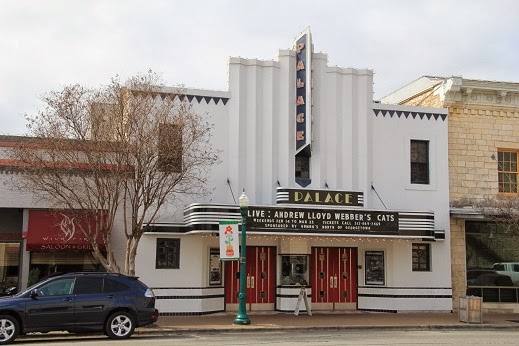
The Palace Theater in Georgetown is an excellent example of a restored theater in the heart of Main Street. Restored in 2000, the project took 3.5 years and a million dollar budget.
Visiting Main Streets throughout Texas, one icon is prevalent in most downtowns—a historic theater. Some of these theaters are architectural masterpieces, while others fit into the streetscape as a modest storefront with a marquee. These theaters are important to our communities as they are places that spark our creativity, sanctuaries for art and cinema, and places for us to be collectively entertained and escape reality, even if only for but an hour. Unfortunately, many of these treasures have long since shuttered their doors due to economic hardships and changing technologies, leaving a hole in the hearts of our downtowns. Luckily, the value of historic theaters is now realized and many communities are fighting hard to save and restore these treasured buildings.
The economic benefits of restoring historic theaters to operating venues has been proven in case studies throughout the United States. Studies in other states show the positive local economic impact of audience spending in arts related events. A 2005 study by the Seattle Arts and Cultural Affairs Office estimates that resident attendees spend on average $21.27 per day in event-related purchases, while non-resident attendees spend an average of $31.92 per day. Based on data from the Texas Office of the Governor, Economic Development and Tourism and studies commissioned by cities, nonprofit arts and culture industries generate $2.46 billion in tourism spending. This translates into 21,000 jobs with earnings in excess of $700 million. In addition, the state and local governments received $158.5 million in tax revenue from these visitors.
Though nostalgia runs deep in these places, it takes modern technology to make theaters economically feasible once again. This article explores a handful of theaters in Texas Main Street cities that are working hard to revitalize their downtowns by restoring their theaters. We then give you some resources to get started on working with your community to help restore your historic theaters.
Texas Theater, Kingsville
Written by Cynthia Martin, Downtown Manager, Dept. of Tourism & Heritage, City of Kingsville
A new page in the history of Kingsville’s Texas Theater started in May of 2013, when a San Antonio businessman, Cal Collins, purchased the deteriorating downtown theater. Built in 1950 according to a design by prolific Dallas theater architect, Jack Corgan, the theater was, according to long-time resident Ben Figueroa, “the place to be in Kingsville in the 1950’s and 1960’s” on date night. Mr. Collins has been producing and directing musicals for 20 years and had always wanted a theater of his own. However, he had a larger vision—to provide the community with a new downtown attraction that could be used by the community for a variety of events—a vision shared by Kingsville Main Street. Mr. Collins applied for and received a façade improvement grant for $45,000 from the City of Kingsville in recognition of the importance of this project as a catalyst for further development in a downtown block that included a number of vacant buildings. Kingsville Main Street Manager, Cynthia Martin, provided technical assistance on design and material issues that came up during work in progress on the theater. She worked with the owner to facilitate the logistics of the project such as coordinating removal of demolition and construction debris; arranging with the City to have the street tree in front of the theater trimmed to make way for the restoration of the vertical “Texas” sign and the marquee; assisting with the choice and procurement of exterior paint for the façade; and documenting the project and keeping it in the public eye to stimulate interest in hope for development of nearby properties.
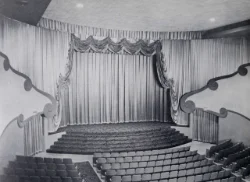
Texas Theater’s interior and 1950 façade. Images courtesy Kingsville Main Street.
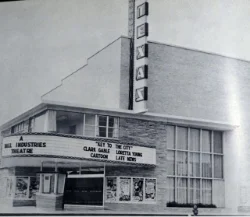

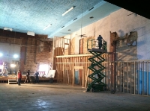
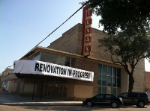
Kingsville’s Texas Theater is currently under renovation. Before (left), During (center), and near completion (right), Image Courtesy Kingsville Main Street
Owner Cal Collins, says the restoration will likely take two years as the theater hasn’t been properly used for about 30 years. But once done, he says “it will be a centerpiece for downtown.”
Fair Theatre, Plainview
Written by Andrew Freeman, Assistant City Manager, City of Plainview
Since being purchased in 1994 by the City of Plainview, and reopened in October 1999, the Fair Theater has re-established itself in the cultural fabric of Plainview.
The Fair Theatre originally opened as a silent movie house in 1925. It has undergone many a transformation, from a popular movie house, to a vaudeville showcase, to an empty shuttered building, to the jewel in the crown of downtown Plainview.
In an effort to promote tourism and recapture a bit of historic grandeur reminiscent of downtown’s glory days, the City of Plainview purchased the building in 1994 with hotel/motel taxes. Those tax funds, which are based on room receipts and taxable revenues of local lodging establishments, are restricted and can only be used to promote tourism and conventions.
A $250,000 restoration followed the purchase. Grants, fund-raisers, and donations helped to pay for stage curtains, lighting and sound systems, central heat and air, and other necessities. The restoration was made possible in large part thanks to free craftsman labor provided by prisoners from the local Wheeler Formby Unit.
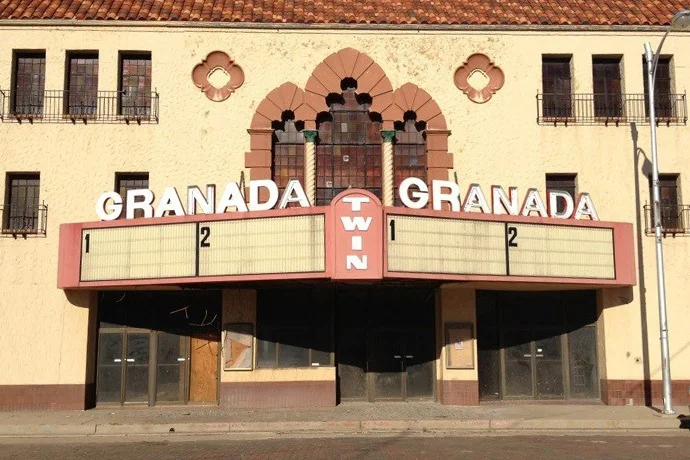
Granada Theater before (left) and after (right), Image Courtesy Plainview Main Street
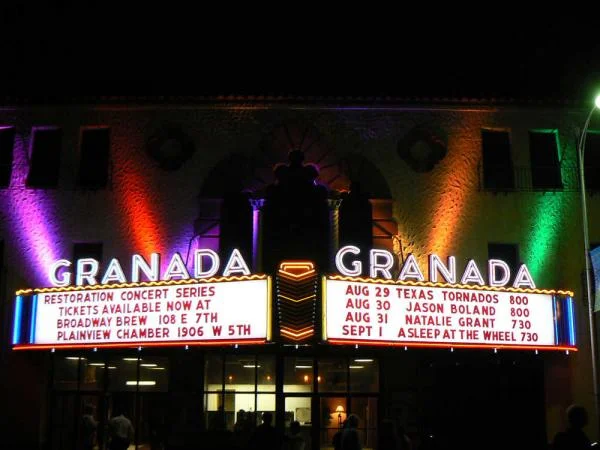
Though the restoration took about 18 months, the glitter and glow of the theatre’s present persona seems as if it has always been there. The theatre stands three stories tall and sports a split balcony. It seats 421 on the main floor and another 110 upstairs.
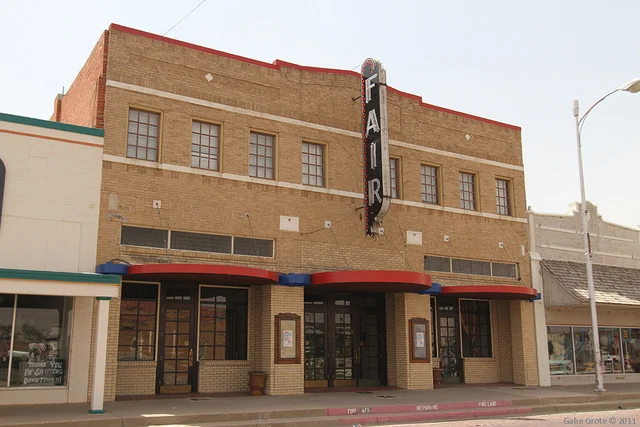
Fair Theater, 2011, Image Courtesy Plainview Main Street
Plainview is fortunate to have another historic theater, The Granada, which was purchased in 2012, and restoration work has begun. It opened in 1929 and closed in 1997. The owner is continuing to work on it and has recently installed a restored marquee on the outside. They also removed the dividing wall, drop ceiling and framework inside that was installed in 1977, concealing the original stage. To date, a cost of $66,000 has been spent on the restoration. The owner held a concert to help raise funds for the restoration. Original seating capacity for the theater was 1,400 before the chairs were removed in 1997. His goal is to return the theater to 1929 specifications.
Lynn Theatre, Gonzales
Written by Barbara Friedrich, Main Street Administrator, City of Gonzales
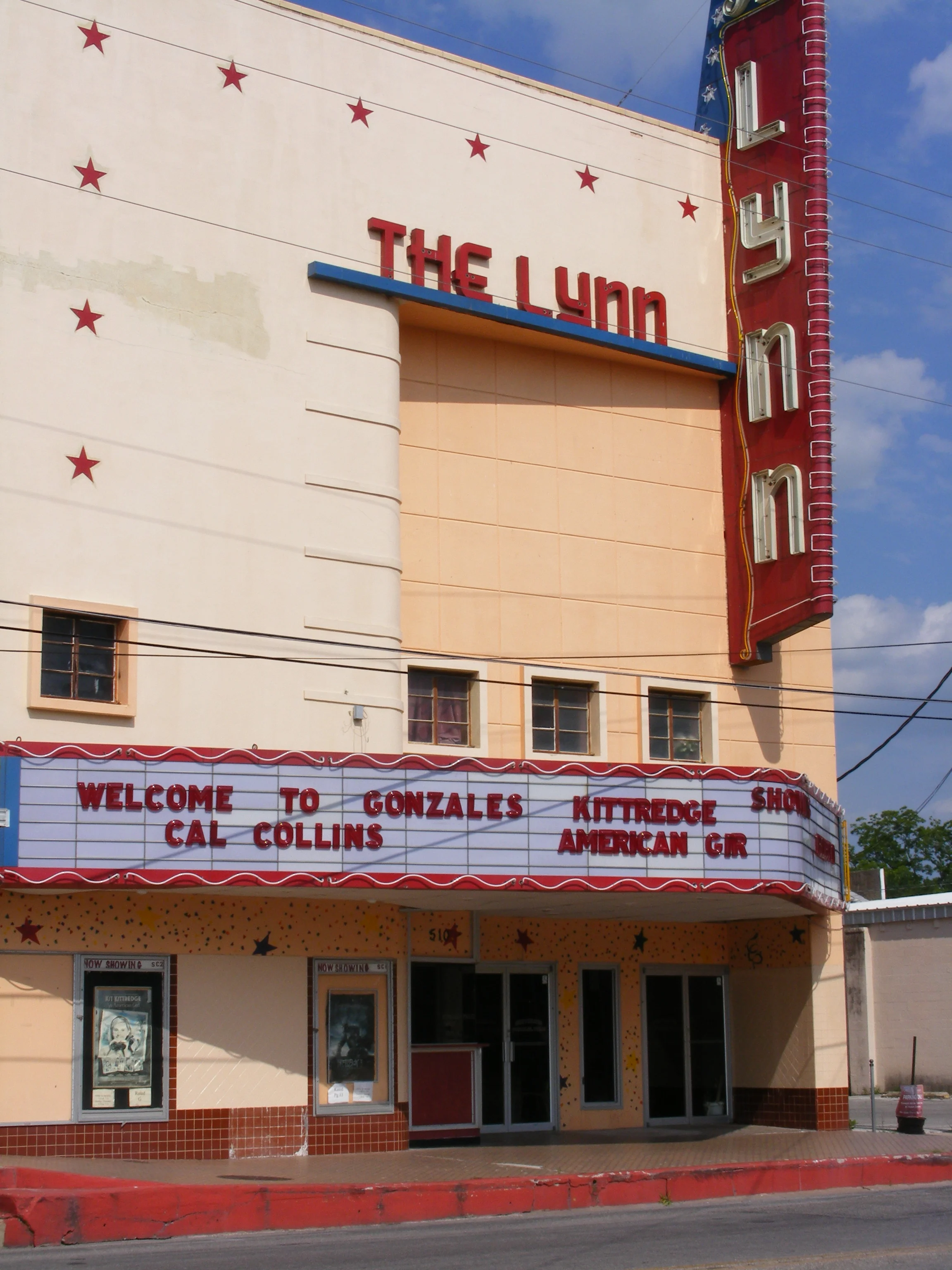
Lynn Theater, 2011, Image Courtesy Gonzales Main Street program
The Lynn Theatre was originally built by Lynn Smith Sr. in 1947 and was in operation until the 1970’s when it was sold to Commonwealth Theaters, who ultimately closed the theater in the 1980’s due to an unfortunate crime which prevented parents from allowing their children to attend. The building was purchased in 1988, but remained closed until 2005.
In 2004, the building once again switched hands. The new owner purchased the dilapidated theater and worked hard to completely renovate the building, including installation of a new roof, plumbing, and electrical system. The balcony was closed off from the main space and a second screen was installed, so that two movies could be shown at the same time. The total investment was $400,000, which was financed through a combination of private funds and loans from the Gonzales Economic Development Corporation, the Gonzales County Revolving Loan, the Gonzales Area Development Corporation, and Prosperity Bank. At the time, the most costly expense was asbestos abatement, which ran $120,000 and took the project over budget. Without this intervention and investment, the Lynn Theater probably would not be standing today.
The greatest challenge of this project was the cost to renovate the theater and get it operational again. The building sat vacant for about 30 years, during which time there was a lot of expressed interest in the building but the current property owner was unwilling to sell it.
In 2009, the Gonzales Economic Development Corporation took possession of the Lynn Theater and sold it. The new owner put about $150,000 into the building turning it into a live theater venue and producing several live shows which brought some interesting traveling shows to Gonzales.
In 2012, the Gonzales Economic Board took control of the building back and leased it out with an option to buy to a family operated business that upgraded and digitized the theater. Although there was a lot of turnover in recent years, the theater is now a viable business and a valuable community asset. This process shows that it took the dedication of numerous people and investors, and public-private partnerships to bring life back to the Lynn Theater. Currently, the theater seats 400 people and first-run movies are shown Wednesday through Monday. The operator hosts a free movie on Confederate Square twice a year and runs $1 movies on Friday nights during football season. After all this time without a theater, it took the citizens of Gonzales to realize they did not have to go out of town for a dinner and a movie. With new restaurants in downtown, Gonzales now has a destination for locals’ right in the heart of Main Street.
Find out about events and happenings on the Lynn Theater Facebook page.
Barnhill Center at the Historic Simon Theater, Brenham, Texas
Written by Jennifer Eckermann, Main Street Manager, Brenham
It has been more than a decade since Brenham Main Street Historical Preservation, Inc. (BMSHP)—a 501(c)(3) non-profit entity—was organized to preserve the architectural heritage of Downtown Brenham.
Soon after purchasing the Simon Theatre in 2003, a theatre consultant, whose company managed and operated renovated theatres across the country, was hired to help determine the best use for this historic property. Following Town Hall public meetings, with representatives from throughout the community, the board felt confident that a downtown conference center would contribute to the economic and cultural vitality of our community, and a Business Plan was developed.
Little did the board know at the time, that it would lose its leader, Tom Bullock, Sr., much too soon, and that it would take as long as it has to complete the renovation of this historic property.
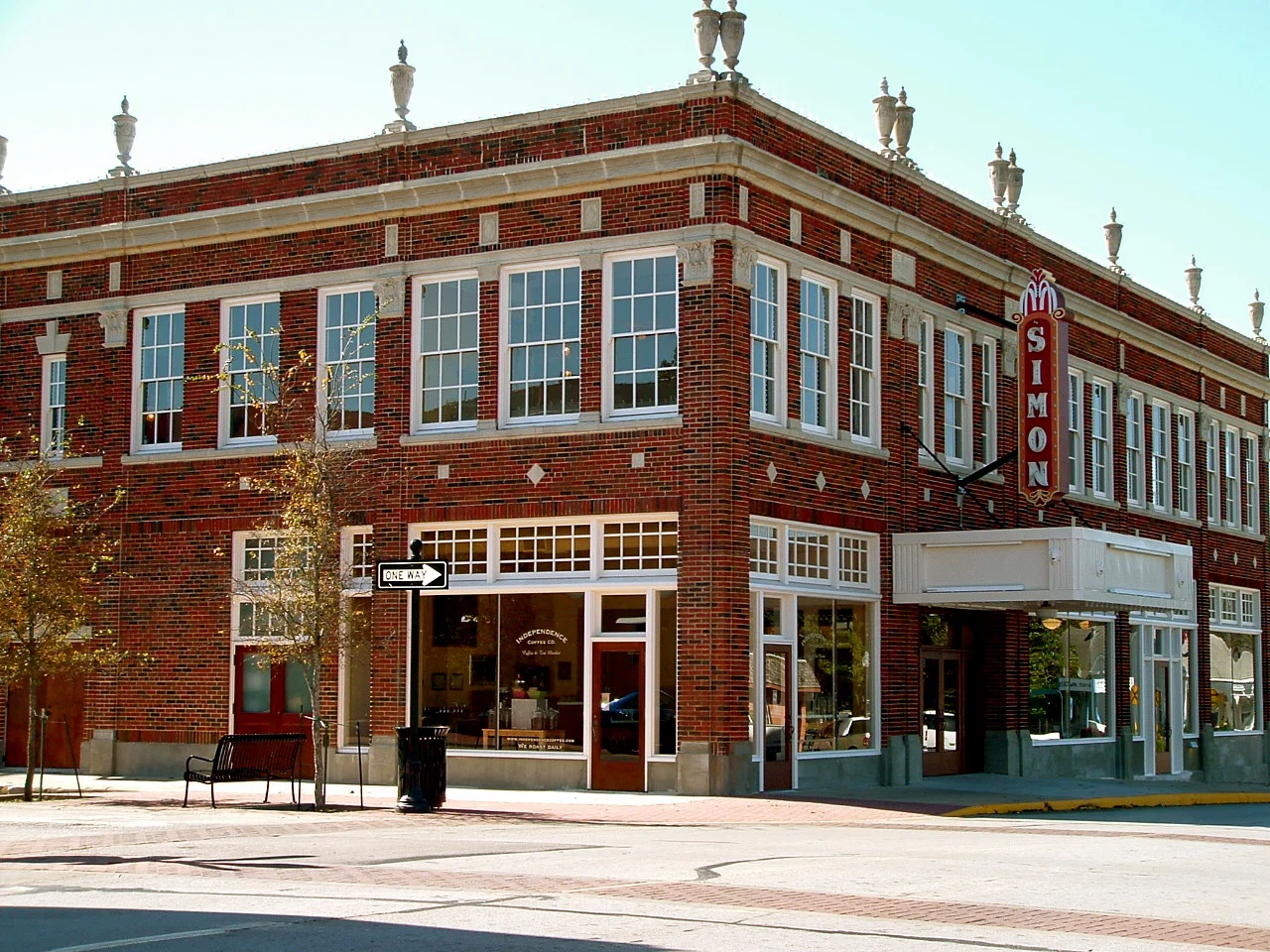
Simon Theater, Brenham. Image Courtesy of The Brenham House Blog.
Initial fundraising led to work on the building’s exterior, including repointing of the brick, and replication of the marquee and neon sign.
Next, a new roof was installed, and in 2010, the board made the decision to move forward with Phase I, which included the lobby and what were shown on the original plans as Retail 1 and 2. This phase was completed at the end of 2010, and the Convention and Visitors Bureau moved in, as was suggested in the Business Plan.
The original Master Plan Scope, designed by preservation architecture firm, ARCHITEXAS, included required ADA restrooms in the back of the theatre, totally changing the look of the theatre.
Not satisfied with that solution, the board voted in 2012 to purchase the property next door to the Simon on Douglas Street for construction of restrooms and additional meeting space for the conference center.
Phase II of the project began earlier this year when work on the 2nd floor ballroom began. This phase includes adding the elevators needed, renovation of the original ballroom space, and adding second and third floor spaces to the three-story fly space above the theatre stage, and a catering kitchen and storage area.
For the past two years, the board has been working with a consultant on tax credits, as a way to help raise the majority of the funding still needed. Although there was a major setback last year when it was learned that the New Market Tax Credit investor had backed out of this and similar projects across the country, the board now has investors for the Federal Historic Tax Credit, and the new State Historic Tax Credit.
It was the ability to take advantage of these tax credits, along with the more than $5M that had been raised, that led the board, in March, to make the decision to move forward with Phase III —completing the renovation of the theatre, and the restrooms needed to complete the building’s renovation. This allows BMSHP to receive a needed Certificate of Occupancy by the end of the year, as required by our federal tax credit investor.
Since the beginning, BMSHP has worked under the premise that this downtown landmark should be renovated to become a downtown conference center, drawing meetings and workshops to town on weekdays, and using the facility on weekends for a variety of receptions and events, including film festivals and showings of classical, independent, and foreign films, concerts, and educational opportunities and programs.
Even 10 years later, the Business Plan, written by the theatre consultant, is timely and relevant, with strategies, policies, and management tools that ensure both community service and financial sustainability.
The whole fund-raising process was long, and honestly, often torturous. There have been great highs, and there have been long periods of little progress, but the board was happy to recently announce that the renovation of the Simon Theatre will be complete in the spring of 2015.
Click here to read more about the history of the theater and the Save The Simon project.
Now that you have some inspiration as to what a theater restoration looks like, both physically and how it impacts the community, it is time to examine the use of historic theaters in your Main Street.
Note that although many people want to restore historic theaters because of their beauty and history, it is important to have a convincing plan of action as to how the restoration will benefit the community and be an economic engine. Research is your friend. Doing a full background investigation on the property and its previous uses will help you plan for its future. Developing a clear vision of your project goals and a plan of action for restoring a theater will help you save time, money, and morale. In restoring a theater, one should visualize the final project, what it means for the community, how it will be programmed and managed, and then work backwards to achieve that result. The League of Historic American Theaters has a wealth of information on everything from the restoration process to programming insights. It’s Historic Theater Rescue, Restoration, Rehabilitation and Adaptive Reuse Manual can be found here. This manual has the most in-depth information about everything related to restoring a historic theater, including how the city fits into the picture, business structure, and financing options.
Here are some additional resources for saving historic theaters:
EDUCATIONAL RESOURCES
American Theatre Organ Society (ATOS)
Organized in 1955, ATOS is an international society of over 5,000 members dedicated to the preservation the theatre pipe organ and its music. Its mission is to preserve, restore, maintain, and promote the theatre pipe organ. A few ATOS chapters own and operate historic theatres. www.atos.org
Cinema Treasures
This ground-breaking website is devoted to movie theater preservation and awareness using the community-building capabilities of the Internet, Cinema Treasures unites movie theater owners and enthusiasts in a common cause—to save the last remaining movie palaces across the country. http://cinematreasures.org/
The League of Historic American Theaters (LHAT)
The League of Historic American Theatres, a nonprofit membership association, is a professional network dedicated to sustaining America’s historic theatres for the benefit of their communities and future generations.www.lhat.org
Theatre Historical Society (THS)
Founded in 1969, THS is the only organization in the nation which documents and preserves the architectural, cultural, and social history of American theatres. Its archives contain information on more than 14,000 theatres nationwide.
www.historictheatres.org
FINANCIAL RESOURCE
Johanna Favrot Fund for Historic Preservation
The Johanna Favrot Fund for Historic Preservation makes grants available to historic theaters hoping to maintain their structures and make improvements. The program was started in honor of Johanna Favrot’s 80th birthday and seeks to encourage the appreciation of historical sites throughout the country. Available to both public and nonprofit organizations, the fund offers grants ranging from $2,500 to $10,000, though the amount awarded must be matched by the particular theater or location. Click here for more information.