The Ins and Outs of Opportunity Zones
May 2019 Main Street Matters
By Alan Cox, Economic Development Specialist, TSI, TMSP
Since last summer, community leaders, developers, and investors have been abuzz about a new federal incentive program which holds the potential to infuse new money into distressed neighborhoods and downtowns. As part of the larger Tax Cuts and Jobs Act of 2017 package passed and signed during the same year, the initiative was designed to attract “patient” capital investments into areas that are designated as “opportunity zones.”
Where are Opportunity Zones?
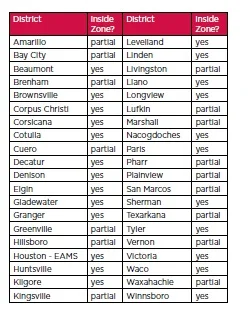
After the bill’s passage, the governor’s office of each state was asked to qualify areas that met specific “low income” requirements during Spring 2018. Our review of the qualified opportunity zones indicates that 40 of Texas’ Main Street districts are either wholly or partially included. To see if your downtown district is located in a certified opportunity zone use this interactive map: https://eig.org/news/opportunity-zones-map-comes-focus
A full list all of Census Tracts designated as Qualified Opportunity Zones in Texas can be viewed here: https://gov.texas.gov/uploads/files/press/Opportunity_Zone_Designations.pdf
How does this work?
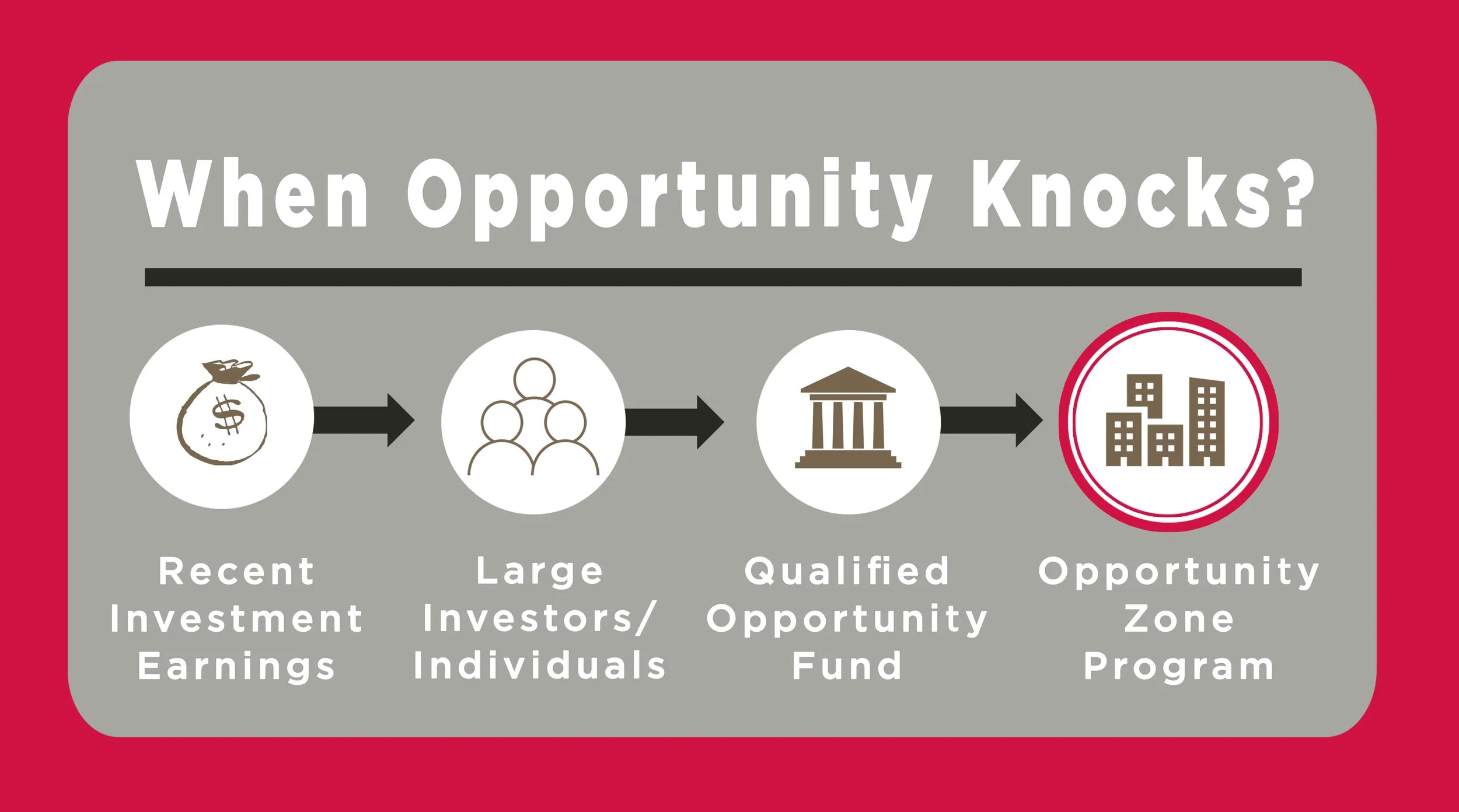
First, let’s unpack what the term “patient capital” means. This refers to people who have money that can be invested but are willing to wait on their return (or profit) from that investment. Only money that is subject to the capital gains tax (made from a previous property that was sold or exchanged) can be used. But investors aren’t the ones who are directly pouring money into the zones. Instead, they hand the money over to a Qualified Opportunity Fund (QOF) that pools the money together and makes the investments themselves.
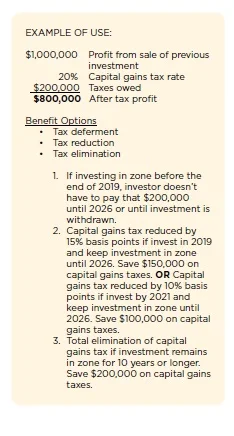
Now, the reason why an investor would be willing to be “patient” is because the program is set up to incentivize people to wait on their return. To put it simply, the money they give to a QOF isn’t taxed by the IRS while it’s in their hands. The longer the investor keeps it in a fund, the greater their tax advantage. Currently, the maximum amount of time is until the end of 2026. The tax benefits are based on three periods: five, seven, and 10 years. Five years reduce capital gains tax payments by 10 percent, seven years yields a 15 percent reduction, and 10 years the tax is eliminated.
The reason the program is set up this way is so the investments made within an Opportunity Zone are sustained over a length of time, and theoretically provide an ample opportunity for it to begin to flourish.
How do Qualified Opportunity Funds operate?
The IRS defines a QOF as “an investment vehicle that is organized as a corporation or partnership for the purpose of investing in qualified opportunity zone property” and must hold at least 90 percent of its assets within a zone. The creation of a QOF appears to be a simple and straightforward process. According to the IRS, any “eligible corporation or partnership self-certifies by filing Form 8996, Qualified Opportunity Fund, with its federal income tax return.”
Early drafts of the form and instructions are available at the following links:
Instructions: https://www.irs.gov/pub/irs-dft/i8996--dft.pdf
The proposed regulations within the above instructions “clarify that there is no prohibition to using a pre-existing entity as a QOF or as a subsidiary entity operating a qualified opportunity business.” Because of this, many speculate that large investors are positioning themselves to take advantage of this program to make major real estate investments in some of the country’s largest cities. These cities are already undergoing gentrification and could bypass most of America’s smaller communities that are in most need of new investment. That said, existing community development entities such as Community Development Financial Institution Funds are also likely to get involved.
QOF investments must meet the following requirements:
Located in an Opportunity Zone,
Must be tangible used in a trade or business,
Purchased after December 31, 2017, and
Must be either new construction or “substantially improved” after purchase with construction costs meeting certain minimum requirements.
A note of caution, however, should be advised. The legislation that enabled this program appears to offer very little in terms of oversight and, as a result, there are concerns that only negligible tracking of investments will be made at the federal level. This obviously causes concerns about whether the funds will be allocated to its intended targets.
How can my Main Street benefit from Opportunity Zones?
Right now, any answer to this question is merely hypothetical speculation since there are no examples of its implementation (and the IRS regulations haven’t even been released yet). But it appears there are essentially two options:
Market your local Opportunity Zone to attract investment from outside QOFs that act as “blind pools” in hopes that your downtown can compete with the potential return on investment that other zones around the country.
Work with individuals or entities that have experience in raising capital and making real estate investments to set up a local QOF that focuses specifically on properties in your downtown.
The second option is an intriguing, albeit risky, one but the advantages seem to be substantial for several reasons:
Your community can finally have a dedicated pool of cash invested available for downtown investment;
Your Main Street board can potentially influence how those investments are made;
Locals with “patient capital” might achieve substantial returns on their investments which would benefit the wider economy.
Through careful guidance and implementation, the Opportunity Zone program could have the potential to be a “game changer” for revitalization and redevelopment efforts across the country. Unfortunately, no existing case studies exist for our Main Street programs. That said, best practices have been learned through trial and error in the broader planning world and should have equal relevance to Opportunity Zones.
Through careful guidance and implementation, the Opportunity Zone program could have the potential to be a “game changer” for revitalization and redevelopment efforts across the country. Unfortunately, no existing case studies exist for our Main Street programs. That said, best practices have been learned through trial and error in the broader planning world and should have equal relevance to Opportunity Zones.
Coordinate investments with the broader economic development framework of your community in mind. Investment decisions shouldn’t be made in a vacuum. In your community, investment decisions are being made daily by the local business community as well as local governmental entities (e.g., city, county, economic development entity, school district). Be mindful of their various priorities and embed Opportunity Funds within the local economic development strategic toolkit. Also, keep in mind that an Opportunity Zone might already have gained a special designation for targeted economic development (e.g., New Market Tax Credits, Empowerment Zones, Tax Increment Financing), so be sure to assess how the various incentives can be best layered to maximize benefits for your downtown and the broader community.
Engage all members of your community. Make sure that planning is inclusive and investment priorities are made with the broader community in mind to mitigate displacement of existing populations (i.e., gentrification).
Measure the performance of investment decisions. Track how money is being spent by QOFs in your local zone to see that it is being spent efficiently and for maximum benefit. This could be especially helpful if your local economic developers embrace the program and begin to tie other incentives to the zone as part of the community’s overall economic development strategies. It can also help ensure that investments can be tracked and that investors can be held accountable for their decisions. Just as important, performance metrics can help influence the types of investments they make.
Clearly, the Opportunity Zone program holds great promise in communities where a zone exists as it has the potential to provide a pipeline of investment dollars that can be directly poured into many of our downtowns. But it remains to be seen how the program will be implemented and eventually pan out. Because of the relative lack of oversight, zones where strategic decision making is closely coordinated at the local level are those that will likely have the greatest success in the coming years.