
Traffic Patterns: Changing the Priorities of TxDOT Streets in Downtowns
July 2017 Main Street Matters / Updated November 2020
Original Article written by Riley Triggs, AIA, Architect, Texas Main Street Program
Space is for movement; Place is for pause.
What happens when the space of a Texas Department of Transportation (TxDOT) facility (road) intersects with the place of a Texas downtown can be as varied as the number of towns in which it occurs. Some towns depend on through traffic, some become choked by it, and most are somewhere in between on the spectrum of benefits and detriments of that road to the community. Each road, however, affects the quality of the place it is a part of, and the intentionality—or the priorities that made it the way it is—are what define the essence of its town square. In the places of downtowns, people, not through car traffic, should be the priority of streets.
The typical TxDot Calculation … and what’s missing.
A traffic engineer will typically use an equation such as Q = KV, where Q is the lane flow in vehicles per hour, K is the density in vehicles per mile and V is the space mean speed in miles per hour combined to determine how to design a road. Notice the optimal result is directly related to speed. Missing from the equation are some very important elements that relate the calculations to the people in the place.
There are no terms that consider the effects of the flow of traffic, like the ability of a person to comfortably jaywalk; the feeling of ease of a parent with small children; the likelihood a senior with a walker will be comfortable crossing the street; the distance from the street a person must be to feel OK walking on the sidewalk; the affordance for seasonal decorations; the amount of dappled shade necessary to create visual relief on a reflective paved surface; or, at the most basic level of importance to a downtown, the tolerance threshold for a person to want to cross a
street. These are essential for making a good place that people want to be in, but they are missing in the equation because a traffic engineer has priorities different than an average citizen.
There are four elements of traffic to prioritize when designing a road, and an engineer is taught and expected most of the time to prioritize in the
following order:
Traffic Speed
Traffic Volume
Safety
Cost
People tend to individualize their own personal connections to a situation, so asking everyone else how they would prioritize yields quite a different result:
Safety
Cost
Traffic Volume
Traffic Speed
How Streets Determine the Character of a Place
This prioritization sets the intention for the space and has a tremendous amount of influence on the character and quality of a place. For instance, this Google Street View from 2008 of Rockwall, TX (below) shows a typical scale, proportion, and intentionality of a Texas town square street. The courthouse is directly to the right behind a layer of shade-producing trees and a row of nicely detailed street lights. The street itself is two-way,
narrow lanes with a painted turning median that keeps auto speeds low. The opposite side of the street is lined with gentle steps that can encourage people to cross the street anywhere since auto speeds are low. Flowers in planters and seasonal decorations show evidence of care and effort to make this a particular, local, and grounded place for people.
If I were to ask you what you would do if you had a few million dollars to improve this stretch of road, what would you suggest? Maybe a landscaped median with a row of trees; more streetlights on the opposite side of the street; narrower lanes to slow traffic more, curb cuts on the courthouse side to make it easier for people to walk through the landscaped islands; a bike lane; or decorative crosswalks protected by embedded
warning lights. These items would allow this street to contribute positively to the value of downtown Rockwall and be an asset. The TxDOT improvements, though, have other priorities, and now the road is a potential liability to the success of downtown.
And how TxDot “Improvements” Can Ruin That Character
The priorities for improving N. Goliad St. that runs north-south through Rockwall, however, were speed and volume—not safety, cost, nor use value to people already at their destination in town. This led to the introduction of a road ‘couplet’ of two one-way streets with more, wider lanes and higher speeds for through traffic. The road also has 18-wheeler truck traffic, which coupled with the higher speed limits and wider lanes, creates a very unfriendly experience for people trying to walk alongside or across the highway strength road through their town square. The trees and streetlights were eliminated for safety concerns, although it seems like those would serve to protect people. This street is now re-intentioned to not be a pedestrian-centric experience, but rather a faster carcentric expressway for cars passing through, instead of going to, downtown.
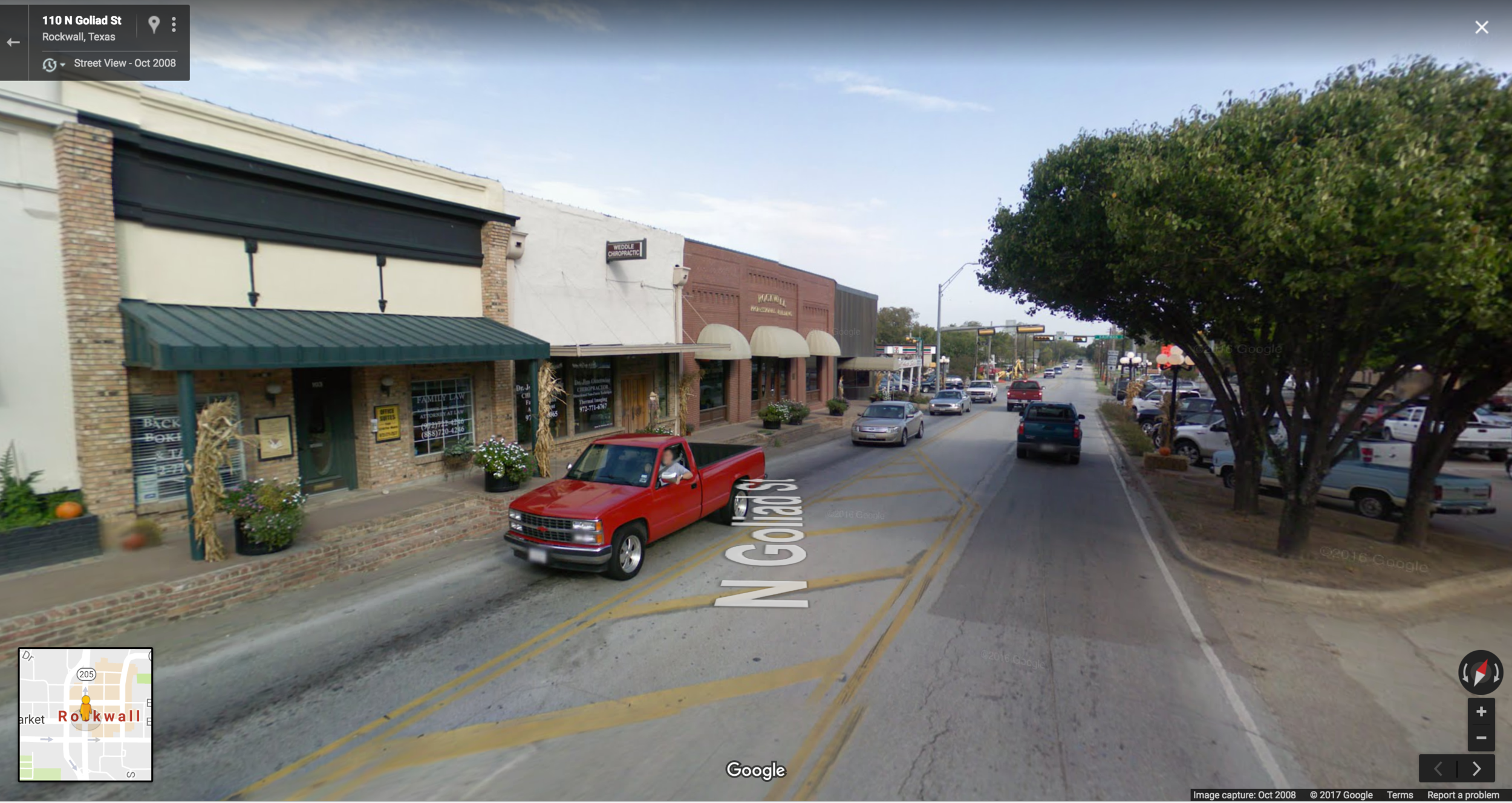
A two-way N. Goliad Street in Rockwal before TxDOT improvements-Google Street View 2008.
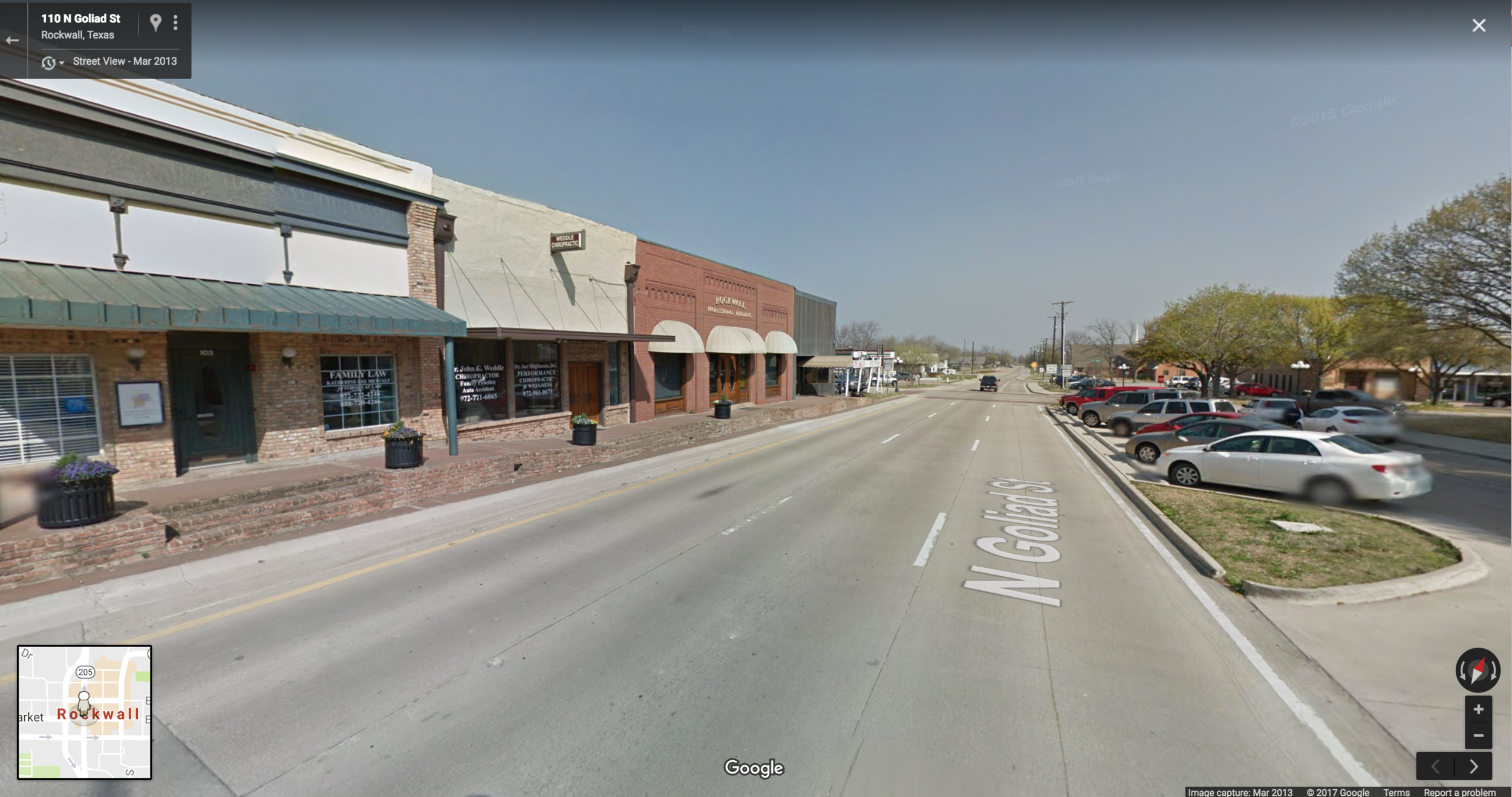
N. Goliad Street re-intentioned by TxDOT for high speed through traffic-Google Street View 2013.
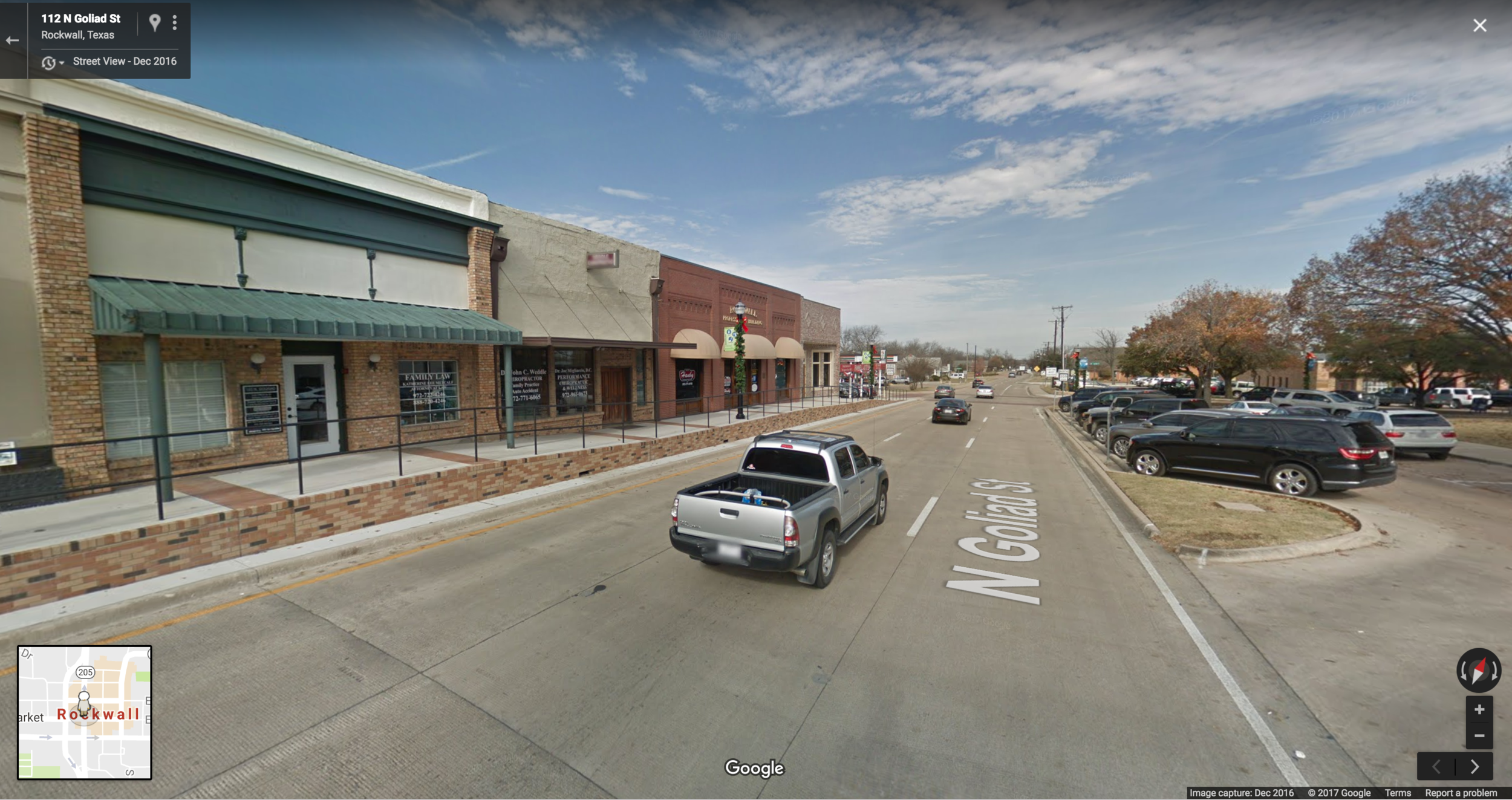
N Goliad Street is now completely car-centric with the addition of handrails to protect people from the higher speed traffic now possible-Google Street View. 2016
Afterward, more remediation for unsafe conditions caused by the improvements was necessary. Elimination of the historic steps and the introduction of a restrictive guardrail were necessary just in case anyone still thought walking across the street was a good idea. Single bulb streetlights with less visual appeal were reintroduced. It is worth noting that the Christmas decoration effort has been limited to the single light poles, which is about one-quarter the decorations found in the previous Halloween season on the two-way street. Also gone are the planters full
of blooming flowers because of the reduced space as a consequence of the remediation.
What can be done?
The sort of car-centric roadway improvement found on N. Goliad St. in Rockwall should cease. TMSP is working to generate people-prioritized transportation standards for downtowns to begin a discussion with TxDOT. Included in those standards: 20 mph speed limits, four-way stops instead of traffic signals, well-marked crosswalks, landscaped medians, appropriate street lighting, mid-block crossings, embedded warning lights, bump-outs, etc.
Coincidentally, efforts for this sort of traffic overlay are already underway by Jennifer Eckermann and her board in Brenham to discuss these issues with local representatives and sympathetic TxDOT district engineers. Hopefully this can parlay into a larger policy initiative for the whole state. The time has come for turning TxDOT roads from safety and experience liabilities into proactive assets for creating quality places to pause in our Texas downtowns.