
Urban Programs in Texas
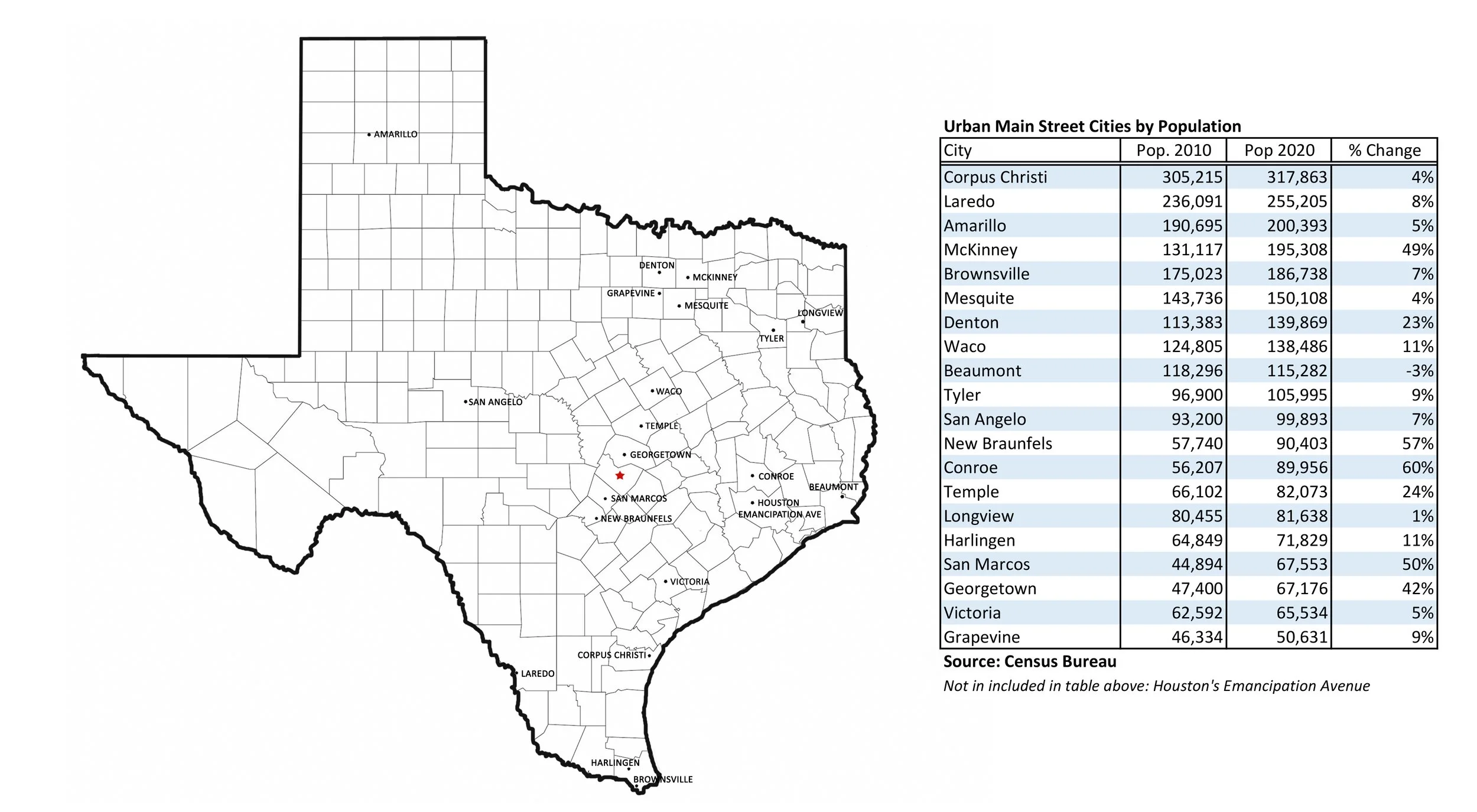
Of the 86 communities that currently participate in the Texas Main Street Program (TMSP) of the Texas Historical Commission, 18 are urban programs in cities with more than 50,000 in population. There are an additional 3 whose populations (2010 census) fall just below 50,000. These communities -- San Marcos, Georgetown and Grapevine -- are still considered in the TMSP Small City category. They are departments or programs of the city, and in each the Main Street manager is a city employees. These three are long-time participants: San Marcos/28 years; Georgetown/24 years; and Grapevine/21 years. The 18 urban programs in Texas have an average participation time of 14 years, with a range of 1 to 24 years.
This is the largest number of urban communities designated in any state in the country. Since many of the urban Main Street programs in Texas have been designated for decades, some have changed in organizational structure over the years, but as a designated Main Street community their primary focus on preservation-based downtown revitalization and economic development has not.
Texas’ urban programs range from those relatively new (Victoria and Waco, both within the past three years) to Denton, Tyler, Beaumont and New Braunfels having all participated since the 1990s. Several others were originally designated in the 1980s when the state and national programs were just beginning, and then returned later by applying for recertification. The length of participation time shows that the framework of Main Street provides worthwhile benefit to these large communities. They have reported hundreds of millions of dollars of reinvestment into their downtowns and significant credit for that success can be attributed to the existence of the local Main Street programs who are paying attention day in and day out to increasing the social, cultural, economic and physical vitality of the district. Also noteworthy is their volunteer hours recorded. Since 1999, local programs have reported to the state office the number of hours volunteers contribute to the success of the local program. This shows that there is broad community buy in and commitment to downtown. During this time, urban programs have averaged 14,163 in cumulative volunteer hours, or almost 950 hours per program per year.
Structure and funding of Texas' urban Main Street programs
Whether urban or small-city all Main Street programs in Texas have several things in common:
They are all viewed by us (and view themselves) as economic development programs that utilize historic preservation as the primary work tool to repurpose historic properties. The redevelopment of the public and private spaces downtown, along with new construction, is addressed within the context of the city's historic town center.
They all have paid staff administering the programs with a volunteer corps providing support and leadership to make the program successful.
Although they don't all follow the Main Street Four Point Approach® in its traditional sense, they all carry out their work through the organization, promotion, economic restructuring and design format. The Texas Main Street Program was one of the first state programs in the country and began accepting communities in 1981 (urbans in 1988). Due to the fact that so many programs in Texas have participated for decades, some of them have transitioned into a variety of structures and use different processes to meet their Main Street objectives.
Regardless of structure, each of the programs receives funding and other types of in-kind or non-financial support from local government. This is a foundation of the national Main Street model, which is designed to be a public-private partnership.
All of them have a Board of Directors, either Advisory or Governing.
Texas' 18 urban Main Street Programs are structured as follows:
Stand-alone non-profits that receive funding through government through a variety of contractual arrangements or local agreements to carry out certain functions (such as manage the overall downtown program; the improvements grant program; certain activities of the downtown effort such as promotional, tourism or marketing activities and events etc.). Each program receives financial support from city government primarily through a Memorandum of Understanding. Each programs also raises funds through events and memberships. Amarillo, Beaumont, Laredo, Longview, San Angelo, Texarkana, Victoria and Waco.
Housed in city government: Each of these fully city based programs has an Advisory Board of Directors or a similar volunteer-based structure to support the city program. McKinney (also manages the Performing Arts Center), New Braunfels, Pharr
Hybrid with a non-profit and a city component:
Denton. A Main Street manager/economic development coordinator in City Hall who works with both the non-profit Denton Main Street Association (DMSA) and the city's downtown task force charged with implementation of the Downtown Master Plan. The DMSA has a paid contractor carrying out the marketing elements of the Main Street Four Point Approach (promotion) through a non-profit with a governing board of directors
Tyler. The Main Street manager is a city employee managing all four points. She also manages a downtown art gallery where the Main Street offices are housed (outside of city hall). The non-profit Heart of Tyler Main Street program provides the volunteer effort for the program across all areas.
Unique hybrid: The Harlingen Main Street program is the management entity for the Harlingen Downtown Public Improvement District, which is funded through assessments collected from property owners in the central business district.
These urban programs have been successful through the structures they have opted to utilize for reasons unique to their individual communities. The important point is that they all adhere to the foundation of Main Street in carrying out their programs.
Urban budgets (for those whose budgets were readily available). It is difficult to make general comparisons for the urban programs as the manager and assistant(s) may have Main Street duties that cross among various departments (i.e. economic development, tourism) and his/her funding may come from a variety of sources such as economic development sales taxes, hotel occupancy taxes, general fund, earned income, raised money from special events and projects or dues etc. The comparisons below should be accepted in that light.
The non-profit budget, all of which receive a government contribution/city contract averaged a $201,000 budget with an average $60,000 government contribution.
$120,000 budget, with $75,000 contribution
$304,000, with a $90,000 contribution
$145,500 with a $15,000 contribution
$265,400 with a $32,000 contribution
$182,000 with $75,000 contribution
$192,000 with $75,000 contribution
The City-housed and hybrid Main Street budgets:
populations ranging from 63,279 to 148,559
length of time in the Main Street program ranging from 10 to 24 years
average annual Main Street budget (including revenue from raised funds or activities) of $212,036