
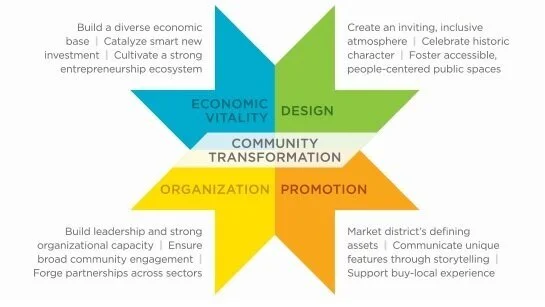
The effectiveness of a local Main Street is dependent on both volunteer and staff leadership as well as meaningful engagement from stakeholders and the broader community. To fully engage everyone, a Main Street program needs to have in place an organizational Plan of Work so that the volunteer leadership team can effectively drive to meaningful outcomes in the revitalization effort. This is not just a requirement in Texas – local Main Street programs nationwide all have this same obligation. Over time, Main Street and the Four Point Approach™ evolved, and in the past few years, there has been some purposeful change in the way programs carry out their work. Some of this reflects the evolution of local programs themselves as their programs and capabilities mature over time. Nationwide, a significant aspect in the progression of Main Street has been the development and introduction of the Main Street Community Transformation Strategy model. Coordinating programs and Main Street America™ staff throughout the U.S. are helping programs work through the process of adopting this strategy model to guide their work.
What is a Transformation Strategy? A Transformation Strategy (TS) articulates a focused, deliberate path to revitalizing or strengthening a downtown or commercial district’s economy. It focuses on a specific market segment or short list of market segments; and/or serves an underserved market and/or is centered around downtown as destination, whether for locals or the tourism market—or both.
This link provides an overview of transformation strategies, “Your Roadmap to Revitalization” -- https://www.mainstreet.org/mainstreetamerica/theapproach. You might also look at the Catalyst Strategies found on the same link above, or directly here. You might choose ‘off the shelf’ from the Catalyst Strategy Matrix, if any align with your market potential, or you might develop individualized strategies that better reflect the local culture, resources or organizational capacity. Regardless, the Main Street Four Point Approach™ remains the foundation of work planning.
A Transformation Strategy process will typically begin with collecting information from i.e. stakeholder surveys, community surveys, market analysis. The second step is analysis of that information and the third step is development of the strategies and subsequent Main Street Plan of Work. Usually you should select only 2-3 articulated Transformation Strategies to be able to have the kind of focus you need and because you will no doubt have other ‘must-do’ things on the work plan not necessarily directly connected to the TS. You might only have one TS if something rises to that level of importance to the revitalization effort-and that’s OK. Regardless, usually the focus of the TS and the work plan will drive you for 2-5 years so it’s not like the strategy(ies) is/are ‘forevermore’.
Please see below, some sample work plans from your peers whose programs have adopted or are starting the process of moving from the more traditional, project-based plans to the development of transformation strategies.
Blank Transformation Strategy Templates
The documents below are provided as samples; local programs are free to adopt four-point planning worksheets that best suit their programs.
Work Plan "Walkabout"
As a board activity during the annual work plan process, you might consider beginning with a walk around the Main Street district to take an objective look at where problem areas are or where downtown really 'works.' This is a good exercise to help build or improve upon the Main Street Plan of Work, and can also be a good team-building activity for the Board and committees. Invite all committee members to participate, or possibly other stakeholders. For the purposes of the annual board retreat, this exercise is intended to provide a very general overview and guide discussions for the rest of the meeting. However, this exercise can also be done at a more in-depth level as a committee project , with each block of the district covered and more precisely documented. (Note: this exercise is designed to help with the work planning process; it does not substitute for something like a survey for a National Register district nomination, or to collect necessary information for DowntownTX. Contact the TMSP office for those templates as needed.) Try to be both 'connected' and 'disconnected'... Connect yourself to the Main Street program/board by looking for things that have improved (or become worse) since the last time you did this exercise. Disconnect yourself by looking at downtown through the eyes of visitors and residents. What would draw them here to spend both time and money? Is the environment pleasant and inviting? Are there accessibility issues? Can they find the places they want to go easily?