

by Debra Drescher
In early July, a query about “finding solutions for absentee building owners and vacant buildings” was posted on the National Main Street listserv. Of course, that is a question with a hundred other questions embedded inside it:
What are the issues exactly – Are the absentee owners charging rents too high? (That’s a market problem.) Are they not taking care of their buildings, and in essence allowing them to be demolished by neglect? (That’s an enforcement and stewardship problem.)
What is your program or other stakeholder partners already doing about it?
What policies or ordinances are already in place to address the issues? How can they be leveraged to address the issue?
What’s the local political landscape right now? Is there a window of opportunity open right now to make change happen?
What the query got down to is: “What are others doing, and is it working?
I responded with some Texas examples, and in return got back some further questions from local program managers and coordinators from across the country. I’ve compiled that information into this blog.
Vacant Building Registration
Some of you will remember our that at our 2015 winter Texas Main Street professional development, we brought in as a speaker John Stevens from the City of San Antonio, who was on the team rolling out that city’s pilot Vacant Building Registration Pilot Program which had been created in 2014. We have these presentations in the online resource library here. The program includes registration, inventory, and a way for others to report to the city a vacant building. The program is run under the city’s Historic Preservation Office, and you can find the website here. The website also includes a series of before/after images that show not only improvements made, but also how city staff worked with building owners on making the changes. The program purpose is:
Vacant buildings can become health and safety hazards, diminishing the overall quality of life of the community and neighborhoods. The purpose of the Vacant Building Registration Program is the encourage redevelopment of vacant properties through the establishment of minimum maintenance requirements, regular enforcement, property owner accountability and the promotion of redevelopment opportunities for registered buildings.
It’s been in place for 2 years now and seems to have been deemed effective, because according to their website:
With the passage of the FY2017 annual budget, the City Council has expanded the program area for the Vacant Building Registration Program. The expansion is effective on January 1, 2017.
Vacancy Ordinances
Cuero
You don’t have to be an urban or metropolitan area to get a vacancy reduction program going. In Cuero, (Main Street city since 2013, population 6,800), a Vacancy Ordinance was just passed last month in an Ordinance that acknowledges: “buildings that are vacant and unsecured and/or not properly maintained are a blight and cause deterioration and preservation and financial instability in the Downtown Historic District.” (Cuero’s downtown is a National Register Commercial Historic District.) The ordinance has been added into the resource library on the Vacant Properties page. Passage of the ordinance was just part of the package of goals laid out in the city’s comprehensive plan and was a partnership with the City, EDC and Main Street. According to Sandra Osman, Cuero Main Street program manager:
“The idea to create a Vacant Building Ordinance came about during an Economic Vitality Committee meeting. We were discussing the detriment several existing vacant buildings created in our downtown district. The majority of them are owned by one owner. Our Code Enforcer is limited with options provided under the International Property Maintenance Code.” It took about a year to go from concept to adoption. She also noted that there was not pushback from property owners or the community in general, nor was there public comment made on the issue at either at Planning and Zoning Commission or City Council meetings.
“However, we did make revisions based on discussions with the P & Z and City Council, and thereby ought about a meeting of the minds and final adoption and approval. One of the concessions was that we will not be issuing any citation letters until September, 2017.” This process will include three steps:
Introductory letter to all building and property owners in the Main Street Downtown District, advising that a Vacant Building Ordinance and Registry has been created; offering an opportunity to voluntarily and proactively meet with the Building Official to discuss a marketing course;
Once identified as a Vacant Building under ordinance definition, a soft letter directly requiring contact with the Building Official within 14 days to be sent, along with design information for building maintenance (as provided by the THC), Grant applications available under the Cuero Development Corporation and information on tax credits;
If no contact is made by the property owner within 14 days, a citation letter will be sent to the property owner, requiring action to register as a Vacant Building or Property.
ARTICLE 4 Ordinance 2017-05 adopted 06 09 17
San Angelo, urban Main Street program
The City of San Angelo has dangerous and boarded building ordinances, but there is ongoing work toward getting an ordinance passed for “vacant and dangerous buildings,” as Main Street program Executive Director Del Velasquez stated during his remarks at summer training a few weeks ago. If you recall, the current Main Street (Downtown San Angelo Inc.) Board Chair was elected Mayor in May, and her championship of downtown is likely to help move this issue forward. This will be a priority issue for DSA Inc. in the coming year.
The city’s existing code on the issue can be found here in San Angelo Code of Ordinances Chapter 4, article 4.05 and 4.06: http://z2codes.franklinlegal.net/franklin/Z2Browser2.html?showset=sanangeloset
Winnsboro (Main Street city since 2003, population 3,400)
Winnsboro adopted a Vacant Building Registration Ordinance in 2015: http://z2codes.franklinlegal.net/franklin/Z2Browser2.html?showset=winnsboroset (Go all the way to the bottom for Section 3.12 – Vacant Building Registration)
The national listserv post also resulted in some ordinances from Ohio being shared with me that I’m passing along here:
Millersburg - http://www.millersburgohio.com/documents/ProposedVacantBuildingOrdinance.pdf (this was proposed in 2014; can’t tell if it was actually ever passed.)
On the Cambridge, Ohio website, you can also see the Vacant Property/Building Request for Exemption, which has a list of allowable exemptions. It is a citywide registration, not just for the historic district like in Cuero. https://www.cambridgeoh.org/code-enforcement/uncategorised/code-enforcement-office
Similarly, the Kent, Ohio registration ordinance is applied citywide. http://www.mcs360.com/documents/compliancedoc/VPR/VPR%20Ordinance%20-%20Kent,%20OH.pdf
Painesville, Ohio outlines its intended outcomes for its registration program:
“Shifting the cost of burden from the general citizenry to the owners of the blighted buildings will be the result of this ordinance.”
http://www.painesville.com/index.asp?Type=B_BASIC&SEC=%7BD8B7BA2D-DA45-4AD4-B908-3019E45FA9FC%7D
In Xenia, Ohio a FAQ webpage provides some insight and outreach to property owners and the community as to the reasons behind the registration, noting that “The ordinance is actually designed to incentivize rehabilitation, marketing of vacant buildings,…” http://www.ci.xenia.oh.us/faq.aspx?TID=29.
Events spotlighting vacancies to present them as opportunities
Most of you recall that with May’s launch of our website www.downtowntx.org, 12 Main Street communities held local ‘Imagine the Possibilities’ tours as a way to showcase opportunity for investors, developers and entrepreneurs. You can get the list of participating cities here. (Side note: If you haven’t already, make sure to see the inventory we’ve got up so far on www.downtowntx.org.)
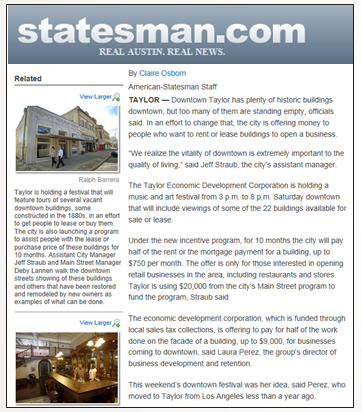
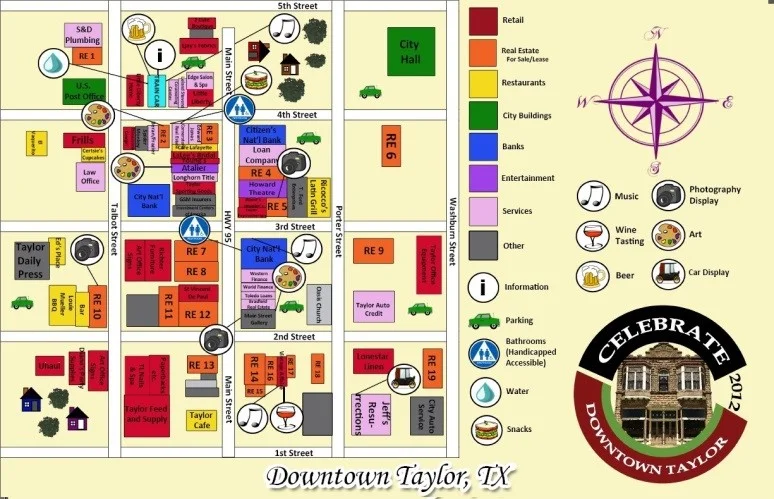
In 2012, Taylor Main Street and the EDC partnered on a “Celebrate Downtown” event that was designed not only as a general downtown event for the community, but it also showcased 22 buildings that were vacant at that time. Part of the reasoning behind this – and which we’ve also realized through our Town Square Initiative and the Downtown,TX website – is that future historic building owners in a Main Street district are oftentimes simply community members ready to launch or expand their small businesses. To only target the traditional developer market would miss a huge opportunity. According to Deby Lannen, Taylor’s Main Street manager, the event included live music, entertainment and the opportunity to get inside the vacant buildings. “We had lots of vacant buildings at that time and fortunately don’t have that many now”, says Deby, which is why the event has not been repeated since 2012. Nonetheless, it’s a good example of taking a proactive approach to a critical issue.
Denison
While not directly a ‘vacant’ building ordinance, Denison has an ordinance passed in 2011 that prohibits ground floor residential, warehousing and storage in the historic/business district. The link to that ordinance is in the Vacant Properties page of this online library. Denison Main Street manager gives the following insight to this process:
“ The Main Street office proposed the ordinance to protect properties from being used for storage or housing. When prices were cheap, that was an attractive option. But when economy got better, we didn’t want to be locked in to storefronts utilized for storage. So we tried to prevent a problem. Council approved the ordinance. As I remember, it only took a couple of months as we had support for the effort. It made sense. There was no resistance. One other factor is that we didn’t wait for this to become an issue. We weren’t addressing a specific request. We enacted the ordinance before we had a request for this. We anticipated it and prevented it becoming an issue. It is always more difficult to address anything when it is friends and neighbors asking. “
The Vacant Properties page of the library also includes a link at the bottom for a sample Downtown Maintenance Code for Salisbury, NC, and also a reprint of a Main Street Matters article on vacant building resources and tools.
Final Note: All Texas Main Street s automatically on the Texas Main Street listserv, but you have to subscribe as a member to the national Main Street listserv. If you want to get on that list and have the opportunity to communicate with local program managers nationwide, you can do so here.