April 4, 2016 (Note: the initial follow-up blog to the leadership roundtable was posted in the online resource library on March 16)
by Debra Drescher, State Coordinator, TMSP
During the leadership and volunteer development roundtable at the New Braunfels training in February, an idea surfaced for the state office to provide Main Street board chairs an opportunity to interact with their peers in other Texas Main Street cities. We didn't know if there would be any interest or not, but you gotta try new things, right? We held a conference call on Monday, April 4 and were pleased to have 9 board chairs* participate, plus one economic development director and five managers (not all of whom had a chair on the call).
For the most part, the board chairs on the call were newer to their chairmanship roles, although several had been on the board for several years. There were participants from several of our smallest programs all the way up to three chairs from urban programs.
There was not a set agenda. The intent of the call was solution-oriented: to give them an opportunity to share tips and best practices for how they support staff and guide/lead their boards; what they struggle with; and to help us better understand what they need by way of Main Street 101 training so we can refine our process accordingly. My role as the facilitator was to let the topic surface on its own from them -- which it did.
Interestingly, they wanted to find common solutions for the same issue that managers also struggle with: grow volunteerism and volunteer accountability/engagement so that the Main Street program has the human resources it needs to carry out an effective program.
So here, in a nutshell, is the recap. Tips, best practices and examples from your board chairs on getting people involved:
- Make it a win-win for everyone.
- In La Grange, for their recent UnCorked event, a stipend ($1,000) was provided to the Rotary Club from the event's proceeds for their assistance to pull off this volunteer-intensive event.
- Levelland Main Street's highly successful Ladies Night Out event gets more involvement from downtown business owners because it directly benefits them and they can see that. For any event a Main Street program does, think about who will most directly benefit from that particular activity and then seek out those groups to help you out with it.
- Support other groups and build relationships with them.
- By supporting other groups and their events you can tap into their volunteers to expand your base (but be prepared for 'payback' -- they'll want to tap into your volunteers also)
- Look at other official boards and commissions in your city to start relationships and share resources
- Ask. There are people who will step up if they are just asked. Some people won't get involved until they are asked.
- Show. Make people aware that they can have a say in how downtown grows and changes with their involvement; that they are needed. Help people see the benefit of being involved in Main Street. Help people understand what Main Street is. (See Morgan’s article below)
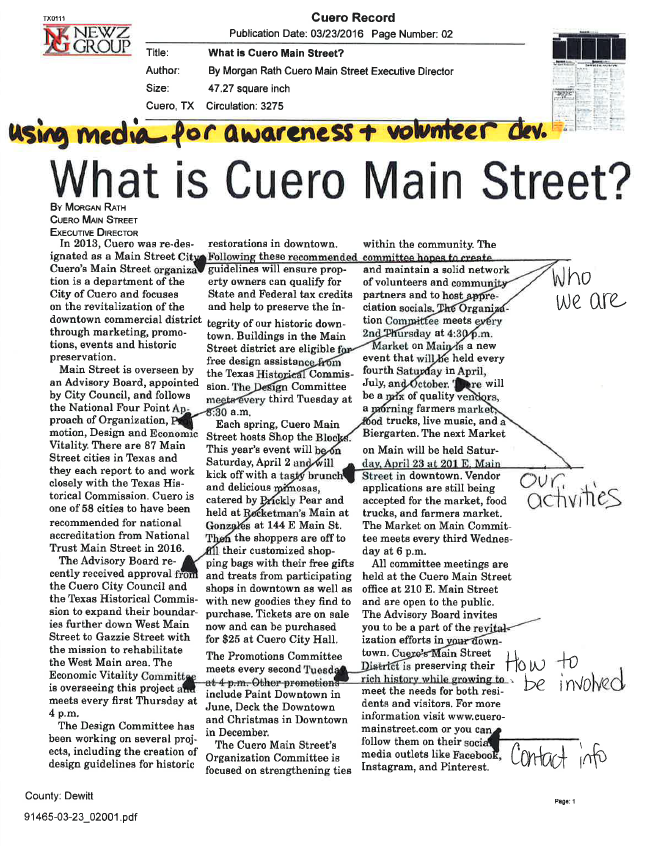
Morgan in Cuero did a good job with this article that covered a lot of ways to get people involved. (Handwritten notes are Debra’s in order to use this as an example in Main Street 101)
Why I got involved/my goals. I wanted to know why the board chairs on the call got involved in their programs. I thought knowing this might help stimulate ideas about drawing in others. Here’s what they said:
- interest in urban planning
- I am in downtown a lot because I work downtown, so because I spend so much time there, that alone makes it an important place to me
- I saw buildings being restored and heard about plans for downtown and I wanted to be a part of it.
- I wanted the opportunity to see my hand, my stamp on my downtown
- To be involved in something good and to help downtown grow in the right way
- A fun thing to do and a way to get to know more people
- Alfred, Waco’s chair, got involved through Waco's Hispanic Chamber of Commerce. Goals that drive him are to do things that help the community's economic prosperity and to get more students and young people involved in their community and in downtown. He sees the Main Street effort as a way to do that.
- "I want to help solidify the vision for downtown so that when people get involved, they'll have a path and direction"
Accountability was also a topic that came up. Just like you, your board chairs want active, engaged, and responsible board members. There was a question about accountability agreements for the board, so for reference, here are Georgetown and Winnsboro’s on the online resource library: http://www.txms-resourcelibrary.org/board-accountability/?rq=board%20accountability%20agreement
Some general information was provided at the close of the call to the chairs:
- To help with goal setting and program strategies. I directed them to the Main Street Four Point Refresh information on the national website -- http://www.preservationnation.org/main-street/about-main-street/main-street-america/the-main-street-approach.html#.VwUUyvkrLcs.
- I encouraged them to look on our website for general Main Street information. http://www.thc.state.tx.us/preserve/projects-and-programs/texas-main-street
- I told them about the online resource library and encouraged them to contact their manager for access. I’ve included it here in case you are planning to forward this email to them. http://www.txms-resourcelibrary.org/ Password: txms1981
Participants had some good feedback for having this opportunity to engage with other Main Street volunteer leaders, and several suggested that we hold an informal Board Chair call each quarter. What do you think?
Thanks to board chairs from the following programs who participated: Bay City, Canton, La Grange, Levelland, Llano, Longview, Marshall, San Marcos, Waco. If I have misinterpreted any of the content or if you'd like to add more information to an example that was shared, please email Debra at debra.drescher@thc.state.tx.us.