

by Debra Drescher, State Coordinator, TMSP
Over the past few months, I’ve had several questions from our network requesting examples of various funding sources for different types of activities in your districts. It seemed like Tax Increment Financing (TIF) and Tax Increment Reinvestment Zones (TIRZ) came up most often. I collected the information specifically for Bastrop Main Street’s recent retreat where I was challenged to bring to the meeting some ‘Big Ideas’ for a program entering its second decade of Main Street (Congratulations on 10 years Bastrop!) Thanks to those of you who shared information with me about how this financing tool has created possibilities and direct impact in your Main Street districts that might not have existed otherwise. (Note: this is not legal advice or recommendation; only the bare essentials of what TIF/TIRZ is. If any of my notes are incorrect pertaining to your individual TIRZ, let me know.) You can read more about these on the state comptroller’s website at: https://www.comptroller.texas.gov/economy/local/ch311/index.php.
For those of you who don’t already know, in a tax increment financing program, a legally created, defined area (the Tax Increment Reinvestment Zone/TIRZ) is established. At the outset of the zone creation, baseline property values are determined. In ensuing years as values rise, increments between the baseline and current values funds improvements (comes back to downtown instead of just into the city general fund), providing a sustainable source of funding for downtown revitalization. There are other powers and opportunities associated with this kind of legal organization as well, which your city attorney should be able to tell you about. Pairing revenue from a TIF program with other pools of funding for incentives, such as grant programs from annual EDC or city budgets; abatements for historic properties; tax credits; and/or Chapter 380 (Local Government Code) programs can substantially stimulate development and activity, in communities of many different population sizes. The funds are not like a management district where there is a property owner assessment; property owners do not pay additional taxes simply as a result of being in the zone. Revenues come from the increase in value over time.
In 2016, downtown TIRZ zones were created in three Main Street communities: Ennis, Bay City, and Denison. In Ennis, funds will be used to accomplish projects identified in the Downtown Master Plan (http://ennistx.com/downtown-master-plan). In Bay City, the reasons for implementing the downtown TIRZ at this time were varied, and included development plans at the edge of downtown (which is within the TIRZ boundaries), as well as a focus on Downtown as part of the city’s Vision 2040 plan (http://www.cityofbaycity.org/departments/planning). Denison’s brand-new TIRZ has 75% participation from county and city for 30 years. Other Main Street communities where a downtown investment zone is either in existence or has been considered include Tyler, Brenham, Beaumont, Denton, Corpus Christi, Weatherford, Waco, and Taylor. Here’s some details on several established zones and how they have helped finance downtown revitalization in these Main Street districts:
Waxahachie
Main Street recertified since 2002
The 2001 downtown master plan recommended a TIRZ. The downtown master plan was updated in 2007 as part of the comprehensive planning process. The plan update called for a parking strategy which allowed construction of a parking garage that helped alleviate parking issues with the county (employees, juries, attorneys, trials etc.) so the county offices (and all that foot traffic) could stay downtown.
http://www.waxahachie.com/images/City2/files/Chapter%206%20-%20Downtown%20FINAL.pdf
This handout explains all the things they use their TIRZ funding for: http://www.waxahachie.com/images/City2/files/D'town%20Incentives%202013.pdf
When the county vacated five buildings on the square upon completion of their new complex, an agreement with a private developer was reached through TIRZ funding and Chapter 380 agreements for downtown living and retail. A separate agreement was reached for The Rogers Hotel, also on the square, and it has been put back into use as well.
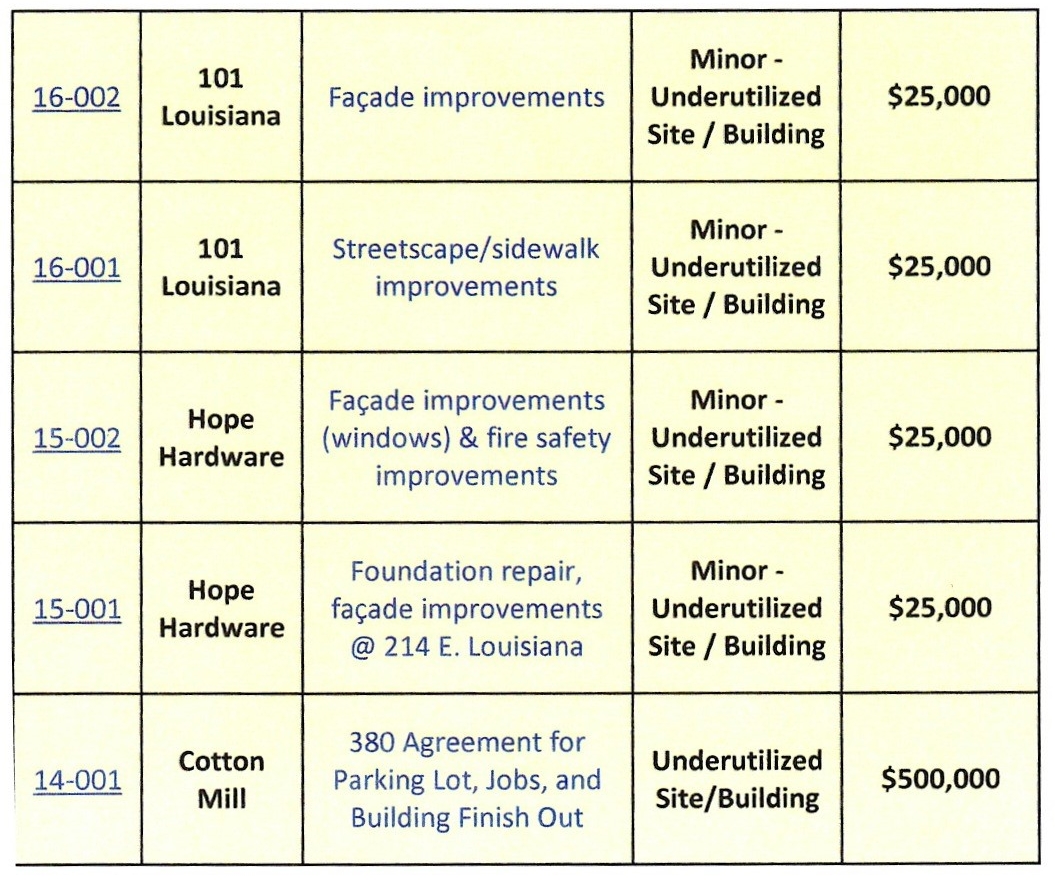
McKinney TIRZ Projects
McKinney
McKinney’s downtown plan recommended adoption of a TIRZ, which was created in 2010. https://www.mckinneytexas.org/DocumentCenter/View/4188. This TIRZ has generated approximately $5 million that has been used for projects such as public parking, historic building and façade improvements to create jobs. This source can also be coupled with the case-by-case possibility of waiving impact fees through the Neighborhood Empowerment Zone. The table on the right outlines projects funded by the TIRZ provided by Amy Rosenthal, the McKinney Main Street Program Director:
Center City Amarillo
Main Street since 2002, non-profit urban program
The TIRZ was created in 2006, and has generated $4.3 million since then. Projects funded include streetscape improvements in support of major private projects such as downtown campus for Amarillo College, Courtyard by Marriott, and two loft developments. Emphasis goes to projects that advance the strategic plan, such as residential living. If a property receives a façade grant, they can automatically be eligible for up to $50,000 in TIRZ funds -- $150,000 is available annually for this. These funds usually go to smaller offices and storefronts. To finance larger projects, TIRZ has rebated up to 90% of property taxes. The TIRZ also paid for landscaping at the Potter County Courthouse as part of the courthouse restoration funded by the Texas Historic Courthouse Preservation Program of the Texas Historical Commission and the county.
Georgetown
Main Street recertified since 1998
Georgetown created a TIRZ as a recommendation from their 2003 Downtown Master Plan, which was updated in 2013. https://files.georgetown.org/files/2008/12/downtowntirzprojectandfinancingplanpdf8may06.pdf
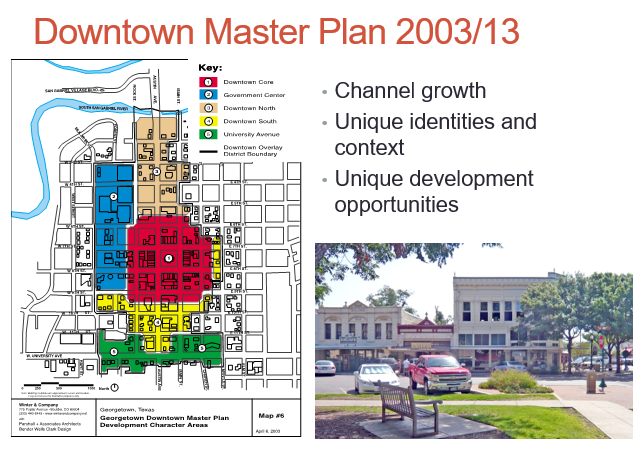
Georgetown character/opportunity areas developed. 10-year update in 2013
Bridgeport
Bridgeport’s downtown TIRZ was created in 2007 and has generated approximately $550,000 since then. The current year budget anticipates revenue of $73,248. Bridgeport’s population is under 7,000. The priority project just funded with $385,000 TIRZ allocation was the Halsell Street (Bridgeport’s ‘Main Street’) Improvement Project in fiscal year 2016/2017. The total project cost was about $1.4 million; of which $1 million came from city-issued bonds unrelated to the TIRZ. San Angelo’s TIRZ was also created in 2007 and generates approximately $450,000 annually which has primarily been used for property improvements downtown. In Sherman, which became a recertified Main Street community last year, TIF #2 was adopted in 2008 as part of a plan to help pay for public works/public improvements in the downtown district. The list of projects ranged from light pole and fixture replacement; curb and sidewalk improvements; and items like benches and trash receptacles. The increments and related revenues at that time paid 100% of the improvements.
Beeville
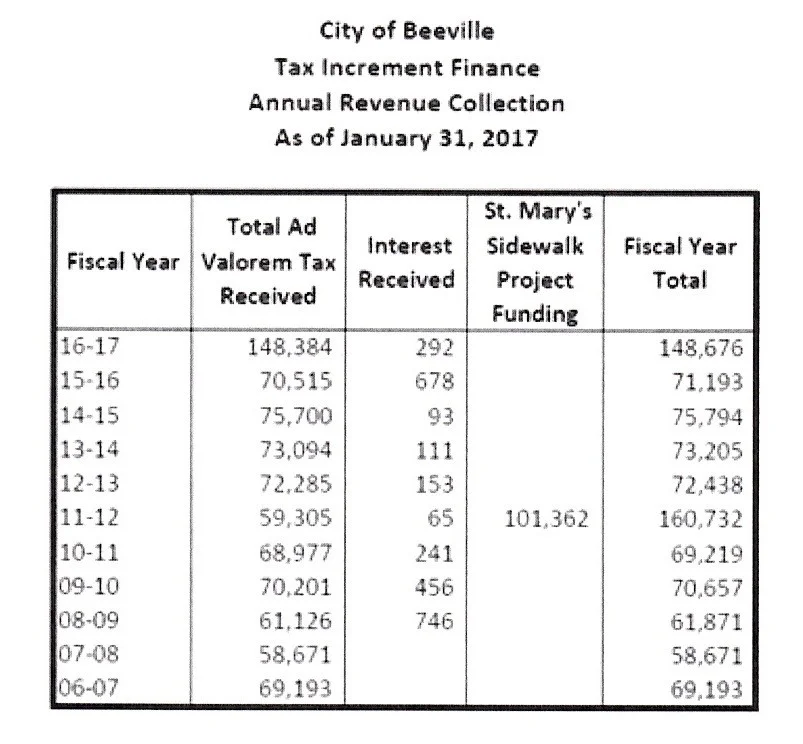
Below is a list of Beeville’s related collections over the past decade. In addition to the public project noted in the chart, the zone has also funded façade grants.
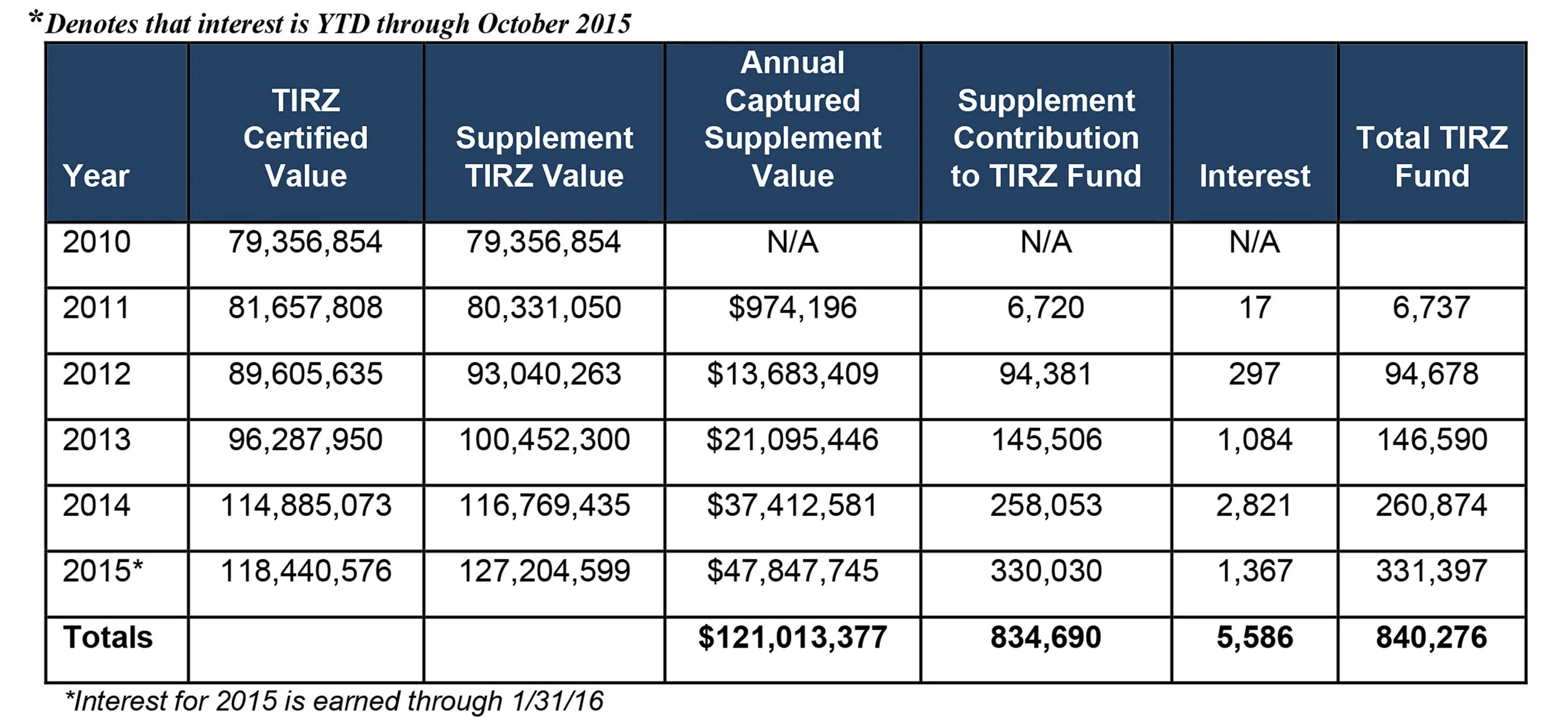
Certified and Supplemental TIRZ No. 1 Contribution Summary
Denton
Tax Increment Finance Zone #1—TIF #1 took effect on January 1, 2011 and will terminate on December 31, 2041 or when the budget of $24.8 million has been collected. The City of Denton is the sole participating jurisdiction.